 Back
BackBacterial Structure, Physiology, Growth, and Genetic Recombination: Study Notes for Microbiology
Study Guide - Smart Notes
 Tailored notes based on your materials, expanded with key definitions, examples, and context.
Bacterial Structure & Physiology
Prokaryotic Cell Structure
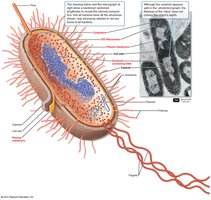
Prokaryotes, such as bacteria, possess unique cellular structures that distinguish them from eukaryotes. Their cellular organization is simpler, lacking membrane-bound organelles, and their genetic material is not enclosed within a nucleus.
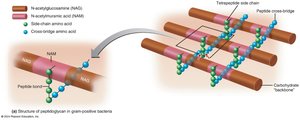
Cell Wall: Provides shape, protection, and prevents cell rupture in hypotonic environments. Composed mainly of peptidoglycan (PG), which consists of N-acetylglucosamine (NAG), N-acetylmuramic acid (NAM), tetrapeptide side chains, and peptide cross-bridges.
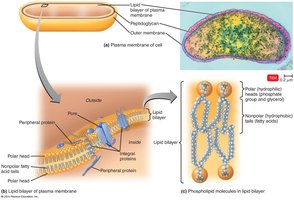
Cell Membrane: Phospholipid bilayer without sterols; functions in ATP synthesis, selective permeability, and photosynthesis in some bacteria.
Cytoplasm: Contains water, proteins, carbohydrates, lipids, and inorganic ions. Houses the cytoskeleton, which aids in cell division, shape, and growth.
Nucleoid: Region containing circular, double-stranded DNA (bacterial chromosome); lacks a nuclear membrane and histones.
Plasmids: Small, circular DNA molecules carrying non-essential genes, often for antibiotic resistance.
Ribosomes: Sites of protein synthesis; prokaryotic ribosomes are 70S, while eukaryotic ribosomes are 80S.
Inclusions: Reserve deposits for nutrients such as phosphate, glycogen, lipids, sulfur, enzymes, gas, and iron oxide.
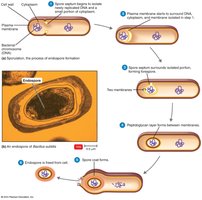
Endospores: Survival structures formed under adverse conditions; highly resistant to heat, chemicals, and radiation.
Capsule (Glycocalyx): External mucopolysaccharide layer that enhances resistance to host defenses and increases virulence.
Flagella and Motility
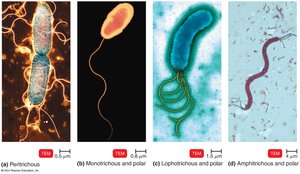
Flagella are appendages used for locomotion in many bacteria. Their arrangement and structure are important for classification and pathogenicity.
Types of Flagella:
Monotrichous: Single flagellum at one end
Amphitrichous: Tuft at each end
Lophotrichous: Two or more flagella at one end
Peritrichous: Flagella distributed over the entire cell
Flagellin: Protein composing flagella; H antigen used to distinguish subspecies (e.g., E. coli O157:H7).
Basal Body: Anchors flagella to cell wall and membrane.
Axial Filaments
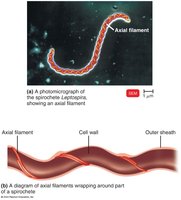
Axial filaments are specialized structures found in spirochetes, enabling corkscrew motion for motility.
Structure: Anchored at one end and wrapped around the cell.
Function: Facilitates movement through viscous environments.
Pili and Fimbriae
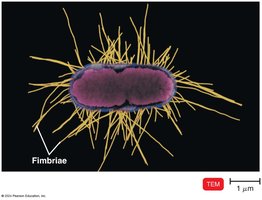
Pili and fimbriae are hair-like appendages found mainly in Gram-negative bacteria. They play roles in adherence and genetic exchange.
Fimbriae: Used for attachment to surfaces, aiding colonization.
Pili: Involved in conjugation, transferring DNA between cells.
Cell Wall Composition
The bacterial cell wall is a critical structure for maintaining cell integrity and is a target for many antibiotics.
Peptidoglycan: Provides rigidity; consists of NAG, NAM, tetrapeptide side chains, and peptide cross-bridges.
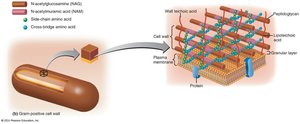
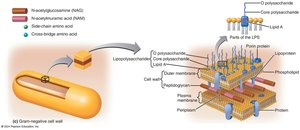
Gram Positive vs. Gram Negative Cell Walls
Bacteria are classified based on their cell wall structure, which affects staining properties and susceptibility to antibiotics.
Gram Positive: Thick, multilayered peptidoglycan; stains blue/purple; contains teichoic acids.
Gram Negative: Thin peptidoglycan layer; outer membrane with lipids; stains pink; contains Lipid A endotoxin.
Cell Membrane
The cell membrane is a phospholipid bilayer responsible for selective permeability, ATP synthesis, and, in some bacteria, photosynthesis.
Composition: Phospholipids and proteins; lacks sterols.
Function: Regulates transport, energy production.
Endospores
Endospores are highly resistant, dormant structures formed by certain bacteria for survival under harsh conditions.
Formation: Sporulation process; involves peptidoglycan, calcium ions, and dipicolinic acid.
Location: Terminal, subterminal, or central within the cell.
Germination: Return to vegetative state when conditions improve.
Morphological Shapes & Arrangements of Bacteria
Cocci
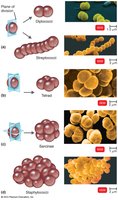
Cocci are spherical bacteria, often found in various arrangements due to their division patterns.
Arrangements: Single, diplococci, streptococci (chains), tetrads, sarcinae (cubical), staphylococci (clusters).
Bacilli
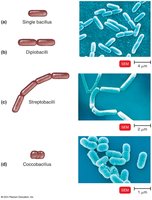
Bacilli are rod-shaped bacteria, which may occur singly, in pairs, chains, or as coccobacilli.
Arrangements: Single, diplobacilli, streptobacilli, coccobacilli.
Spiral Bacteria
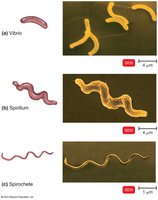
Spiral-shaped bacteria include vibrio (curved), spirillum (rigid), and spirochetes (flexible).
Vibrio: Comma-shaped
Spirillum: Rigid spiral
Spirochete: Flexible spiral
Bacterial Growth
Physical Requirements
Bacterial growth is influenced by environmental factors such as temperature, pH, and osmotic pressure.
Temperature:
Psychrophiles: Cold-loving; optimum 15°C
Mesophiles: Moderate temperatures; optimum 25–40°C
Thermophiles: Heat-loving; optimum 50–60°C
pH: Most bacteria grow at pH 6.5–7.5; molds at pH 5–6.
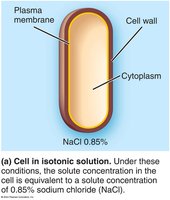
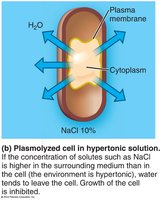
Osmotic Pressure: Movement of water across membranes; isotonic (no net movement), hypotonic (water enters, cell may burst), hypertonic (water leaves, plasmolysis occurs).
Osmophiles, Halophiles, Saccharophiles
Some bacteria are adapted to extreme osmotic conditions.
Osmophiles: Prefer hypertonic environments.
Halophiles: Salt-loving; found in oceans and salt mines.
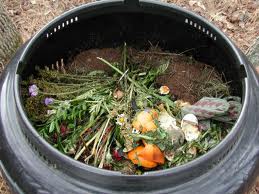
Saccharophiles: Sugar-loving; found in compost piles and grain silos.

Chemical Requirements
Bacteria require various chemical elements for growth, including carbon, energy sources, nitrogen, sulfur, phosphorus, trace elements, and organic growth factors.
Carbon & Energy Source:
Autotrophs: Use CO2 as carbon source; photoautotrophs use light, chemoautotrophs use inorganic compounds.
Heterotrophs: Use organic compounds; photoheterotrophs use light, chemoheterotrophs use organic compounds.
Nitrogen, Sulfur, Phosphorus: Essential for protein, DNA, RNA, ATP synthesis.
Trace Elements: Fe++, Zn++, Cu++ for enzymatic reactions.
Organic Growth Factors: Vitamins and amino acids.
Oxygen Requirements
Bacteria are classified based on their oxygen requirements, which affect their metabolism and growth patterns.
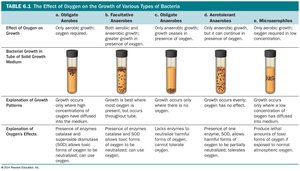
Strict Aerobe: Requires O2; growth at top of tube; example: Pseudomonas sp.
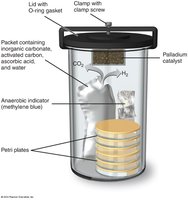
Strict Anaerobe: No O2; growth at bottom of tube; example: Clostridium sp.
Facultative Aerobe/Anaerobe: Can grow with or without O2; growth throughout tube; example: E. coli.
Microaerophilic: Tolerates small amounts of O2; growth in middle of tube; example: Neisseria gonorrhoeae.
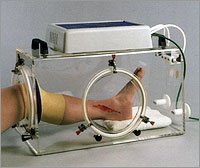
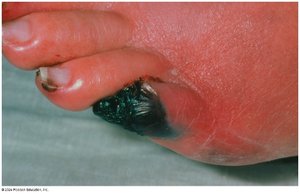
Type | Effect of Oxygen | Bacterial Growth in Tube | Explanation |
|---|---|---|---|
Obligate Aerobe | Only aerobic growth; oxygen required | Growth at top | Presence of enzymes SOD and catalase |
Facultative Anaerobe | Aerobic and anaerobic growth; greater growth with oxygen | Growth throughout, best at top | Presence of enzymes SOD and catalase |
Obligate Anaerobe | Only anaerobic growth; oxygen is toxic | Growth at bottom | Lacks enzymes to neutralize oxygen |
Aerotolerant Anaerobe | Only anaerobic growth; tolerates oxygen | Growth evenly throughout | Presence of SOD only |
Microaerophile | Only aerobic growth; oxygen required in low concentration | Growth in middle | Produces lethal amounts of toxic oxygen if exposed to normal atmospheric oxygen |
Bacterial Reproduction
Binary Fission
Bacteria reproduce primarily by binary fission, a process in which a single cell divides into two identical daughter cells.
Generation Time: Time required for a cell to divide; typically 1–3 hours.
Growth Curve: Bacterial populations exhibit lag, log, stationary, and death phases.
Genetic Recombination
Transfer of Genetic Information
Genetic recombination in bacteria involves the exchange of genes between DNA molecules, resulting in new gene combinations.
Transformation: Uptake of DNA fragments (plasmids) from the environment by competent cells.
Conjugation: Direct transfer of DNA between cells via pili; involves F+ (donor) and F- (recipient) cells.
Transduction: Transfer of bacterial DNA by a virus (bacteriophage).
Example: E. coli O157:H7 is a pathogenic strain distinguished by its H antigen and ability to produce toxins, leading to foodborne epidemics and hemolytic uremic syndrome.
Additional info: These notes cover essential concepts from chapters 2, 4, 5, 6, and 8, including cell structure, physiology, growth, reproduction, and genetic recombination, providing a comprehensive overview for microbiology students.
