 Back
Bacterial Surface Structures, Motility, Endospores, and Growth
Study Guide - Smart Notes
 Tailored notes based on your materials, expanded with key definitions, examples, and context.
Surface Structures of Bacteria
Functions of Surface Structures
Bacterial surface structures play critical roles in survival, colonization, and pathogenicity. These structures enable bacteria to interact with their environment and host organisms.
Attachment to surfaces: Essential for colonization and biofilm formation.
Biofilm development: Surface structures help bacteria adhere to each other and to surfaces, forming complex communities.
Infection and virulence: Facilitate host invasion and immune evasion. Infection refers to the entry of a pathogen into a host, while virulence is the degree of pathogenicity.
Prevention of dehydration: Surface structures can reduce water loss in harsh environments.
Pili, Fimbriae, and Flagella
These are protein-based appendages with specialized functions in attachment, motility, and genetic exchange.
Pili: Thin, proteinaceous structures found in all Gram-negative and many Gram-positive bacteria. Functions include:
Attachment to surfaces (biofilm and pellicle formation)
Horizontal gene transfer via conjugative pili
Motility (Type IV pili enable twitching motility)
Fimbriae: Short filaments aiding in surface attachment.
Flagella: Long, multi-protein appendages responsible for swimming motility. Powered by the proton-motive force, their arrangement affects movement:
Peritrichous: Flagella distributed over the cell surface
Polar: Single flagellum at one end
Lophotrichous: Cluster of flagella at one end
Amphitrichous: Flagella at both ends
Flagella can be visualized using negatively-charged stains.
Flagellar Motility
Mechanisms of Flagellar Movement
Bacteria use different flagellar arrangements and rotation patterns to achieve motility.
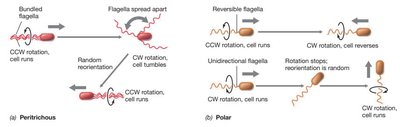
Peritrichous flagella: Bundled flagella rotate counter-clockwise (CCW) for forward movement (run). Clockwise (CW) rotation causes tumbling and random reorientation.
Polar flagella: Can be reversible (CCW for run, CW for reversal) or unidirectional (CW for run, stop for random reorientation).
Structure of Gram-Negative Flagella
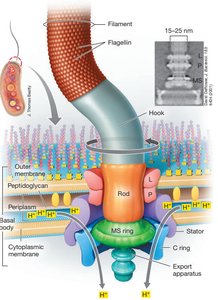
The flagellum is a complex nanomachine with distinct structural components:
MS ring: Located in the cytoplasmic membrane; acts as the motor.
P ring: Embedded in the peptidoglycan layer; stabilizes the structure.
L ring: Located in the outer membrane; provides additional support.
Filament: Rigid, helical structure made of flagellin protein.
Hook: Connects the filament to the basal body.
Rod and basal body: Transmit torque from the motor to the filament.
Export apparatus (Type III secretion system): Transports flagellin subunits during assembly.
Flagellar Assembly
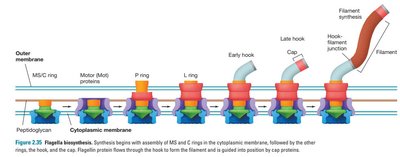
Flagella are assembled in a stepwise manner, beginning at the base and extending outward.
Assembly starts with the MS and C rings in the cytoplasmic membrane, followed by the P and L rings, hook, and filament.
Flagellin monomers are exported through the hollow core and added to the tip.
Twitching and Gliding Motility
Some bacteria move across surfaces using mechanisms other than flagella.
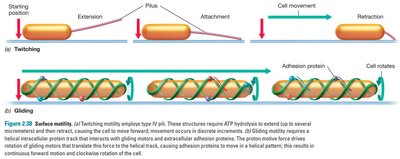
Twitching motility: Mediated by Type IV pili, which extend, attach to a surface, and retract, pulling the cell forward.
Gliding motility: Involves motor proteins and a helical intracellular track, powered by the proton-motive force. The cell moves in a slow, spiraling fashion.
Endospores
Properties and Significance
Endospores are highly resistant, dormant structures formed by certain Gram-positive bacteria (notably Bacillus and Clostridium species) to survive extreme conditions.
Resistant to heat, radiation, chemicals, desiccation, and nutrient deprivation.
Can remain viable for centuries or millennia.
Formed in response to adverse environmental conditions; revert to vegetative cells when conditions improve.
Dispersed by wind, water, and animals.
Appear refractile (white) under light microscopy after staining.
Types of endospore positioning:
Terminal: At the end of the cell
Subterminal: Near the end, but not at the tip
Central: In the middle of the cell
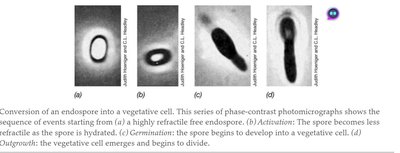
Germination Process
Endospore germination is the process by which a dormant spore returns to active growth as a vegetative cell.
Activation: Spore rehydrates and prepares for metabolic activity.
Germination: Cellular processes resume, and the spore becomes less refractile.
Outgrowth: The cell emerges and begins to divide.
Endospore Structure
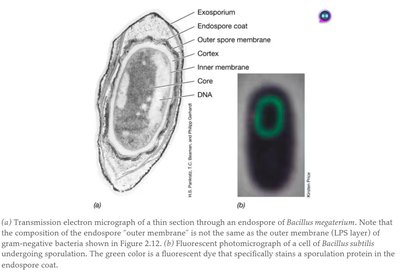
Endospores have a unique, multilayered structure that confers resistance and dormancy.
Core: Contains DNA, ribosomes, dipicolinic acid, and small acid-soluble proteins (SASPs) for DNA stabilization.
Inner membrane: Former cytoplasmic membrane.
Cortex: Modified peptidoglycan layer.
Outer spore membrane: Unique to endospores.
Endospore coat: Protein layers unique to endospores.
Exosporium: Additional protein layer present in some species.
Sporulation Cycle
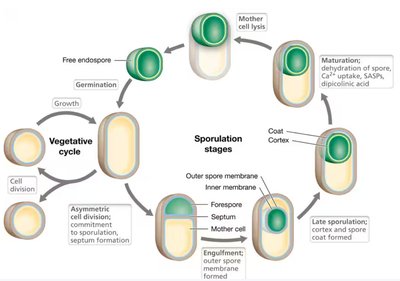
Sporulation is a complex, multistage process resulting in the formation of a mature endospore.
Asymmetric cell division
Engulfment of the forespore by the mother cell
Late sporulation (cortex and coat formation)
Maturation (dehydration, uptake of Ca2+, SASPs, dipicolinic acid)
Mother cell lysis and release of the free endospore
Germination and outgrowth when conditions improve
Bacterial Growth and Division
Methods of Bacterial Division
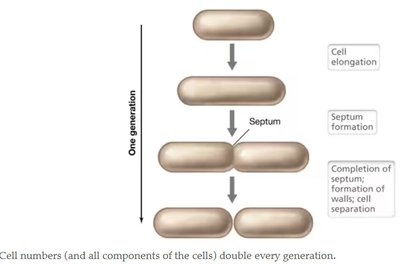
Bacteria primarily reproduce by binary fission, a process in which a single cell divides into two genetically identical daughter cells.
Binary fission: Cell elongates, forms a septum, and divides into two cells.
Generation time (doubling time): The time required for one complete cell division cycle (e.g., E. coli ~20 min, M. tuberculosis 15–20 hours).
Growth states: Planktonic (in suspension) and sessile (on surfaces).
Unequal division: Some bacteria divide asymmetrically, producing cells with different properties (e.g., stalked and flagellated cells).
Microbial Growth Cycle
Bacterial populations in batch culture exhibit a characteristic growth curve with four phases:
Lag phase: Cells adapt to new environment; little to no division.
Exponential (log) phase: Rapid cell division; population doubles at a constant rate.
Stationary phase: Growth rate slows as nutrients deplete; cell division equals cell death; secondary metabolites may be produced.
Decline (death) phase: Nutrients exhausted; cell death exceeds growth. Cryptic growth may occur as some cells use nutrients from lysed cells.
Environmental Factors Affecting Growth
Bacteria can be classified based on their optimal growth conditions:
Temperature: Psychrophiles, mesophiles, thermophiles, hyperthermophiles
pH: Acidophiles, neutrophiles, alkaliphiles
Osmolarity: Halophiles, osmophiles
Oxygen requirements: Obligate aerobes, obligate anaerobes, facultative anaerobes, microaerophiles, aerotolerant anaerobes
Additional info: These classifications are important for understanding microbial ecology, pathogenesis, and industrial applications.
