 Back
BackBacteriophages and Bacterial Defense Mechanisms
Study Guide - Smart Notes
 Tailored notes based on your materials, expanded with key definitions, examples, and context.
Bacteriophages and Viruses
Introduction to Viruses and Bacteriophages
Viruses are acellular infectious agents that require a host cell for replication. Bacteriophages, or phages, are viruses that specifically infect bacteria. Their discovery and study have been pivotal in understanding microbial genetics and host-pathogen interactions.
Virus: A microscopic infectious agent composed of genetic material (DNA or RNA) enclosed in a protein coat, sometimes with a lipid envelope.
Bacteriophage: A virus that infects and replicates within bacteria.
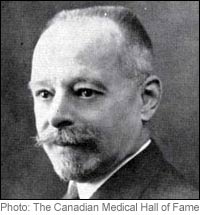
Historical Note: Felix d’Herelle is credited with the discovery of bacteriophages.
Bacteriophage Structure and Morphology
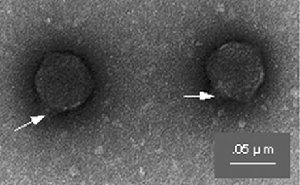
Bacteriophages exhibit diverse morphologies, but most share common structural features such as a head (capsid), tail, and tail fibers. These structures facilitate attachment to and penetration of bacterial cells.
Capsid: Protein shell that encases the viral genome.
Tail: Structure used by many phages to inject genetic material into the host.
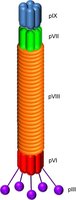
Filamentous Phages: Long, filament-shaped phages that extrude from the host without causing lysis.
Bacteriophage Life Cycles
Lytic Cycle
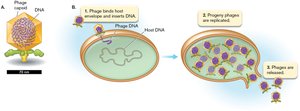
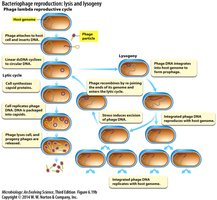
The lytic cycle is a reproductive cycle in which the phage takes over the host's machinery to produce new phage particles, culminating in the lysis (destruction) of the host cell and release of progeny phages.
Attachment: Phage binds to specific receptors on the bacterial surface.
Penetration: Phage injects its genome into the host cell.
Biosynthesis: Host machinery is redirected to synthesize phage components.
Assembly: New phage particles are assembled.
Release: Host cell lyses, releasing new phages.
Lysogenic Cycle
Some phages can integrate their genome into the host's chromosome, becoming a prophage. This lysogenic state allows the phage genome to be replicated along with the host's DNA until certain conditions trigger entry into the lytic cycle.
Prophage: Integrated phage DNA within the bacterial genome.
Lysogeny: The state in which the phage genome is maintained in the host without causing lysis.
Induction: Environmental triggers can cause the prophage to excise and enter the lytic cycle.
Slow Release (Chronic Infection)
Filamentous phages can extrude progeny through the cell envelope without lysing the host, resulting in chronic infection where the host survives but grows slowly.
Bacteriophage Growth and Quantification
Batch Culture and One-Step Growth Curve
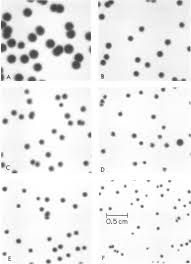
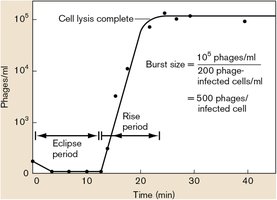
Batch culture experiments and one-step growth curves are used to study phage replication dynamics, including the eclipse period, rise period, and burst size.
Eclipse Period: Time after infection during which no infectious phage particles are detected.
Burst Size: Number of phages released per infected cell.
Bacterial Defense Mechanisms Against Phages
Prevention of Attachment
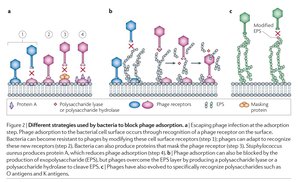
Bacteria can prevent phage adsorption by modifying or masking surface receptors, producing extracellular polysaccharides, or expressing specific proteins that block phage binding.
Receptor Modification: Alteration of phage-binding sites on the bacterial surface.
Capsule Production: Secretion of polysaccharide layers that block phage access.
Prevention of DNA Entry
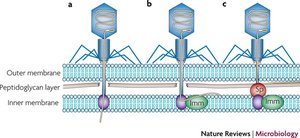
Bacteria may block the injection of phage DNA through changes in cell envelope structure or by producing proteins that interfere with DNA translocation.
Destruction of Invading Nucleic Acid: Restriction-Modification Systems
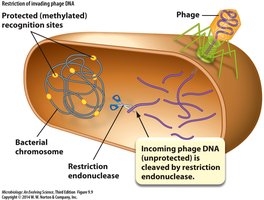
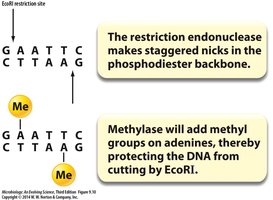
Bacteria use restriction-modification systems to recognize and cleave foreign DNA. Restriction endonucleases cut unmethylated phage DNA, while host DNA is protected by methylation.
Restriction Endonuclease: Enzyme that cleaves foreign DNA at specific sequences.
Methylase: Enzyme that adds methyl groups to host DNA, protecting it from cleavage.
CRISPR-Cas Adaptive Immunity
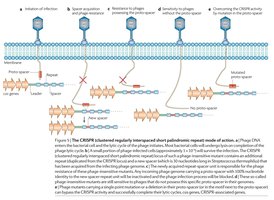
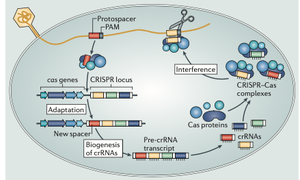
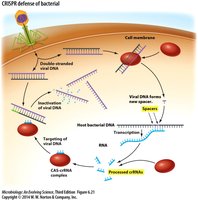
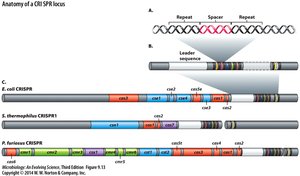
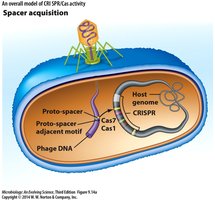
CRISPR (Clustered Regularly Interspaced Short Palindromic Repeats) is an adaptive immune system in bacteria and archaea. It provides sequence-specific immunity by capturing fragments of phage DNA (spacers) and using them to recognize and destroy future invaders.
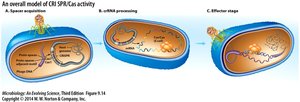
Spacer Acquisition: Integration of short phage DNA sequences into the CRISPR locus.
crRNA Processing: Transcription and processing of CRISPR loci into small RNAs (crRNAs).
Effector Stage: crRNAs guide Cas proteins to complementary phage DNA, leading to its cleavage.
Phages in the Human Gut
The Gut Bacteriophage Community
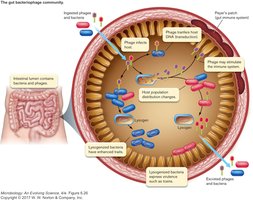
Bacteriophages are abundant in the human gut, where they influence bacterial populations, horizontal gene transfer, and potentially human health by modulating the microbiome.
Phage Therapy: Use of bacteriophages to treat bacterial infections.
Microbiome Modulation: Phages can alter the composition and function of the gut microbiota.
Case Study: Phage Lambda
Phage Lambda: Enteric Bacteriophage
Phage lambda is a model temperate phage that infects Escherichia coli. It can undergo both lytic and lysogenic cycles, making it a key system for studying gene regulation and viral genetics.
Lysogeny Control: Lambda phage integrates into the host genome and can remain dormant until induced to enter the lytic cycle.
Genetic Switch: Regulatory proteins control the decision between lysogeny and lysis.
Additional info: More details on lambda phage regulation and virus classification will be covered in subsequent lessons.
