 Back
BackBIO240 Microbiology Study Guide: Core Concepts and Learning Objectives
Study Guide - Smart Notes
 Tailored notes based on your materials, expanded with key definitions, examples, and context.
Ch. 1 - A Brief History of Microbiology
Introduction to Microbiology
Microbiology is the study of organisms too small to be seen with the naked eye, including bacteria, viruses, fungi, protozoa, and some multicellular parasites. Understanding the history and foundational concepts of microbiology is essential for grasping its impact on science and society.
Microbe vs. Microorganism: A microbe is a microscopic organism, which may include viruses, while microorganism typically refers to living microscopic organisms.
Impact of Microbes: Microbes play roles in health (e.g., gut flora), disease (e.g., pathogens), industry (e.g., fermentation), and the environment (e.g., nutrient cycling).
Scientific Nomenclature: Binomial nomenclature assigns each organism a genus and specific epithet (e.g., Escherichia coli).
Major Groups: Bacteria, Archaea, Fungi, Protists (Protozoa and Algae), Animals (including Platyhelminthes and Nematodes).
Viruses: Non-living infectious agents; lack cellular structure and metabolism.
Three Domains of Life: Bacteria, Archaea, Eukarya (discovered by Carl Woese).
Historical Figures: Robert Hooke (cell theory), Antoni van Leeuwenhoek (microscopy), Francesco Redi, John Needham, Lazzaro Spallanzani, Rudolf Virchow, Louis Pasteur (biogenesis vs. spontaneous generation), Joseph Lister, Robert Koch (Koch's postulates), Edward Jenner (vaccination), Lady Mary Wortley Montagu, Paul Ehrlich (chemotherapy), Alexander Fleming (antibiotics), Rebecca Lancefield (serology).
Ch. 3 - Cell Structure and Function
Prokaryotic vs. Eukaryotic Cells
Cells are the basic units of life, classified as prokaryotic (bacteria, archaea) or eukaryotic (fungi, protozoa, algae, animals, plants). Understanding their structure and function is fundamental to microbiology.
Shapes of Bacteria: Cocci (spherical), Bacilli (rod-shaped), Spirilla (spiral), Vibrios (comma-shaped), Spirochetes (flexible spirals).
Arrangements: Chains (strepto-), clusters (staphylo-), pairs (diplo-).
Glycocalyx: Capsule (organized, protective) and slime layer (loose, unorganized); aids in adherence and evasion of host defenses.
Flagella and Axial Filaments: Motility structures; flagella are external, axial filaments are internal (spirochetes).
Fimbriae and Pili: Attachment and genetic exchange (conjugation).
Biofilm Formation: Communities of microbes attached to surfaces, protected by extracellular matrix.
Cell Walls: Gram-positive (thick peptidoglycan), Gram-negative (thin peptidoglycan, outer membrane), acid-fast (mycolic acids), mycoplasmas (no cell wall), archaea (varied).
Protoplast, Spheroplast, L form: Variants of bacterial cells with altered or absent cell walls.
Plasma Membrane: Phospholipid bilayer; site of transport, energy generation.
Transport Mechanisms: Simple diffusion, facilitated diffusion, osmosis, active transport, group translocation.
Internal Structures: Nucleoid (DNA), ribosomes (protein synthesis), inclusions (storage).
Endospores: Dormant, resistant structures formed by some bacteria (e.g., Bacillus, Clostridium).
Eukaryotic Organelles: Nucleus, endoplasmic reticulum, Golgi complex, lysosomes, mitochondria, chloroplasts, peroxisomes, centrosomes.
Endosymbiotic Theory: Mitochondria and chloroplasts originated from prokaryotic cells engulfed by ancestral eukaryotes.
Ch. 4 - Microscopy, Staining, and Classification
Microscopy and Staining Techniques
Microscopy and staining are essential for observing and identifying microorganisms. Classification systems organize microbial diversity.
Metric System: Used for scientific measurements (micrometers, nanometers).
Compound Light Microscope: Key parts include ocular lens, objective lens, stage, condenser, and light source.
Path of Light: Light passes from the source through the condenser, specimen, objective lens, and ocular lens.
Total Magnification: Product of ocular and objective lens magnifications.
Resolution and Contrast: Ability to distinguish two points; enhanced by staining and special optics.
Types of Microscopy: Brightfield, darkfield, phase-contrast, DIC, fluorescence, confocal, electron (TEM, SEM), scanned-probe.
Staining: Simple (one dye), differential (Gram, acid-fast), special stains (capsule, endospore, flagella).
Acidic vs. Basic Dyes: Acidic dyes stain background; basic dyes stain cells.
Gram Stain: Differentiates bacteria by cell wall structure (positive: purple, negative: pink).
Taxonomy: Science of classification; includes taxon (group), phylogeny (evolutionary relationships).
Classification Systems: Two-kingdom (Linnaeus), five-kingdom (Whittaker), three-domain (Woese).
Identification Methods: Staining, biochemical tests, serology, phage typing, dichotomous keys, cladograms, Bergey's Manual.
Ch. 9 - Control of Microorganisms in the Environment
Principles of Microbial Control
Controlling microbial growth is essential in healthcare, industry, and research. Various physical and chemical methods are used to achieve sterilization, disinfection, and antisepsis.
Key Terms: Sterilization, disinfection, antisepsis, degerming, sanitization, biocide, germicide, bacteriostasis, asepsis.
Patterns of Microbial Death: Microbial populations die at a constant rate when exposed to control agents.
Physical Methods: Moist heat (boiling, autoclaving, pasteurization), dry heat, filtration, low temperature, high pressure, desiccation, osmotic pressure, radiation.
Chemical Methods: Disinfectants, antiseptics, halogens, surface-active agents.
Testing Effectiveness: Use-dilution tests, disk-diffusion method.
Factors Affecting Control: Type of microbe, number of microbes, environment, time of exposure.
Ch. 10 - Controlling Microbial Growth in the Body: Antimicrobial Drugs
Antimicrobial Therapy
Antimicrobial drugs are used to treat infections by targeting specific microbial structures or functions. Understanding their mechanisms and resistance is crucial for effective therapy.
Types of Drugs: Antibiotics (natural), semisynthetic, synthetic antimicrobials.
Spectrum of Activity: Narrow-spectrum (specific), broad-spectrum (wide range).
Testing Sensitivity: Methods include disk diffusion, broth dilution.
Modes of Action: Inhibit cell wall synthesis, protein synthesis, nucleic acid synthesis, disrupt membranes, inhibit metabolic pathways.
Resistance Mechanisms: Enzymatic destruction, altered targets, decreased uptake, efflux pumps.
Prevention of Resistance: Appropriate use, combination therapy, limiting unnecessary prescriptions.
Ch. 14 - Infection, Infectious Diseases, and Epidemiology
Pathogenesis and Disease Transmission
Understanding how pathogens cause disease and how infections spread is central to microbiology and public health. Epidemiology studies the patterns, causes, and effects of health and disease conditions.
Normal vs. Transient Microbiota: Normal microbiota are permanent residents; transient are temporary.
Symbiosis: Mutualism, commensalism, parasitism.
Reservoirs of Infection: Animal, human, inanimate (soil, water).
Mechanisms of Pathogenesis: Entry, adherence, evasion, damage, exit.
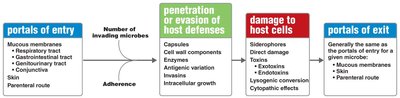
Etiology: Study of disease causation (Koch's postulates).
Virulence Factors: Toxins (exotoxins, endotoxins), enzymes, capsules.
Development of Disease: Incubation, prodromal, illness, decline, convalescence.
Epidemiology: Incidence, prevalence, morbidity, mortality, notifiable diseases.
Transmission: Direct, indirect, droplet, vector (mechanical, biological).
Nosocomial Infections: Healthcare-associated; prevention is critical.
Ch. 15 - Innate Immunity
First and Second Lines of Defense
Innate immunity provides immediate, non-specific defense against pathogens. It includes physical barriers, cellular responses, and chemical mediators.
Physical and Chemical Barriers: Skin, mucous membranes, secretions.
Blood Cells: Granulocytes (neutrophils, eosinophils, basophils), agranulocytes (lymphocytes, monocytes).
Phagocytosis: Engulfment and destruction of microbes.
Cytokines and Interferons: Signaling molecules in immune response.
Complement System: Protein cascade aiding in pathogen destruction.
Inflammation and Fever: Local and systemic responses to infection.
Ch. 16 - Adaptive Immunity
Third Line of Defense
Adaptive immunity is specific and has memory. It involves lymphocytes (B and T cells), antibodies, and the recognition of antigens.
Cell-Mediated Immunity: T cells recognize and destroy infected cells.
Humoral Immunity: B cells produce antibodies against antigens.
Antigen Presentation: Major histocompatibility complex (MHC) molecules display antigens to T cells.
Antibody Structure and Types: IgG, IgM, IgA, IgD, IgE; each with specific roles.
Primary vs. Secondary Response: Faster and stronger upon re-exposure.
Types of Adaptive Immunity: Naturally acquired, artificially acquired, active, passive.
Ch. 17 - Immunization and Immune Testing
Vaccination and Herd Immunity
Vaccination stimulates adaptive immunity and provides protection against infectious diseases. Herd immunity protects populations by reducing the spread of pathogens.
Types of Vaccines: Live attenuated, inactivated, subunit, toxoid, conjugate, mRNA.
Herd Immunity: When a high percentage of the population is immune, disease spread is limited.
Vaccine Hesitancy: Understanding and addressing concerns is important for public health.
Bacterial, Viral, and Eukaryotic Pathogens
Pathogen-Specific Diseases
Microbiology covers the etiology, transmission, diagnosis, treatment, and prevention of diseases caused by bacteria, viruses, fungi, protozoa, and helminths.
Bacterial Diseases: Necrotizing fasciitis (Streptococcus pyogenes), botulism (Clostridium botulinum), tetanus (Clostridium tetani), strep throat, gastritis (Helicobacter pylori), gastroenteritis, UTIs, syphilis, chlamydia.
Viral Diseases: Measles, herpesviruses, dengue, influenza, SARS-CoV-2, monkeypox, West Nile virus.
Eukaryotic Pathogens: Fungi (e.g., dermatophytes, Candida auris), protozoa (Plasmodium falciparum), helminths (tapeworms, pinworm, roundworm).
Vectors: Arthropods such as ticks and mosquitoes transmit diseases.
Additional info:
For detailed pathogen-specific objectives, refer to the “BIO240_Pathogen and Disease Guide Fall 24.pdf”.
Students are encouraged to use textbook flashcards and note guides for mastering key terms and concepts.
