 Back
BackBiochemical Tests for Microbial Metabolism and Hydrolysis
Study Guide - Smart Notes
 Tailored notes based on your materials, expanded with key definitions, examples, and context.
Energy Metabolism in Microorganisms
Respiration and Fermentation
Microorganisms utilize various metabolic pathways to obtain energy from organic molecules. The two primary modes are respiration and fermentation, which differ in their electron acceptors and end products.
Respiration: Involves glycolysis, the TCA (Krebs) cycle, and oxidative phosphorylation (electron transport chain).
Aerobic Respiration: Oxygen is the final electron acceptor.
Anaerobic Respiration: Other molecules (e.g., sulfur, nitrate) serve as final electron acceptors.
Fermentation: Glucose acts as the electron donor, and organic products (acids, solvents, CO2) are electron acceptors.
ATP is produced by converting chemical energy from organic molecules.
Oxidation-Fermentation (O-F) Test
Principle and Procedure
The O-F test differentiates bacteria based on their ability to oxidize or ferment carbohydrates, specifically glucose. Bromothymol blue is used as a pH indicator, turning yellow when the pH drops due to acid production.
Two tubes are inoculated for each organism; one is sealed with mineral oil to create anaerobic conditions.
Helps distinguish fermentative Enterobacteriaceae from oxidative Pseudomonas and nonreactive Alcaligenes.
Interpretation:
Yellow in both tubes: Fermentation (O-F or F)
Yellow only in unsealed tube: Oxidation (O)
No color change: Non-saccharolytic (N)
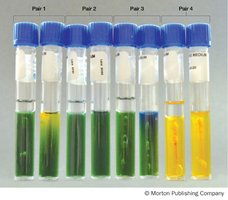
Example: Pair 1 shows oxidative metabolism, Pair 3 shows non-saccharolytic and strictly aerobic organism, Pair 4 shows both oxidative and fermentative utilization.
Phenol Red Broth Fermentation Test
Principle and Interpretation
This test detects fermentation of specific carbohydrates (e.g., glucose, lactose, sucrose) and distinguishes members of Enterobacteriaceae from other Gram-negative rods. The broth contains phenol red as a pH indicator and a Durham tube to capture gas.
Phenol Red Color Changes:
pH < 6.8: Yellow (acid production)
pH ~ neutral: Red
pH > 7.4: Pink/Magenta (alkaline)
Durham Tube: Detects gas production during fermentation.
Possible Results:
Acid and gas (A/G)
Acid only (A/-)
No reaction (-/-)
Alkaline reaction (K) due to peptone degradation
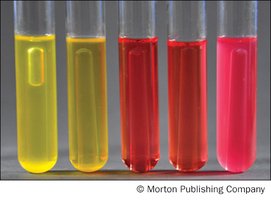
Example: The leftmost tube shows acid and gas production, the second tube shows acid only, the third is a control, the fourth shows no reaction, and the fifth shows an alkaline reaction.
Hydrolytic Enzyme Tests
Overview of Hydrolysis
Hydrolysis is the splitting of molecules using water, catalyzed by enzymes. Enzymes may act intracellularly or be secreted extracellularly.
Intracellular: Urease
Extracellular: Amylase, casease, lipase
Starch Hydrolysis Test
Starch is a large polysaccharide composed of glucose units, existing as amylose (linear) and amylopectin (branched). It is too large to cross the cell membrane, so extracellular enzymes (amylase and oligo-1,6-glucosidase) hydrolyze it into smaller units.
Iodine is added to the plate after incubation; it binds to starch that has not been hydrolyzed, producing a blue-black color.
Clear zones around growth indicate starch hydrolysis.
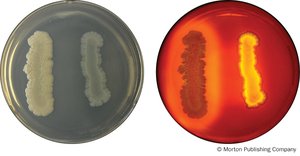
Example: The right plate after iodine addition shows a clear zone (positive for starch hydrolysis) and a blue-black zone (negative).
Casease (Casein Hydrolysis) Test
Casein is the main milk protein, giving milk its white color. Organisms that produce casease can hydrolyze casein, resulting in clearing of the agar plate. This test is used to detect bacteria in dairy products.
Clear zones indicate casein hydrolysis.
Incubation is typically 24 hours.
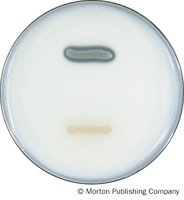
Example: The upper streak shows clearing (positive for casease), while the lower streak does not (negative).
Lipase (Lipid Hydrolysis) Test
The lipase test uses a tributyrin plate, where tributyrin oil is a simple triglyceride. Lipase is an extracellular enzyme that hydrolyzes fats. Clearing around bacterial growth indicates lipid hydrolysis.
Used to detect lipolytic bacteria in high-fat dairy products.
Helps differentiate Staphylococcus, Enterobacteriaceae, Clostridium, Neisseria.
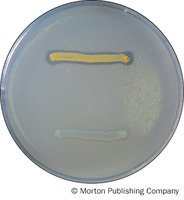
Example: The upper streak shows clearing (positive for lipase), while the lower streak does not (negative).
Summary Table: Hydrolytic Enzyme Tests
Test | Substrate | Enzyme | Positive Result | Application |
|---|---|---|---|---|
Starch Hydrolysis | Starch | Amylase | Clear zone after iodine | Detects amylolytic bacteria |
Casease Test | Casein | Casease | Clear zone in milk agar | Detects proteolytic bacteria in dairy |
Lipase Test | Tributyrin oil | Lipase | Clear zone in tributyrin agar | Detects lipolytic bacteria |
Additional info:
These tests are fundamental for identifying and differentiating bacteria based on their metabolic capabilities, which is crucial in clinical, environmental, and industrial microbiology.
Biochemical tests are often used in conjunction with other methods for comprehensive microbial identification.
