 Back
BackBiotechnology and DNA Technology: Microbiology Study Notes
Study Guide - Smart Notes
 Tailored notes based on your materials, expanded with key definitions, examples, and context.
Biotechnology and DNA Technology
Introduction to Biotechnology
Biotechnology is the application of microorganisms, cells, or cell components to produce useful products. This field encompasses the production of foods, antibiotics, vitamins, and enzymes. A major advancement in biotechnology is recombinant DNA (rDNA) technology, which involves the insertion or modification of genes to produce desired proteins.
Biotechnology: Use of living systems and organisms to develop or make products.
Recombinant DNA technology: Manipulation of genetic material to achieve specific outcomes, such as the production of human insulin in bacteria.
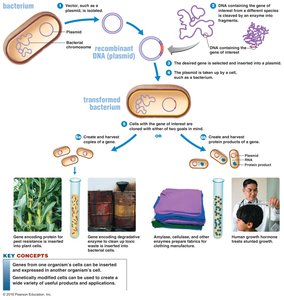
Overview of Recombinant DNA Procedures
Recombinant DNA technology relies on several key concepts and tools:
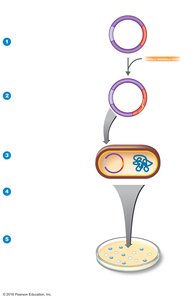
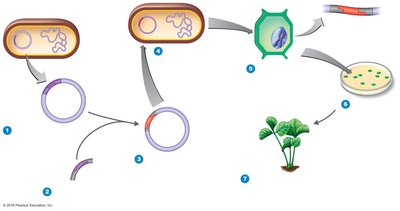
Vector: A self-replicating DNA molecule (such as a plasmid or virus) used to transport foreign DNA into a host cell.
Clone: A population of genetically identical cells, each carrying the vector with the inserted gene of interest.
Tools of Biotechnology
Several methods are used to manipulate and select for desired genetic traits:
Selection: Identifying and isolating microbes that naturally produce a desired product.
Mutation: Using mutagens to induce genetic changes that may result in beneficial traits.
Site-directed mutagenesis: Introducing specific, targeted changes into a gene to alter its function.
Restriction Enzymes
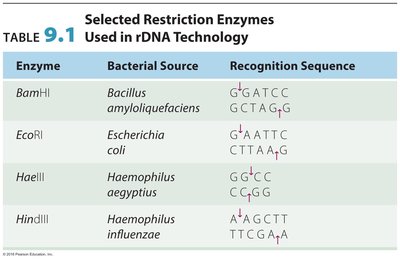
Restriction enzymes are essential tools in genetic engineering. They cut DNA at specific sequences, allowing for the precise manipulation of genetic material.
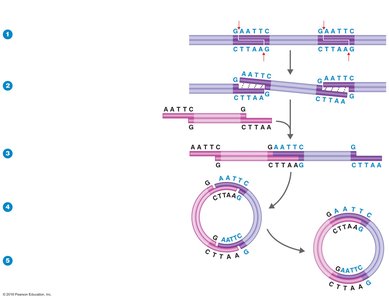
Function: Cut double-stranded DNA at specific recognition sites, producing fragments with either blunt or sticky ends.
Biological role: Protect bacteria from bacteriophage infection by degrading foreign DNA.
Protection: Bacterial DNA is protected from its own restriction enzymes by methylation of cytosines.
Enzyme | Bacterial Source | Recognition Sequence |
|---|---|---|
BamHI | Bacillus amyloliquefaciens | G^GATCC |
EcoRI | Escherichia coli | G^AATTC |
HaeIII | Haemophilus aegyptius | GG^CC |
HindIII | Haemophilus influenzae | A^AGCTT |
Restriction enzymes create sticky ends that can be joined with DNA fragments from other sources, forming recombinant DNA. DNA ligase is used to seal the sugar-phosphate backbone.
Vectors
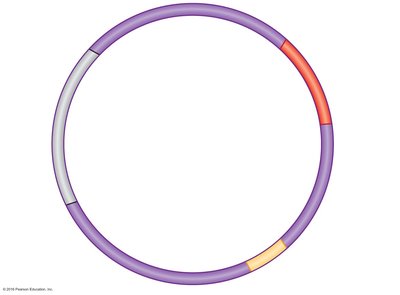
Vectors are DNA molecules used to carry foreign genetic material into another cell. They must be capable of self-replication and often contain selectable markers.
Plasmids: Circular DNA molecules commonly used as vectors in bacteria.
Viruses: Can be engineered to deliver genes into host cells.
Shuttle vectors: Plasmids that can replicate in multiple species, facilitating gene transfer between organisms.
Polymerase Chain Reaction (PCR)
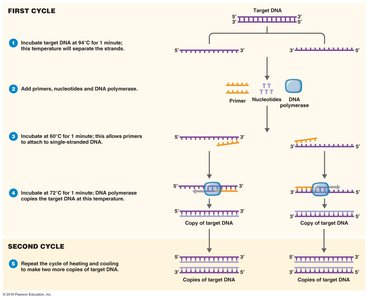
PCR is a technique used to amplify small quantities of DNA, making it possible to analyze genetic material from minute samples. It is widely used in diagnostics and research.
Steps: Denaturation, annealing, and extension.
Applications: Detection of pathogens, genetic disease diagnosis, and forensic analysis.
Reverse-transcription PCR: Uses mRNA as a template to study gene expression.
Inserting Foreign DNA into Cells
Several methods are used to introduce foreign DNA into host cells:
Transformation: Uptake of naked DNA from the environment by a cell.
Electroporation: Application of an electrical current to create pores in cell membranes, allowing DNA to enter.
Protoplast fusion: Fusion of cells with removed cell walls, allowing exchange of genetic material.
Gene gun: Physical delivery of DNA-coated particles into cells.
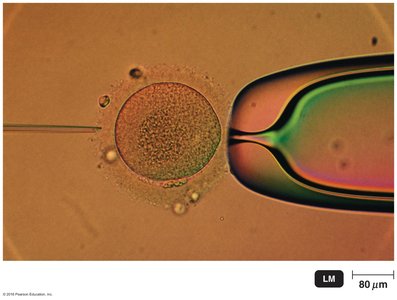
Microinjection: Direct injection of DNA into cells using a fine needle.
Genomic Libraries
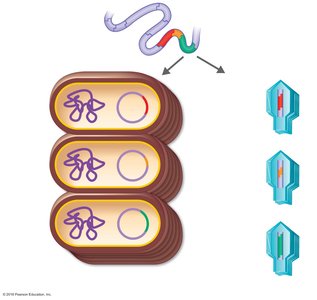
A genomic library is a collection of clones that together contain the entire genetic material of an organism. These libraries are essential for gene discovery and functional studies.
Construction: DNA is fragmented and inserted into vectors, which are then introduced into host cells.
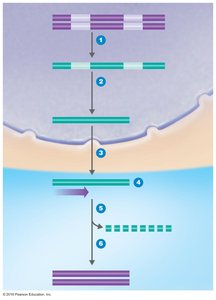
cDNA libraries: Created from mRNA using reverse transcriptase, representing only expressed genes (without introns).
Synthetic DNA
Synthetic DNA is produced using automated DNA synthesizers, allowing for the creation of genes with specific sequences for research or therapeutic purposes.
Selecting a Clone
After transformation, it is necessary to identify cells that have successfully taken up the recombinant DNA:
Blue-white screening: Uses plasmids with antibiotic resistance and lacZ genes. Colonies with recombinant plasmids appear white, while non-recombinant colonies are blue.
Colony hybridization: Uses labeled DNA probes to identify colonies containing the gene of interest.
Making a Gene Product
Various host systems are used to express recombinant genes and produce proteins:
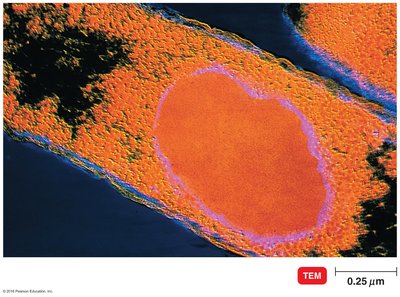
E. coli: Advantages include rapid growth and well-known genetics; disadvantages include endotoxin production and poor secretion of proteins.
Saccharomyces cerevisiae: Yeast cells that efficiently express eukaryotic genes.
Plant cells and whole plants: Useful for large-scale, low-cost production of eukaryotic proteins.
Mammalian cells: Best for producing proteins for medical use, but are more difficult to grow.
Therapeutic Applications
Recombinant DNA technology has revolutionized medicine by enabling the production of human proteins, vaccines, and gene therapies.
Human enzymes and proteins: Such as insulin and growth hormone.
Subunit vaccines: Produced in genetically modified organisms.
Gene therapy: Replacement of defective or missing genes to treat disease.
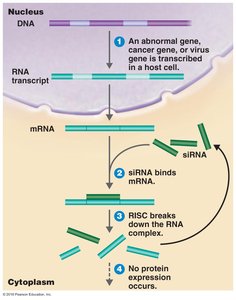
Gene silencing: Use of siRNA to block expression of specific genes, potentially treating a range of diseases.
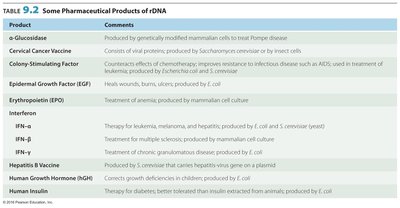
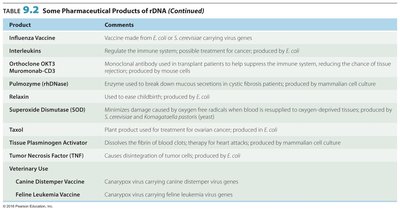
Product | Comments |
|---|---|
α-Glucosidase | Produced by genetically modified mammalian cells to treat Pompe disease |
Cervical Cancer Vaccine | Consists of viral proteins produced by Saccharomyces cerevisiae or by insect cells |
Colony-Stimulating Factor | Counteracts effects of chemotherapy; improves resistance to infection |
Human Insulin | Therapy for diabetes; better tolerated than insulin extracted from animals |
Interferons | Treatment for viral infections and some cancers |
Hepatitis B Vaccine | Protects against hepatitis B infection |
Genome Projects and Scientific Applications
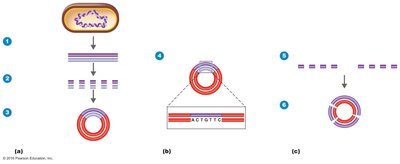
Genome projects involve sequencing and analyzing the genetic material of organisms. These efforts have led to advances in bioinformatics, proteomics, and reverse genetics.
Shotgun sequencing: Randomly sequences small DNA fragments and assembles them computationally.
Metagenomics: Studies genetic material recovered directly from environmental samples.
Bioinformatics: Uses computational tools to analyze gene function and expression.
Proteomics: Studies the complete set of proteins expressed by a genome.
Reverse genetics: Determines gene function by analyzing phenotypic effects of specific gene sequences.
Southern Blotting and Forensic Microbiology
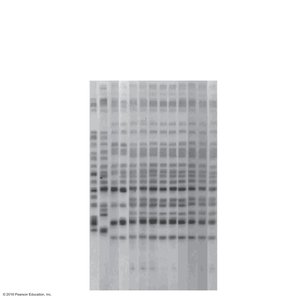
Southern blotting is a technique used to detect specific DNA sequences in DNA samples. Forensic microbiology uses DNA fingerprinting to identify pathogens and track disease outbreaks.
Southern blotting: DNA fragments separated by gel electrophoresis are transferred to a membrane and probed with labeled DNA to detect specific sequences.
DNA fingerprinting: Compares DNA patterns to identify individuals or sources of infection.
Nanotechnology
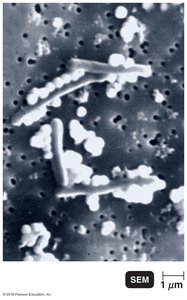
Microorganisms can be used to produce nanoscale materials, such as nanospheres for drug delivery and targeting.
Agricultural Applications
Recombinant DNA technology is widely used in agriculture to improve crop yield, resistance to pests, and nutritional value.
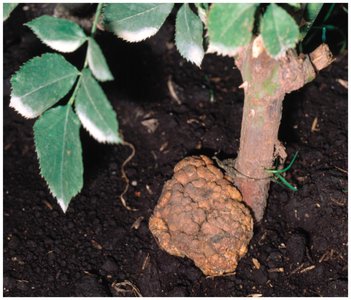
Ti plasmid: A plasmid from Agrobacterium tumefaciens used to introduce foreign genes into plants, causing crown gall disease as a natural genetic engineer.
Bt toxin: Gene from Bacillus thuringiensis confers insect resistance to plants.
Herbicide resistance: Allows crops to survive applications of herbicides.
Suppression of genes and antisense DNA: Used to inhibit undesirable traits.
Production of human proteins in plants: For pharmaceutical use.
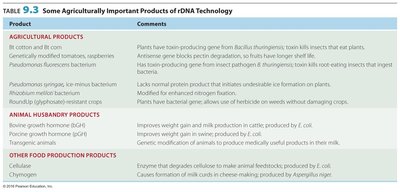
Product | Comments |
|---|---|
Bt cotton and Bt corn | Contain toxin-producing gene from Bacillus thuringiensis for insect resistance |
Herbicide-resistant crops | Plants with genes allowing survival after herbicide application |
Bovine growth hormone (BGH) | Improves milk production in cattle |
Cellulase | Enzyme for animal feed production |
Safety Issues and Ethics
The use of recombinant DNA technology raises important safety and ethical concerns:
Preventing accidental release of genetically modified organisms into the environment.
Ensuring genetically modified crops are safe for consumption and the environment.
Protecting individual genetic information and privacy.
