 Back
Back9 Biotechnology and DNA Technology: Principles, Tools, and Applications
Study Guide - Smart Notes
 Tailored notes based on your materials, expanded with key definitions, examples, and context.
Biotechnology and DNA Technology
Introduction to Biotechnology
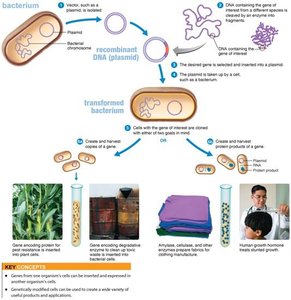
Biotechnology is the use of microorganisms, cells, or cell components to produce useful products such as foods, antibiotics, vitamins, and enzymes. Recombinant DNA (rDNA) technology involves the insertion or modification of genes to produce desired proteins, enabling the creation of genetically modified organisms for research, medicine, and industry.
Biotechnology: Application of biological systems or organisms to technical and industrial processes.
Genetic modification: Alteration of an organism's genetic material to achieve desired traits.
Recombinant DNA technology: Combining DNA from different sources to create new genetic combinations.
Cloning and Vectors
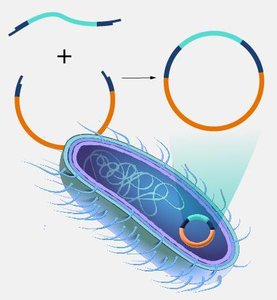
Vectors are self-replicating DNA molecules used to transport foreign DNA into a host cell. A clone is a population of genetically identical cells, each carrying the vector with the inserted gene of interest.
Vector: DNA molecule (often a plasmid or virus) that carries foreign DNA into a host cell.
Clone: Genetically identical cells derived from a single cell, each containing the recombinant vector.
Tools of Biotechnology
Selection and Mutation
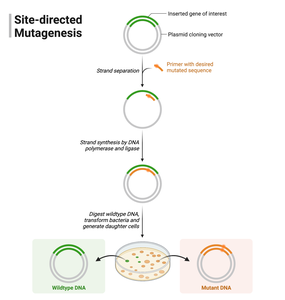
Selection involves isolating microbes that naturally produce a desired product, while mutation uses mutagens to induce genetic changes that may result in beneficial traits. Site-directed mutagenesis allows for precise, intentional changes in DNA sequences.
Selection: Identifying and cultivating organisms with naturally occurring desirable traits.
Mutation: Inducing genetic changes to create new traits.
Site-directed mutagenesis: Targeted alteration of specific DNA sequences to study gene function or improve traits.
Restriction Enzymes
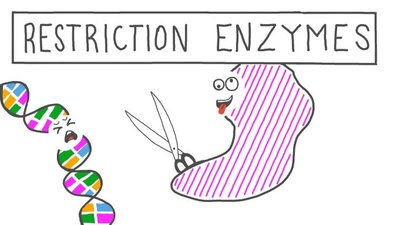
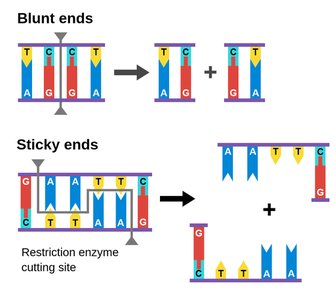
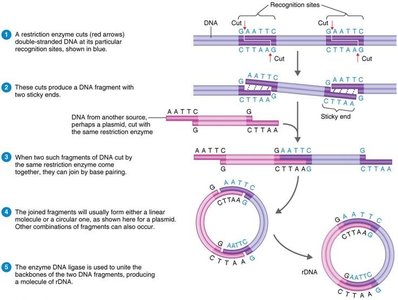
Restriction enzymes are proteins that cut DNA at specific sequences, generating fragments with blunt or sticky ends. These enzymes are essential for creating recombinant DNA molecules.
Restriction enzymes: Enzymes that recognize and cut specific DNA sequences.
Blunt ends: DNA fragments with no overhanging bases; less efficient for ligation.
Sticky ends: DNA fragments with single-stranded overhangs; facilitate the joining of DNA from different sources.
Properties and Types of Vectors
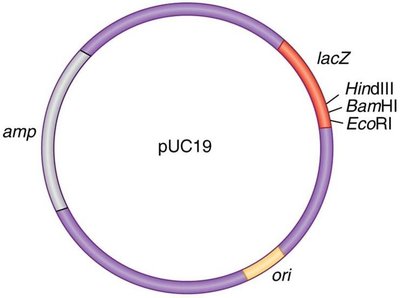
Vectors must be able to self-replicate, carry selectable markers, and have unique restriction sites. Plasmids and viruses are commonly used as vectors, and shuttle vectors can transfer DNA between different species.
Self-replication: Ability to replicate independently within a host cell.
Selectable marker: Gene (e.g., antibiotic resistance) that allows identification of cells containing the vector.
Multiple cloning site: Region with several unique restriction sites for gene insertion.
Polymerase Chain Reaction (PCR)
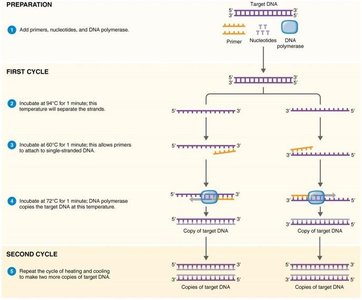
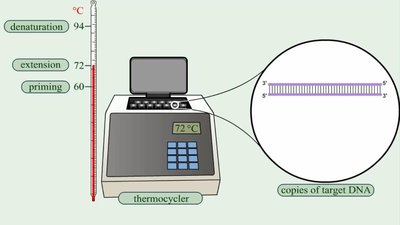
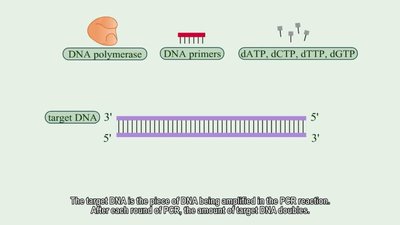
PCR is a technique used to amplify small quantities of DNA for analysis. It is widely used in diagnostics, genetic testing, and research. Reverse-transcription PCR uses mRNA as a template to study gene expression.
Denaturation: Heating to separate DNA strands (typically at 94°C).
Annealing: Cooling to allow primers to bind to target sequences (typically at 60°C).
Extension: DNA polymerase synthesizes new DNA strands (typically at 72°C).
Techniques of Genetic Modification
Methods for Introducing DNA into Cells
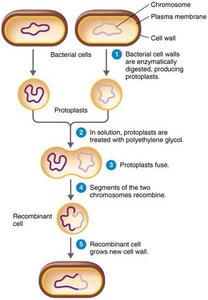
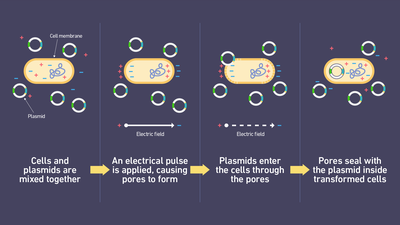
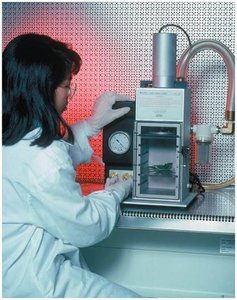
Several methods are used to introduce foreign DNA into cells, including transformation, electroporation, protoplast fusion, gene gun, and microinjection.
Transformation: Uptake of naked DNA from the environment by a cell.
Electroporation: Electrical pulses create pores in cell membranes, allowing DNA to enter.
Protoplast fusion: Fusion of cells without cell walls to combine genetic material.
Gene gun: Shoots DNA-coated particles into cells.
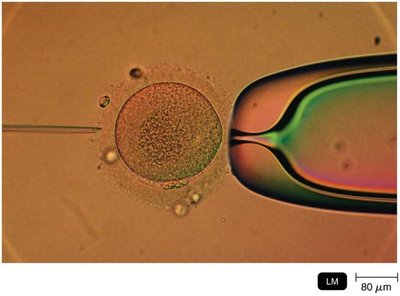
Microinjection: Direct injection of DNA into a cell using a fine needle.
Genomic Libraries
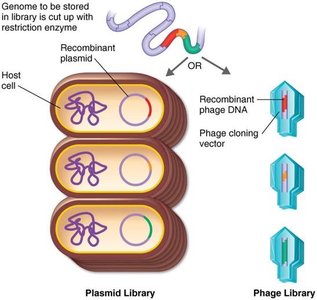
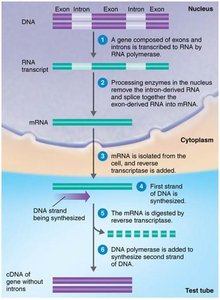
A genomic library is a collection of DNA fragments representing the entire genome of an organism, stored in vectors such as plasmids or phages. Complementary DNA (cDNA) libraries are made from mRNA using reverse transcriptase, which is useful for expressing eukaryotic genes in prokaryotes.
Genomic library: Complete set of DNA fragments from an organism cloned into vectors.
cDNA library: Collection of DNA copies synthesized from mRNA, representing expressed genes.
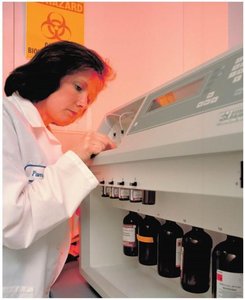
Synthetic DNA: Artificially created DNA sequences using chemical synthesis machines.
Selection and Identification of Recombinant Clones
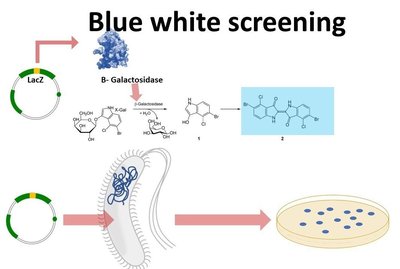
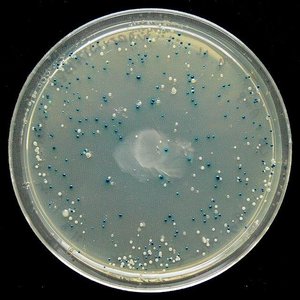
Blue-white screening and colony hybridization are common methods for identifying recombinant clones. Blue-white screening uses the lacZ gene and X-gal substrate to distinguish between recombinant (white) and non-recombinant (blue) colonies.
Blue-white screening: Differentiates recombinant bacteria (white colonies) from non-recombinant (blue colonies) using β-galactosidase activity.
Colony hybridization: Uses labeled DNA probes to identify colonies containing the gene of interest.
Making a Gene Product
Host Cells for Gene Expression
Different host cells are used for producing gene products, each with advantages and disadvantages:
E. coli: Easily grown, well-characterized genome, but produces endotoxins and does not secrete proteins efficiently.
Saccharomyces cerevisiae (yeast): Grows easily, expresses eukaryotic genes, and secretes proteins.
Plant cells: Suitable for large-scale, low-cost production of eukaryotic proteins.
Mammalian cells: Best for producing complex proteins for medical use, but are harder to grow.
Applications of DNA Technology
Therapeutic Applications
DNA technology is used to produce human proteins (e.g., insulin, growth hormone), vaccines, gene therapy, and gene editing (e.g., CRISPR). Gene silencing using RNA interference (RNAi) can treat diseases by blocking the expression of harmful genes.
Subunit vaccines: Contain only parts of pathogens, produced in genetically modified organisms.
Gene therapy: Replaces defective genes to treat genetic disorders.
Gene editing (CRISPR): Precisely alters DNA sequences to correct mutations.
RNA interference (RNAi): Uses small interfering RNAs (siRNAs) to silence gene expression.
Examples of Pharmaceutical Products from rDNA Technology
Product | Produced By | Application |
|---|---|---|
Human Insulin | E. coli | Diabetes therapy |
Human Growth Hormone | E. coli | Treats growth deficiencies |
Hepatitis B Vaccine | S. cerevisiae | Prevents hepatitis B |
Interferons | E. coli, S. cerevisiae, mammalian cells | Treats viral infections, cancer |
Tissue Plasminogen Activator | Mammalian cells | Dissolves blood clots |
Bt Toxin | Bacillus thuringiensis gene in plants | Insect resistance in crops |
Genome Projects and Scientific Applications
Genome projects use shotgun sequencing to determine the DNA sequence of entire genomes. Bioinformatics analyzes genetic data, while proteomics studies protein expression. Southern blotting detects specific DNA sequences, and DNA fingerprinting is used in forensics and epidemiology.
Shotgun sequencing: Randomly sequences small DNA fragments and assembles them computationally.
Bioinformatics: Computer-assisted analysis of genetic data.
Proteomics: Study of all proteins expressed by a genome.
Southern blotting: Detects specific DNA fragments using labeled probes.
DNA fingerprinting: Identifies individuals or pathogens based on unique DNA patterns.
Agricultural Applications
Agrobacterium tumefaciens and its Ti plasmid are used to introduce recombinant DNA into plants, creating transgenic crops with improved traits such as pest resistance, herbicide tolerance, and enhanced nutrition.
Bt crops: Contain genes from Bacillus thuringiensis for insect resistance.
Herbicide-resistant crops: Tolerate specific herbicides, allowing selective weed control.
Golden rice: Engineered to produce vitamin A precursor for improved nutrition.
Safety Issues and Ethics
The use of genetic modification raises safety and ethical concerns, including the potential for accidental release of genetically modified organisms, food safety, environmental impact, and privacy of genetic information. Strategies such as "suicide" genes are used to prevent the survival of GMOs outside controlled environments.
Containment: Preventing accidental release of GMOs.
Food and environmental safety: Ensuring GMOs are safe for consumption and do not harm ecosystems.
Ethical considerations: Addressing issues of genetic privacy and access to genetic information.
