 Back
BackBiotechnology and Recombinant DNA: Microbiology Study Guide
Study Guide - Smart Notes
 Tailored notes based on your materials, expanded with key definitions, examples, and context.
Biotechnology & Recombinant DNA
Genetic Engineering
Genetic engineering is the purposeful recombination of DNA in the laboratory to create new genetic combinations. This process is fundamental to modern biotechnology and allows scientists to manipulate genetic material for research, medicine, and industry.
Definition: The deliberate modification of an organism's genetic material using recombinant DNA technology.
Applications: Production of pharmaceuticals, gene therapy, agricultural improvements, and research.
Example: Synthesis of human insulin using genetically modified bacteria.

Plasmids
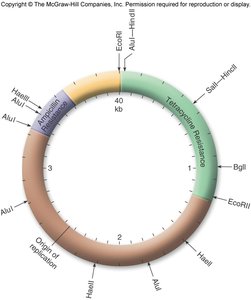
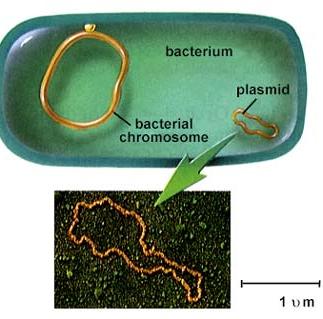
Plasmids are small, circular DNA molecules found in bacteria that are separate from chromosomal DNA. They are commonly used as vectors in genetic engineering due to their ability to replicate independently and carry foreign genes.
Definition: Extrachromosomal, circular DNA molecules in bacteria.
Role: Serve as vectors to transfer genes between organisms.
Example: Plasmids carrying antibiotic resistance genes.
Restriction Endonucleases & Sticky Ends
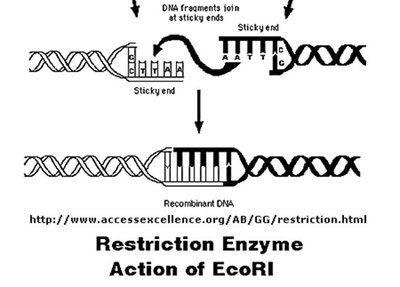
Restriction endonucleases are enzymes that cut DNA at specific sequences, producing fragments with 'sticky ends' that can be joined with other DNA fragments. This is a key step in creating recombinant DNA.
Definition: Enzymes that recognize and cleave specific DNA sequences.
Sticky Ends: Overhanging sequences that facilitate the joining of DNA fragments.
Example: EcoRI creates sticky ends at the sequence GAATTC.

Insertion of Gene into Plasmid
After DNA is cut with restriction enzymes, a gene of interest can be inserted into a plasmid vector. DNA ligase is used to seal the fragments, creating recombinant DNA.
Process: Gene is inserted into plasmid using sticky ends and DNA ligase.
Result: Recombinant plasmid containing the foreign gene.
Example: Insertion of human insulin gene into a bacterial plasmid.

Transformation of Bacteria
Transformation is the process by which bacteria take up recombinant plasmids from their environment. This allows the bacteria to express the foreign gene and produce the desired protein.
Definition: Uptake of foreign DNA by bacterial cells.
Application: Production of recombinant proteins in bacteria.
Example: Bacteria transformed with plasmid containing antibiotic resistance gene.

Selection of Transformed Bacteria
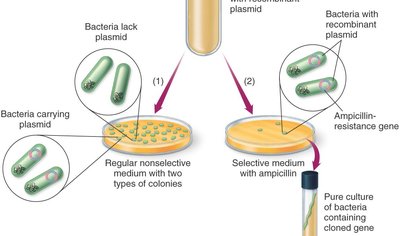
To identify bacteria that have successfully taken up the recombinant plasmid, selective media containing antibiotics are used. Only bacteria with the plasmid survive and grow.
Method: Use of antibiotic-containing medium to select for transformed bacteria.
Result: Pure culture of bacteria containing the cloned gene.
Example: Ampicillin resistance gene used for selection.

Protein Purification
Once bacteria produce the recombinant protein, purification techniques are used to isolate the protein for research or therapeutic use.
Definition: Methods to extract and purify proteins from bacterial cultures.
Techniques: Chromatography, precipitation, and affinity purification.
Example: Purification of recombinant insulin.

DNA Probes
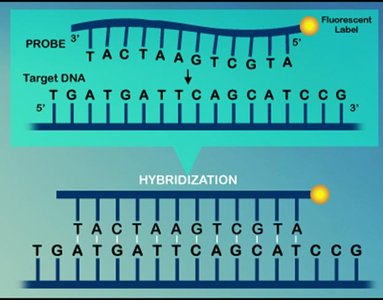
DNA probes are single-stranded pieces of DNA tagged with a reporter molecule. They are used to detect specific DNA sequences in samples by hybridization.
Definition: Labeled DNA fragments used to identify complementary sequences.
Application: Diagnostic tests for pathogens, gene identification.
Example: Fluorescent probes for detecting Salmonella DNA.
Polymerase Chain Reaction (PCR)
PCR is a technique used to amplify specific DNA sequences, making millions of copies from a small initial sample. It is essential for genetic analysis, diagnostics, and research.
Definition: Method to exponentially amplify DNA using DNA polymerase.
Steps: Denaturation, annealing, extension.
Equation: (where N is the number of DNA copies after n cycles)
Example: Detection of genetic mutations or pathogens.

Southern Blot
The Southern blot is a method for separating and detecting DNA fragments. It involves gel electrophoresis, transfer to a membrane, and hybridization with a labeled probe.
Definition: Technique to detect specific DNA sequences in a sample.
Steps: DNA digestion, gel electrophoresis, transfer, probe hybridization.
Example: Identification of gene mutations.

DNA Fingerprinting (PFGE)
DNA fingerprinting, also known as Pulse Field Gel Electrophoresis (PFGE), uses restriction enzymes and gel electrophoresis to produce unique banding patterns for identification and epidemiological studies.
Definition: Technique to distinguish individuals or strains based on DNA patterns.
Application: Outbreak investigations, forensic analysis.
Example: Multistate outbreak of Salmonella infections traced using PFGE.

Northern Blot
The Northern blot is a method for separating and detecting RNA fragments. It is used to study gene expression by identifying specific RNA molecules in a sample.
Definition: Technique to detect specific RNA sequences.
Steps: RNA separation, transfer to membrane, probe hybridization.
Example: Analysis of mRNA expression levels.

Human Peptides and Proteins Synthesized by Genetic Engineering
Genetic engineering enables the synthesis of human peptides and proteins for therapeutic use. These products are used to treat various diseases and conditions.
Examples: Insulin for diabetes, blood-clotting factor VIII for hemophilia, erythropoietin for anemia.
Applications: Treatment of genetic disorders, hormone replacement, cancer therapy.
Peptide or Protein | Potential Use |
|---|---|
α1-antitrypsin | Treatment of emphysema |
α-, β-, and γ-interferons | As antiviral, antitumor, and anti-inflammatory agents |
Blood-clotting factor VIII | Treatment of hemophilia |
Calcitonin | Treatment of osteomalacia |
Epidermal growth factor | Treatment of wounds |
Erythropoietin | Treatment of anemia |
Growth hormone | Growth promotion |
Insulin | Treatment of diabetes |
Interleukins-1, 2, and 3 | Treatment of immune disorders and tumors; cancer treatment |
Macrophage colony stimulating factor | Aid to childbirth |
Relaxin | Plasma supplement |
Serum albumin | Plasma supplement |
Somatostatin | Anticoagulant |
Streptokinase | Anticoagulant |
Tissue plasminogen activator | Anticoagulant |
Tumor necrosis factor | Cancer treatment |
