 Back
BackCalibrating the Ocular Micrometer and Measuring Microorganisms
Study Guide - Smart Notes
 Tailored notes based on your materials, expanded with key definitions, examples, and context.
Calibrating an Ocular Micrometer
Principle and Importance
Accurate measurement of microorganisms is essential for their identification and classification. The ocular micrometer is a small glass disk with a scale etched into it, placed in the microscope eyepiece. However, its divisions are arbitrary and must be calibrated using a stage micrometer, which has a precisely spaced scale (typically 0.01 mm or 10 µm per division). Calibration ensures that measurements taken with the ocular micrometer are accurate for each objective lens used.
Ocular Micrometer: An eyepiece ruler with arbitrary divisions.
Stage Micrometer: A microscope slide with a known scale (e.g., 0.01 mm per division).
Calibration: The process of determining the actual length each ocular division represents at a given magnification.
Calibration Procedure
Place the stage micrometer on the microscope stage and focus using the desired objective.
Superimpose the ocular micrometer scale over the stage micrometer scale.
Count how many ocular divisions align with a known number of stage micrometer divisions.
Calculate the value of one ocular division using the formula:
For example, if 25 ocular divisions align with 10 stage divisions (each 10 µm):
Example Calibration Factors
High Power Objective (400X): Calibration factor = 2.5 µm/division
Oil Immersion Objective (1000X): Calibration factor = 1.0 µm/division

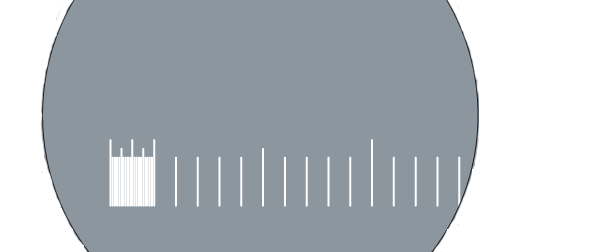
Estimating Field Diameter of a Microscope
Field Diameter Measurement
The field diameter is the visible width of the specimen area under the microscope. Knowing the field diameter helps estimate the size of microorganisms quickly. To measure it, align a stage micrometer so that its scale overlaps the field of view, and count the number of divisions spanning the diameter.
Example: If the field diameter covers 52 divisions of a stage micrometer (each 0.01 mm), then:

Representative Bacterial Morphologies and Characteristics
Bacillus sp.
Bacillus species are Gram-positive, rod-shaped bacteria that often form chains (strepto arrangement). They are motile with peritrichous flagella and can produce oval, cylindrical endospores. These bacteria are aerobic or facultatively anaerobic and inhabit diverse environments.
Shape: Rods, straight
Size: 0.5–2.5 µm wide × 1.2–10 µm long
Arrangement: Chains
Motility: Peritrichous flagella
Endospores: Present
Oxygen Requirement: Aerobic or facultative anaerobe
Staphylococcus aureus
Staphylococcus aureus is a Gram-positive, spherical bacterium that forms clusters. It is nonmotile, facultatively anaerobic, and found in various environments, including clinical specimens, soil, water, and as part of the normal flora of animals.
Shape: Coccus (spherical)
Size: 1.0–1.5 µm diameter
Arrangement: Clusters
Motility: Nonmotile
Oxygen Requirement: Facultative anaerobe
Habitat: Humans, soil, water, plants, digestive tracts of rodents and insects
Metabolism: Chemoorganotrophic (respiratory/fermentative)
Optimal Temperature: 30–37°C
Escherichia coli
Escherichia coli is a Gram-negative, rod-shaped bacterium found primarily in the intestines of warm-blooded animals. It can be motile (peritrichous flagella) or nonmotile, is a facultative anaerobe, and is associated with both normal flora and pathogenic strains (e.g., O157:H7).
Shape: Rods
Size: 1.1–1.5 µm wide × 2–6 µm long
Arrangement: Single or pairs
Motility: Peritrichous flagella or nonmotile
Oxygen Requirement: Facultative anaerobe
Optimal Temperature: ~37°C
Habitat: Intestines of warm-blooded animals, soil, water
Pathogenicity: Can cause urinary tract infections, diarrheal diseases (e.g., O157:H7)
Virulence Factors: K capsule, H flagella, O antigen
Table: Comparison of Bacterial Characteristics
Species | Gram Stain | Shape & Arrangement | Size (µm) | Motility | Oxygen Requirement |
|---|---|---|---|---|---|
Bacillus sp. | Positive | Rods, chains | 0.5–2.5 × 1.2–10 | Peritrichous flagella | Aerobic/facultative |
Staphylococcus aureus | Positive | Cocci, clusters | 1.0–1.5 (diameter) | Nonmotile | Facultative anaerobe |
Escherichia coli | Negative | Rods, single/pairs | 1.1–1.5 × 2–6 | Peritrichous flagella or nonmotile | Facultative anaerobe |
Additional info: Accurate measurement of microorganisms is foundational for microbiological research, clinical diagnostics, and taxonomy. Calibration must be repeated for each objective lens, as magnification changes the apparent size of ocular divisions.
