 Back
(Chapter 17, Part 2) Cell-Mediated Immunity and Adaptive Immune Responses
Study Guide - Smart Notes
 Tailored notes based on your materials, expanded with key definitions, examples, and context.
Cell-Mediated Immunity
Antigen-Presenting Cells (APCs)
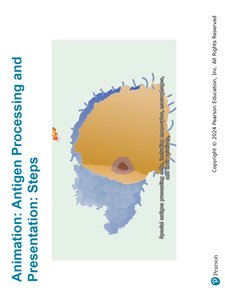
Antigen-presenting cells are essential for initiating adaptive immune responses by processing and presenting antigens to T cells. The main types of APCs include dendritic cells, macrophages, and B cells.
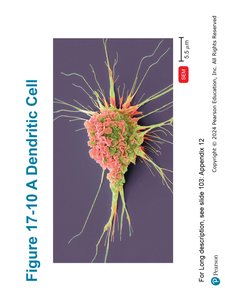
Dendritic cells (DCs): Engulf and degrade microbes, then display microbial antigens to T cells. Found in skin, genital tract, lymph nodes, spleen, thymus, and blood.
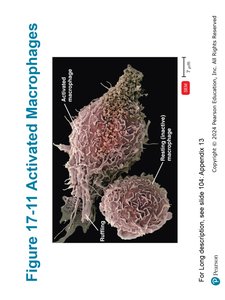
Macrophages: Activated by cytokines or ingestion of antigenic material. Migrate to lymph tissue and present antigens to T cells.
B cells: Also function as APCs by presenting antigen to T cells.
Antigen Processing and Presentation
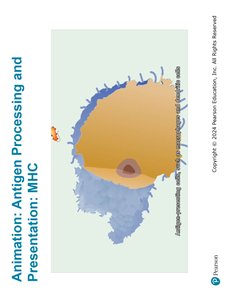
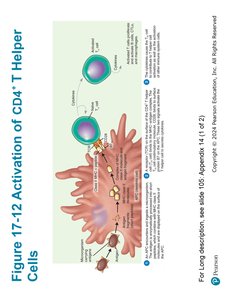
APCs process antigens and present them on their surface via major histocompatibility complex (MHC) molecules. This is crucial for T cell activation.
MHC Class I: Presents endogenous antigens to CD8+ cytotoxic T cells.
MHC Class II: Presents exogenous antigens to CD4+ helper T cells.
Classes of T Cells
Clusters of Differentiation (CD)
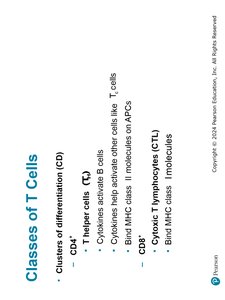
T cells are classified based on surface molecules called clusters of differentiation (CD). The two main classes are CD4+ and CD8+ T cells.
CD4+ T cells (Helper T cells, TH): Activate B cells and other immune cells. Bind MHC class II molecules on APCs.
CD8+ T cells (Cytotoxic T lymphocytes, CTL): Destroy infected or abnormal cells. Bind MHC class I molecules.
T Helper Cells (CD4+ T Cells)
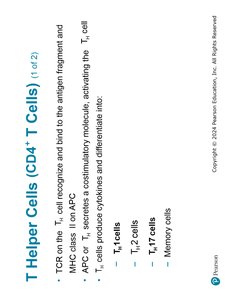
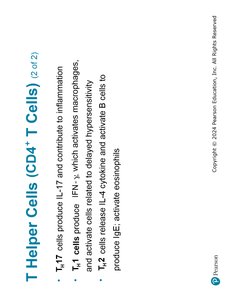
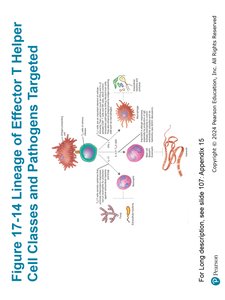
T helper cells recognize antigens presented by APCs and coordinate immune responses by producing cytokines. They differentiate into several subtypes with distinct functions.
TH1 cells: Produce IFN-γ, activate macrophages, and are involved in delayed hypersensitivity.
TH2 cells: Release IL-4 cytokines, activate B cells to produce IgE, and activate eosinophils.
TH17 cells: Produce IL-17, contribute to inflammation.
Memory cells: Provide long-term immunity by remembering past antigens.
T Regulatory Cells (Treg)
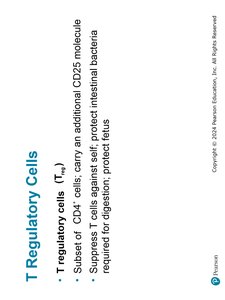
T regulatory cells are a subset of CD4+ cells that carry an additional CD25 molecule. They suppress immune responses against self, protect intestinal bacteria required for digestion, and protect the fetus during pregnancy.
Suppress T cells: Prevent autoimmunity and maintain tolerance.
Cytotoxic T Lymphocytes (CD8+ T Cells)
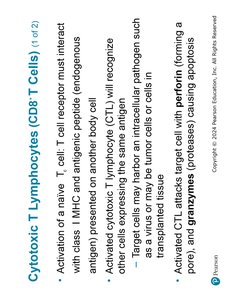
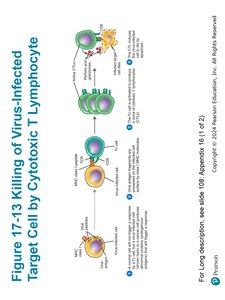
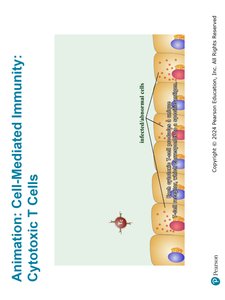
Cytotoxic T lymphocytes (CTLs) recognize and kill infected or abnormal cells. Activation requires interaction with MHC class I and antigen peptide.
Perforin: Forms pores in target cell membranes.
Granzymes: Cause apoptosis (programmed cell death).
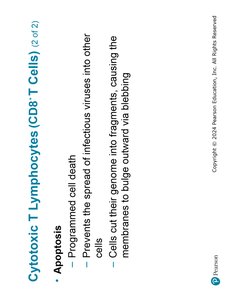
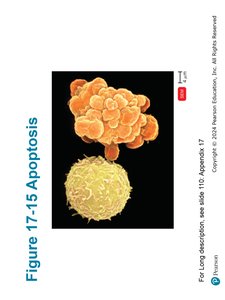
Apoptosis: Prevents spread of infectious viruses by fragmenting cell genome and causing membrane blebbing.
Nonspecific Cells and Extracellular Killing by the Adaptive Immune System
Natural Killer (NK) Cells
NK cells destroy virus-infected cells, tumor cells, and attack large extracellular parasites. They are not stimulated by antigen and detect target cells based on MHC expression.
Make pores: Lead to apoptosis in target cells.
Antibody-Dependent Cell-Mediated Cytotoxicity (ADCC)
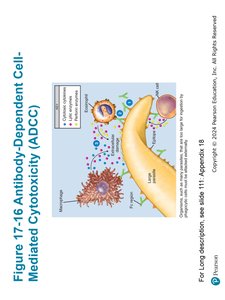
ADCC is a mechanism where immune cells destroy protozoans and helminths that are too large to be phagocytosed. Target cells are coated with antibodies, and immune system cells attach to these antibodies and secrete chemicals to kill the target.
Principal Cells That Function in Cell-Mediated Immunity
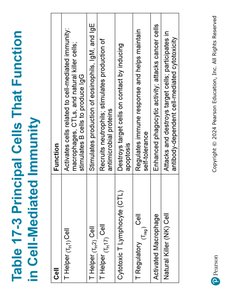
The following table summarizes the principal cells involved in cell-mediated immunity and their functions:
Cell | Function |
|---|---|
Helper T (TH1) Cell | Activates cells related to cell-mediated immunity: macrophages, CTLs, and natural killer cells |
Helper T (TH2) Cell | Stimulates production of eosinophils, IgM, and IgE |
Helper T (TH17) Cell | Recruits neutrophils; stimulates production of antimicrobial proteins |
Cytotoxic T lymphocyte (CTL) | Destroys target cells on contact by inducing apoptosis |
Regulatory T Cell | Regulates immune response and helps maintain tolerance |
Activated Macrophage | Enhances phagocytic activity; attacks cancer cells |
Natural Killer (NK) Cell | Attacks and destroys target cells; participates in antibody-dependent cell-mediated cytotoxicity |
Immunological Memory
Primary and Secondary Responses
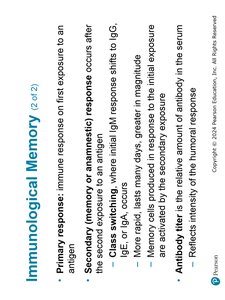
Immunological memory refers to the ability of the immune system to respond more rapidly and effectively to pathogens that have been encountered previously.
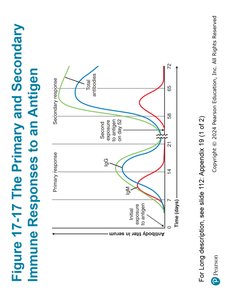
Primary response: Occurs on first exposure to an antigen.
Secondary (memory or anamnestic) response: Occurs after subsequent exposure; more rapid and intense.
Class switching: Initial IgM response shifts to IgG.
Antibody titer: Relative amount of antibody in serum, reflecting response intensity.
Types of Adaptive Immunity
Acquisition of Immunity
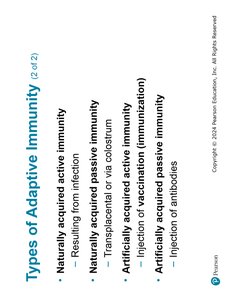
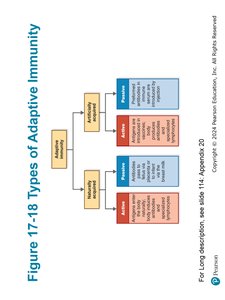
Adaptive immunity can be acquired naturally or artificially, and can be active or passive.
Naturally acquired active immunity: Resulting from infection.
Naturally acquired passive immunity: Transplacental or via colostrum.
Artificially acquired active immunity: Injection of vaccination (immunization).
Artificially acquired passive immunity: Injection of antibodies.
The Dual Nature of the Adaptive Immune System
Cellular and Humoral Immunity
The adaptive immune system consists of two main branches: cellular immunity (mediated by T cells) and humoral immunity (mediated by B cells and antibodies). Both branches work together to eliminate pathogens and provide immunological memory.
Summary Table: Cellular vs. Humoral Immunity
Type | Key Cells | Function |
|---|---|---|
Cellular Immunity | T cells (TH, CTL, Treg), macrophages, NK cells | Direct killing of infected cells, regulation of immune responses |
Humoral Immunity | B cells, plasma cells | Production of antibodies, neutralization of pathogens |
Additional info:
Cell-mediated immunity is crucial for defense against intracellular pathogens, such as viruses and some bacteria.
Humoral immunity is effective against extracellular pathogens and toxins.
