Back
BackCell Structure and Function: Prokaryotes, Archaea, and Eukaryotes
Study Guide - Smart Notes
 Tailored notes based on your materials, expanded with key definitions, examples, and context.
Cell Structure and Function
Introduction
All living organisms are composed of cells, which are the fundamental units of life. Understanding cell structure and function is essential for comprehending microbial life, disease mechanisms, and their treatment. This chapter explores the similarities and differences among the three major types of cells: bacterial, archaeal, and eukaryotic cells.
Processes of Life
Basic Characteristics of Living Cells
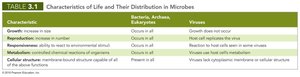
Growth: Ability to increase in size.
Reproduction: Ability to produce more organisms, either asexually or sexually.
Responsiveness: Ability to respond to environmental changes.
Metabolism: Ability to take in nutrients and convert them into energy and cellular components through controlled chemical reactions.
Not all organisms exhibit these processes at all times. Viruses, for example, do not exhibit all characteristics of life.
Characteristic | Bacteria, Archaea, Eukaryotes | Viruses |
|---|---|---|
Growth | Occurs in all | Growth does not occur |
Reproduction | Occurs in all | Host cell replicates the virus |
Responsiveness | Occurs in all | Reaction to host cells seen in some viruses |
Metabolism | Occurs in all | Viruses lack metabolism |
Cellular structure | Present in all | Viruses lack cytoplasmic membrane or cellular structure |
Prokaryotic and Eukaryotic Cells: An Overview
Key Differences
Prokaryotes: Include bacteria and archaea; lack a nucleus and membrane-bound organelles; typically 1.0 µm or smaller; simple structure.
Eukaryotes: Have a nucleus and internal membrane-bound organelles; typically 10–100 µm; complex structure; include algae, protozoa, fungi, animals, and plants.
Bacterial Cells: External Structures
Glycocalyx
The glycocalyx is a gelatinous, sticky substance surrounding the outside of the cell, composed of polysaccharides, polypeptides, or both. It protects cells from desiccation and enhances survival and pathogenicity. There are two types:
Capsule: Organized, firmly attached, may prevent recognition by host immune system.
Slime layer: Loosely attached, water-soluble, aids in surface attachment and biofilm formation.
Flagella
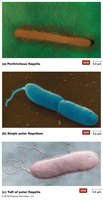
Flagella are long, whip-like structures responsible for bacterial motility. They extend beyond the cell surface and glycocalyx, enabling movement toward favorable environments (positive taxis) or away from harmful stimuli (negative taxis). Not all bacteria possess flagella.
Flagellar rotation can be clockwise or counterclockwise.
Arrangements include monotrichous (single), lophotrichous (tuft), amphitrichous (both ends), and peritrichous (all over).
Fimbriae and Pili
Fimbriae: Short, bristle-like projections for adherence to surfaces and other cells; important in biofilm formation.
Pili: Longer than fimbriae but shorter than flagella; usually one or two per cell; involved in DNA transfer (conjugation).
Bacterial Cells: Cell Walls
Structure and Function
The cell wall provides structure, shape, and protection from osmotic forces. It is primarily composed of peptidoglycan and determines the cell's shape (e.g., cocci, bacilli). There are two main types:
Gram-positive: Thick peptidoglycan layer, teichoic acids, sometimes mycolic acid (acid-fast bacteria), stains purple.
Gram-negative: Thin peptidoglycan layer, outer membrane with lipopolysaccharide (LPS), lipid A (endotoxin), stains pink.
Some bacteria lack cell walls and are often mistaken for viruses due to their small size.
Bacterial Cells: Cytoplasmic Membranes
Structure
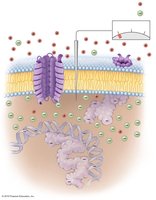
The cytoplasmic membrane is a phospholipid bilayer with hydrophilic heads and hydrophobic tails. It contains integral and peripheral proteins and is selectively permeable, controlling the passage of substances in and out of the cell.
Functions
Maintains concentration and electrical gradients.
Controls nutrient and waste transport.
Involved in energy storage and, in photosynthetic bacteria, light energy harvesting.
Transport Processes
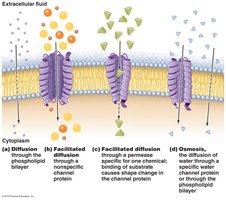
Passive Transport: Does not require energy. Includes diffusion, facilitated diffusion, and osmosis.
Active Transport: Requires ATP to move substances against their gradient. Includes group translocation (substance is chemically modified during transport).
Transport Process | Description | Examples of Transported Substances |
|---|---|---|
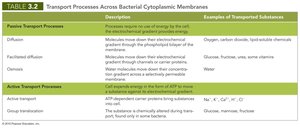
Diffusion | Molecules move down their electrochemical gradient through the phospholipid bilayer | Oxygen, carbon dioxide, lipid-soluble chemicals |
Facilitated diffusion | Molecules move down their electrochemical gradient through channels or carrier proteins | Glucose, fructose, urea, some vitamins |
Osmosis | Water molecules move down their concentration gradient across a selectively permeable membrane | Water |
Active transport | ATP-dependent carrier proteins bring substances into cell | Na+, K+, Ca2+, H+, Cl- |
Group translocation | Substance is chemically altered during transport; found only in some bacteria | Glucose, mannose, fructose |
Bacterial Cells: Cytoplasm
Components
Cytosol: Liquid portion containing water, ions, and the cell's circular DNA (nucleoid region).
Inclusions: Deposits of reserve chemicals.
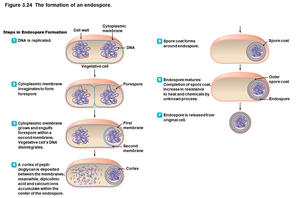
Endospores: Highly resistant, dormant structures formed by some bacteria for survival under adverse conditions.
Nonmembranous Organelles
Ribosomes: Sites of protein synthesis; 70S in prokaryotes (composed of 30S and 50S subunits).
Cytoskeleton: Protein fibers involved in cell shape, division, DNA segregation, and movement.
Archaeal Cells
External Structures
Glycocalyces: Similar to bacteria; function in adherence and biofilm formation.
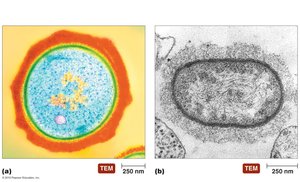
Flagella: Structurally different from bacterial flagella; rotate as a bundle, thinner, and move slower.
Fimbriae and Hami: Fimbriae for attachment; hami are unique, barbed-wire-like structures for secure attachment.
Cell Walls and Cytoplasmic Membranes
Most have cell walls lacking peptidoglycan; composed of specialized polysaccharides and proteins.
All have cytoplasmic membranes maintaining gradients and controlling transport.
Cytoplasm
Similar to bacteria: 70S ribosomes, cytoskeleton, circular DNA.
Differences: Unique ribosomal proteins, metabolic enzymes, and genetic code more similar to eukaryotes.
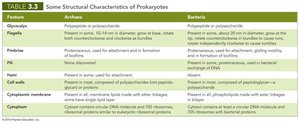
Feature | Archaea | Bacteria |
|---|---|---|
Glycocalyx | Polypeptide or polysaccharide | Polypeptide or polysaccharide |
Flagella | Present in some; thinner, rotate as bundle | Present in some; thicker, rotate independently |
Fimbriae | Present in some | Present in some |
Pili | None discovered | Present in some |
Cell wall | Most; no peptidoglycan | Most; peptidoglycan |
Cytoplasmic membrane | Lipids with ether linkages | Lipids with ester linkages |
Cytoplasm | Circular DNA, 70S ribosomes | Circular DNA, 70S ribosomes |
Eukaryotic Cells
External Structures
Glycocalyces: Present in animal and some protozoan cells; anchor cells, strengthen surfaces, prevent dehydration, and aid in recognition and communication.
Cell Walls: Found in fungi, algae, plants, and some protozoa; composed of cellulose, chitin, glucomannan, or other polysaccharides.
Cytoplasmic Membranes
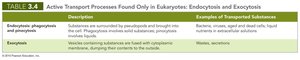
Phospholipid bilayer with proteins; controls movement via passive (diffusion, facilitated diffusion, osmosis) and active (endocytosis, exocytosis) transport.
Motility Structures
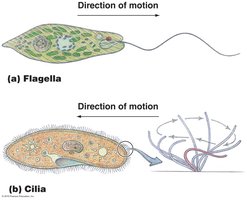
Flagella: Internal, undulate rhythmically, usually at one pole.
Cilia: Shorter, more numerous, coordinated beating for movement or moving substances past the cell.
Nonmembranous Organelles
Ribosomes: 80S (60S + 40S subunits), sites of protein synthesis.
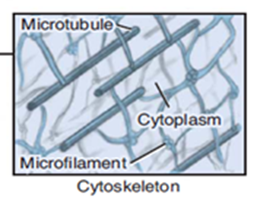
Cytoskeleton: Network of microtubules, microfilaments, and intermediate filaments; provides shape and anchors organelles.
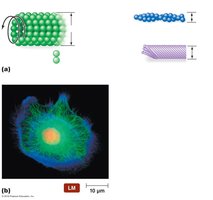
Centrioles and Centrosome
Centrioles are microtubule-based structures found in the centrosome region of animal cells. They play roles in mitosis, cytokinesis, and the formation of flagella and cilia.
Membranous Organelles
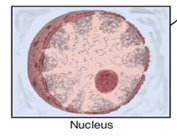
Nucleus: Largest organelle, contains DNA, surrounded by nuclear envelope with pores; nucleolus manages cell activity.
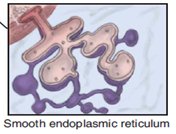
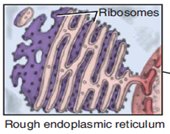
Endoplasmic Reticulum (ER): Network of membranes; rough ER (with ribosomes) synthesizes proteins, smooth ER (no ribosomes) synthesizes lipids and detoxifies chemicals.
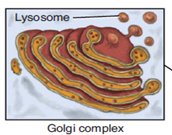
Golgi Body: Processes, packages, and ships molecules; composed of flattened sacs.
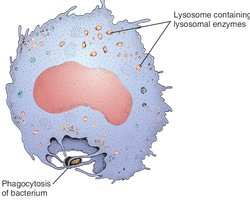
Lysosomes, Peroxisomes, Vacuoles, Vesicles: Lysosomes contain digestive enzymes; peroxisomes degrade toxins; vacuoles and vesicles store and transport substances.
Mitochondria: Double-membraned organelles, produce ATP, contain their own DNA and 70S ribosomes.
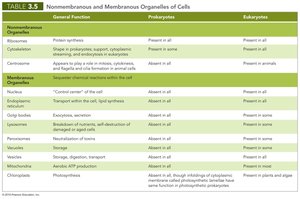
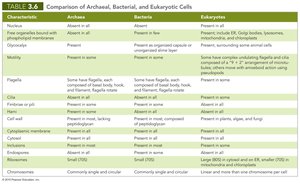
Comparison of Cell Types
Characteristic | Archaea | Bacteria | Eukaryotes |
|---|---|---|---|
Nucleus | Absent | Absent | Present |
Glycocalyx | Present in some | Present in some | Present in some |
Cell wall | Most; no peptidoglycan | Most; peptidoglycan | Present in plants, algae, fungi |
Cytoplasmic membrane | Present; ether linkages | Present; ester linkages | Present; ester linkages |
Ribosomes | 70S | 70S | 80S (70S in mitochondria/chloroplasts) |
Chromosomes | Circular, single | Circular, single | Linear, multiple |