 Back
BackCellular Immunity: T Cells, Antigen Presentation, and Immune Response
Study Guide - Smart Notes
 Tailored notes based on your materials, expanded with key definitions, examples, and context.
Specific Immunity
Overview of Specific Immunity
Specific immunity, also known as adaptive immunity, is a highly specialized defense mechanism that targets particular pathogens or foreign substances. It involves the activation of lymphocytes, primarily B cells and T cells, which recognize and respond to specific antigens. This process is essential for the body's ability to remember and mount stronger responses upon subsequent exposures to the same pathogen.

The Life History and Migrations of B and T Cells
B Lymphocytes (B Cells)
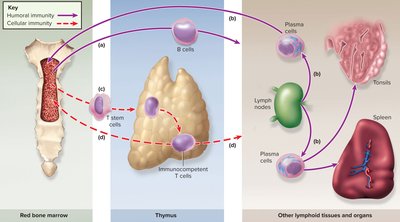
B cells are a type of lymphocyte that develop entirely in the red bone marrow. They undergo selection processes to ensure self-tolerance, eliminating those that react to self-antigens through anergy or clonal deletion. Self-tolerant B cells synthesize antigen surface receptors, divide rapidly, and produce immunocompetent clones. After maturation, B cells leave the bone marrow and colonize lymphoid tissues and organs, such as lymph nodes, spleen, and tonsils.
T Lymphocytes (T Cells)
T cells originate from stem cells in the bone marrow but mature in the thymus. Like B cells, T cells undergo selection to ensure self-tolerance. Immunocompetent T cells then migrate to lymphoid tissues and organs, where they participate in immune responses.
Antigen-Presenting Cells (APCs)
Types and Functions of APCs
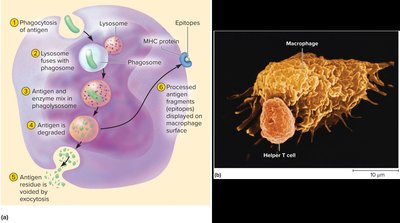
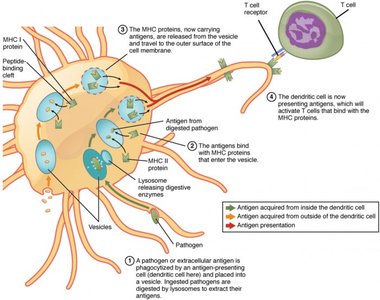
Antigen-presenting cells (APCs) are essential for initiating T cell responses. APCs include dendritic cells, macrophages, and B cells. Their function depends on major histocompatibility complex (MHC) proteins, which act as cell identification tags unique to each individual (except identical twins). APCs display fragments of processed antigens (epitopes) on their surface, allowing T cells to recognize and respond to them.
Antigen Processing and Presentation
APCs encounter antigens, internalize them by endocytosis, and digest them into fragments. These fragments are displayed in the grooves of MHC proteins on the APC surface. T cells only respond to antigens presented by APCs, disregarding self-antigens and initiating immune responses against non-self antigens. Communication between APCs and lymphocytes occurs via cytokines called interleukins.
Cellular Immunity
Types of T Cells and Their Roles
Cellular immunity, also known as cell-mediated immunity, is a form of specific defense in which T lymphocytes directly attack and destroy diseased or foreign cells. There are four main classes of T cells:
Cytotoxic T (TC) cells: Carry out attacks on infected or abnormal cells.
Helper T (TH) cells: Promote activities of other immune cells.
Regulatory T (TR) cells: Limit the immune response to prevent autoimmunity.
Memory T cells: Responsible for immune memory and rapid recall responses.
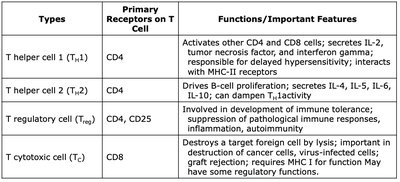
Types | Primary Receptors on T Cell | Functions/Important Features |
|---|---|---|
T helper cell 1 (TH1) | CD4 | Activates other CD4 and CD8 cells; secretes IL-2, tumor necrosis factor, and interferon gamma; responsible for delayed hypersensitivity; interacts with MHC-II receptors |
T helper cell 2 (TH2) | CD4 | Drives B-cell proliferation; secretes IL-4, IL-5, IL-6, IL-10; can dampen TH1 activity |
T regulatory cell (Treg) | CD4, CD25 | Involved in development of immune tolerance; suppression of pathological immune responses, inflammation, autoimmunity |
T cytotoxic cell (TC) | CD8 | Destroys target foreign cells by lysis; important in destruction of cancer cells, virus-infected cells; graft rejection; requires MHC I for function; may have some regulatory functions |
General Stages of Cellular Immune Response
The cellular immune response consists of three main stages:
Recognition: T cells recognize antigens presented by APCs.
Attack: T cells destroy infected or abnormal cells.
Memory: Memory T cells ensure rapid response upon re-exposure to the same antigen.
Recognition: Antigen Presentation and T Cell Activation
Antigen Presentation
APCs process antigens and migrate to lymph nodes to display them to T cells. T cells respond to two classes of MHC proteins:
MHC-1 proteins: Present internal peptides on all nucleated cells; cytotoxic T cells respond to these.
MHC-2 proteins: Present external (phagocytosed, foreign) antigens on APCs; helper T cells respond to these.
This specificity is known as MHC restriction.
T Cell Activation
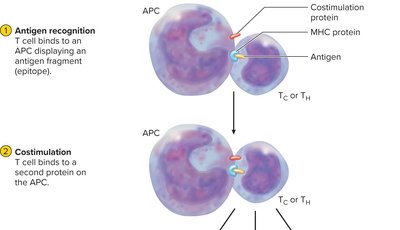
T cell activation begins when a cytotoxic (TC) or helper (TH) cell binds to an MHC protein displaying an epitope. Costimulation is required for full activation, involving additional signaling proteins on the APC surface. This ensures the immune system only responds to genuine threats and prevents autoimmunity. Successful costimulation triggers clonal selection, where activated T cells undergo mitosis to produce clones programmed against the same epitope. Some become effector cells, others become memory T cells.
Attack Phase: Effector Functions of T Cells
Helper T Cells
Helper T cells coordinate both cellular and humoral immunity. Upon recognizing the Ag-MHC complex, they secrete interleukins (ILs) that:
Attract neutrophils and NK cells
Attract and stimulate macrophages
Stimulate T and B cell mitosis and maturation
Cytotoxic T Cells
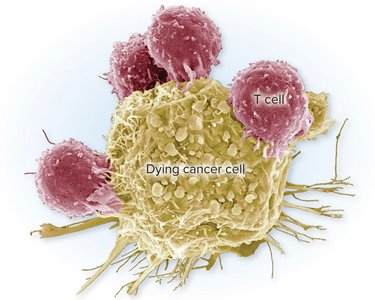
Cytotoxic T cells directly attack infected or abnormal cells. Upon recognizing a complex of antigen and MHC-1 protein, they dock onto the target cell and deliver a lethal hit using chemicals:
Perforin and granzymes: Induce cell death similar to NK cells
Interferons: Inhibit viral replication and recruit macrophages
Tumor necrosis factor (TNF): Activates macrophages and kills cancer cells
Memory: Immune Memory in Cellular Immunity
Memory T Cells
Memory T cells are long-lived and more numerous than naive T cells. They require fewer steps to be activated, enabling a rapid recall response upon re-exposure to the same antigen. This forms the basis of immune memory and is crucial for effective long-term immunity.
T Cells and Superantigens
Superantigens and Their Effects
Superantigens are virulence factors found in certain bacteria and viruses, such as enterotoxins from pathogenic staphylococci, toxins from group A streptococci, and proteins from Epstein-Barr virus. They provoke overwhelming immune responses by activating large numbers of T cells regardless of specificity, leading to massive cytokine release, blood vessel damage, toxic shock, and multiorgan failure.
