 Back
BackCellular Respiration and Photosynthesis: Key Processes in Microbial Metabolism
Study Guide - Smart Notes
 Tailored notes based on your materials, expanded with key definitions, examples, and context.
Cellular Respiration
Overview of Cellular Respiration
Cellular respiration is a fundamental metabolic process by which cells convert biochemical energy from nutrients into adenosine triphosphate (ATP), the energy currency of the cell. This process occurs in both prokaryotic and eukaryotic microorganisms and is essential for growth, maintenance, and survival.
ATP Production: Cellular respiration generates ATP through a series of enzymatic reactions.
Stages: The process consists of glycolysis, the Krebs cycle, and the electron transport chain.
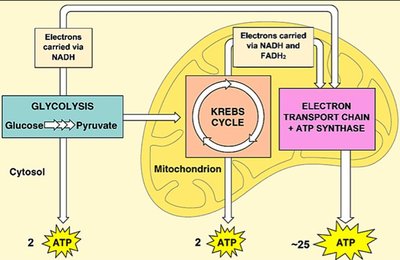
Location: Glycolysis occurs in the cytosol, while the Krebs cycle and electron transport chain occur in the mitochondrion (in eukaryotes).
Glycolysis
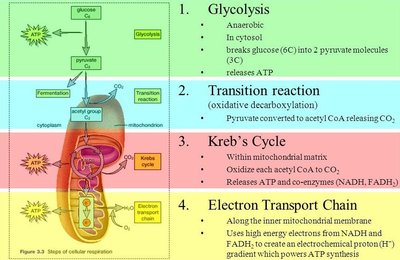
Glycolysis is the first stage of cellular respiration, occurring in the cytosol. It is an anaerobic process that breaks down glucose (6C) into two pyruvate molecules (3C), releasing ATP and NADH.
Key Steps: Glucose is phosphorylated and split into two three-carbon molecules.
ATP Yield: Net gain of 2 ATP molecules per glucose.
Electron Carriers: NADH is produced and carries electrons to later stages.
Transition Reaction (Oxidative Decarboxylation)
The transition reaction converts pyruvate into acetyl-CoA, releasing CO2. This step links glycolysis to the Krebs cycle.
Location: Occurs in the mitochondrial matrix (eukaryotes).
Products: Acetyl-CoA, CO2, and NADH.
Krebs Cycle (Citric Acid Cycle)
The Krebs cycle is a series of reactions that further oxidize acetyl-CoA to CO2, producing ATP, NADH, and FADH2.
Location: Mitochondrial matrix.
ATP Yield: 2 ATP per glucose.
Electron Carriers: NADH and FADH2 are generated for the electron transport chain.
Electron Transport Chain (ETC) and ATP Synthase
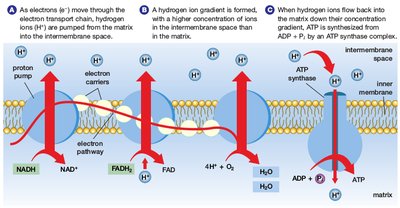
The ETC is located along the inner mitochondrial membrane. It uses electrons from NADH and FADH2 to create a proton (H+) gradient, which powers ATP synthesis.
Process: Electrons are transferred through protein complexes, pumping protons into the intermembrane space.
ATP Yield: Approximately 25 ATP per glucose.
Final Electron Acceptor: Oxygen (O2) combines with electrons and protons to form water.
Summary Table: ATP Yield from Cellular Respiration
Stage | ATP Produced | Main Products |
|---|---|---|
Glycolysis | 2 | Pyruvate, NADH |
Transition Reaction | 0 | Acetyl-CoA, NADH, CO2 |
Krebs Cycle | 2 | NADH, FADH2, CO2 |
Electron Transport Chain | ~25 | ATP, H2O |
Photosynthesis
Overview of Photosynthesis
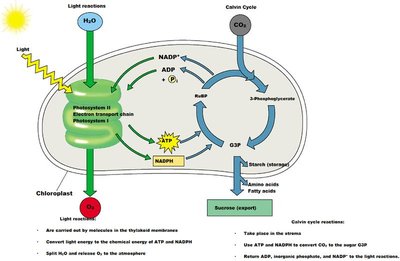
Photosynthesis is the process by which autotrophic organisms, such as algae and cyanobacteria, convert light energy into chemical energy. This process occurs in the chloroplasts and involves two main stages: the light reactions and the Calvin cycle.
Light Reactions: Capture solar energy and convert it to ATP and NADPH.
Calvin Cycle: Uses ATP and NADPH to fix CO2 into organic molecules (e.g., glucose).
Light Reactions
The light reactions occur in the thylakoid membranes of the chloroplast. They use light energy to split water, release oxygen, and produce ATP and NADPH.
Key Steps: Light is absorbed by photosystems, driving electron transport and proton pumping.
Products: ATP, NADPH, O2.
Calvin Cycle
The Calvin cycle takes place in the stroma of the chloroplast. It uses ATP and NADPH to convert CO2 into 3-phosphoglycerate (3PG), which is further processed into glucose and other organic molecules.
Key Steps: Carbon fixation, reduction, and regeneration of ribulose bisphosphate (RuBP).
Products: Glucose, amino acids, fatty acids, starch.
Key Terms and Concepts
ATP (Adenosine Triphosphate): The primary energy carrier in cells.
NADH/FADH2: Electron carriers used in cellular respiration.
NADPH: Electron carrier used in photosynthesis.
Oxidative Phosphorylation: ATP synthesis powered by the electron transport chain.
Carbon Fixation: Incorporation of CO2 into organic molecules during photosynthesis.
Important Equations
Cellular Respiration (Aerobic)
Photosynthesis
Comparison: Cellular Respiration vs. Photosynthesis
Process | Location | Reactants | Products |
|---|---|---|---|
Cellular Respiration | Mitochondria (eukaryotes) | Glucose, O2 | CO2, H2O, ATP |
Photosynthesis | Chloroplasts | CO2, H2O, light | Glucose, O2 |
Additional info: These processes are central to microbial metabolism, providing energy and organic molecules necessary for cellular functions. Understanding their mechanisms is essential for microbiology students studying microbial growth, metabolism, and environmental interactions.
