 Back
BackCellular Respiration: Key Pathways and Processes
Study Guide - Smart Notes
 Tailored notes based on your materials, expanded with key definitions, examples, and context.
Cellular Respiration
Overview of Cellular Respiration
Cellular respiration is a fundamental metabolic process by which cells convert biochemical energy from nutrients into adenosine triphosphate (ATP), releasing waste products. This process is essential for the survival of both prokaryotic and eukaryotic organisms.
Purpose: To generate ATP, the energy currency of the cell, from organic molecules such as glucose.
Main Stages: Glycolysis, Krebs Cycle (Citric Acid Cycle), and Electron Transport Chain (ETC).
Key Molecules: ATP, NADH, FADH2, CO2, H2O
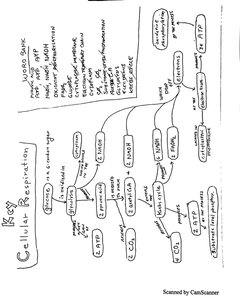
Glycolysis
Pathway and Products
Glycolysis is the first step in cellular respiration, occurring in the cytoplasm. It breaks down one molecule of glucose (6C) into two molecules of pyruvate (3C each).
Location: Cytoplasm
Inputs: Glucose, 2 NAD+, 2 ADP, 2 Pi
Outputs: 2 Pyruvate, 2 NADH, 2 ATP (net gain)
ATP Yield: 2 ATP (net)
Equation:
Krebs Cycle (Citric Acid Cycle)
Pathway and Products
The Krebs cycle occurs in the mitochondrial matrix (or cytoplasm in prokaryotes). It processes pyruvate (converted to Acetyl-CoA) to produce electron carriers and CO2.
Location: Mitochondrial matrix (eukaryotes), cytoplasm (prokaryotes)
Inputs: 2 Acetyl-CoA, 6 NAD+, 2 FAD, 2 ADP, 2 Pi
Outputs: 4 CO2, 6 NADH, 2 FADH2, 2 ATP
ATP Yield: 2 ATP per glucose
Equation:
Electron Transport Chain (ETC) and Chemiosmosis
Pathway and Products
The electron transport chain is the final stage of cellular respiration, located in the inner mitochondrial membrane (or plasma membrane in prokaryotes). Electrons from NADH and FADH2 are transferred through protein complexes, driving the production of ATP via oxidative phosphorylation.
Location: Inner mitochondrial membrane (eukaryotes), plasma membrane (prokaryotes)
Inputs: NADH, FADH2, O2, ADP, Pi
Outputs: H2O, ATP
ATP Yield: About 34 ATP per glucose
Equation:
Summary Table: ATP Yield from Cellular Respiration
Stage | ATP Produced (per glucose) |
|---|---|
Glycolysis | 2 |
Krebs Cycle | 2 |
Electron Transport Chain | ~34 |
Total | ~38 |
Key Electron Carriers
NADH and FADH2
During glycolysis and the Krebs cycle, electrons are transferred to the carriers NAD+ and FAD, forming NADH and FADH2. These molecules donate electrons to the ETC, driving ATP synthesis.
NADH: Nicotinamide adenine dinucleotide (reduced form)
FADH2: Flavin adenine dinucleotide (reduced form)
Fermentation (Anaerobic Respiration)
Alternative Pathway
When oxygen is not available, cells may undergo fermentation to regenerate NAD+ from NADH, allowing glycolysis to continue. Fermentation produces less ATP and results in end products such as lactic acid or ethanol.
ATP Yield: 2 ATP per glucose (from glycolysis only)
End Products: Lactic acid (in animals), ethanol and CO2 (in yeast)
Example: Muscle cells produce lactic acid during intense exercise when oxygen is limited.
Additional info: The maximum theoretical yield of ATP per glucose is about 38 in prokaryotes and 36 in eukaryotes due to differences in mitochondrial transport efficiency.
