 Back
BackChapter 1: A Brief History of Microbiology – Foundations, Classification, and Key Discoveries
Study Guide - Smart Notes
 Tailored notes based on your materials, expanded with key definitions, examples, and context.
Chapter 1: A Brief History of Microbiology
The Early Years of Microbiology
Microbiology began with the invention of the microscope, which allowed scientists to observe organisms too small to be seen with the naked eye. The field was pioneered by early scientists who sought to understand the nature and diversity of microscopic life.
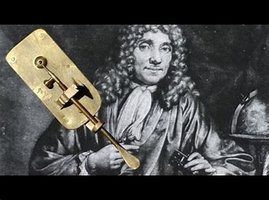
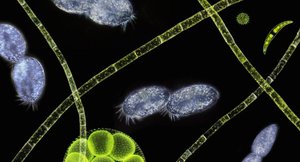
Antoni van Leeuwenhoek: Developed simple microscopes in the late 1600s and was the first to observe and describe microorganisms, which he called “animalcules.” He examined water samples and visualized tiny animals, fungi, algae, protozoa, and possibly bacteria.
Microorganisms: By the end of the 19th century, these organisms were collectively referred to as microorganisms.
Microscopy: Essential for the study of microbiology, enabling visualization of cells and microbes.
Classification of Microbes
Microbes are classified based on their characteristics and evolutionary relationships. The classification system has evolved from simple groupings to complex phylogenetic trees.
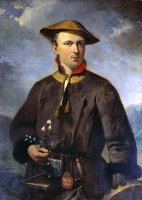
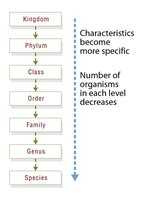
Carolus Linnaeus: Known as the Father of Taxonomy, he developed the hierarchical system of classification (Kingdom, Phylum, Class, Order, Family, Genus, Species).
Binomial Nomenclature: Scientific names consist of a genus (capitalized) and species (lowercase), both italicized or underlined. Example: Streptococcus pyogenes.
Woese-Fox Classification: Modern classification divides life into three domains: Bacteria, Archaea, and Eukarya.
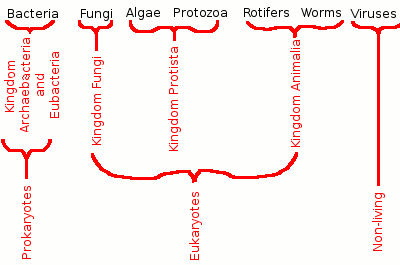
Major Groups of Microorganisms
Microbiology studies a wide range of organisms, each with unique characteristics and roles in nature and disease.
Fungi: Eukaryotic, heterotrophic, possess cell walls. Includes molds and yeasts. Example: Candida albicans causes yeast infections and oral thrush.
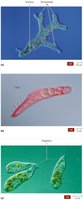
Protozoa: Eukaryotic, heterotrophic, unicellular, most are motile. Example: Giardia lamblia causes severe diarrhea.
Algae: Eukaryotic, autotrophic, can be unicellular or multicellular. Example: Diatoms are common algae found in aquatic environments.
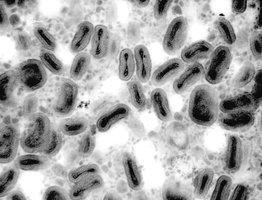
Prokaryotes: Includes Bacteria and Archaea. Unicellular, lack a nucleus. Bacteria are found in diverse environments; Archaea often inhabit extreme conditions.
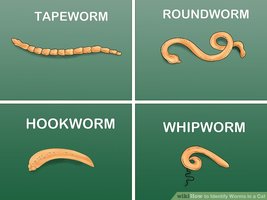
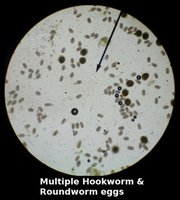
Parasitic Worms: Multicellular, not always microscopic as adults, but eggs and larvae are microscopic. Example: Tapeworms and roundworms.
Viruses: Acellular, non-living, obligate intracellular parasites. Example: Coronaviruses and Ebolavirus.
Microbial Size and Diversity
Microorganisms vary greatly in size, from large protozoa to tiny viruses. Understanding their scale is important for laboratory techniques and disease diagnosis.
Size Range: Protozoa (up to 500 μm), bacteria (~1-2 μm), viruses (as small as 0.03 μm).
Visibility: Most microbes require a microscope for observation; only larger colonies or organisms are visible to the naked eye.
The Golden Age of Microbiology
During the late 1800s, scientists made significant advances in understanding the origins, classification, and control of microorganisms.
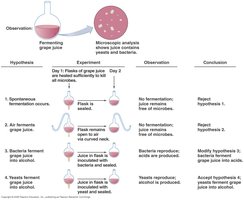
Spontaneous Generation: The belief that life could arise from non-living matter, proposed by Aristotle, was disproven by Louis Pasteur.
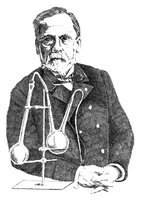
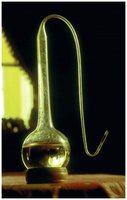
Louis Pasteur: Demonstrated that spontaneous generation does not occur using swan-neck flask experiments. Developed pasteurization and contributed to the germ theory of disease.
Fermentation and Germ Theory
Pasteur’s experiments on fermentation led to the understanding that microbes cause fermentation and disease, forming the basis of industrial microbiology and the germ theory.
Pasteurization: Heating liquids to kill microbes and prevent spoilage.
Germ Theory of Disease: Microorganisms are responsible for causing diseases.
Key Figures and Discoveries
Several scientists contributed to the development of microbiology through their discoveries and innovations.
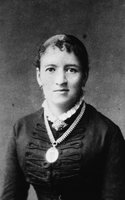
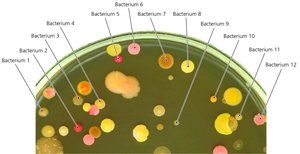
Fanny Hesse: Introduced agar as a solid growth medium for culturing bacteria.
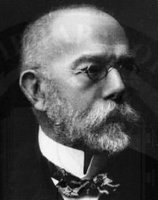
Robert Koch: Developed Koch’s postulates for linking specific microbes to diseases. Studied anthrax, tuberculosis, malaria, and cholera.
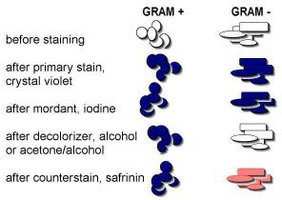
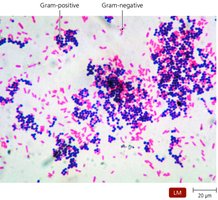
Christian Gram: Developed the Gram stain, a differential staining technique to classify bacteria as Gram-positive or Gram-negative.
Other Notable Scientists
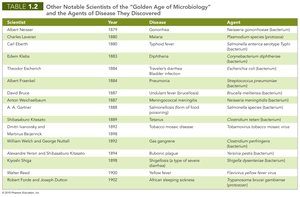
Many scientists during the "Golden Age of Microbiology" discovered causative agents of various diseases, advancing the field significantly.
Table: Notable Scientists and Their Discoveries
Name | Year | Disease | Agent |
|---|---|---|---|
Albert Neisser | 1879 | Gonorrhea | Neisseria gonorrhoeae (Bacterium) |
Charles Laveran | 1880 | Malaria | Plasmodium spp. (Protozoan) |
Carl Eberth | 1880 | Typhoid fever | Salmonella typhi (Bacterium) |
Theodor Escherich | 1885 | Traveler's diarrhea | Escherichia coli (Bacterium) |
Dmitri Ivanovski | 1892 | Tobacco mosaic disease | Tobacco mosaic virus (Virus) |
Paul Ehrlich | 1910 | Syphilis | Treponema pallidum (Bacterium) |
Robert Koch and Joseph Lister | 1905 | Various | Multiple agents |
Additional info: See Table 1.2 for more scientists and discoveries. |
Infection Prevention and Disease Control
Advances in infection prevention and disease control were made by several key figures, leading to modern practices in medicine and public health.
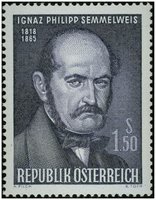
Ignaz Semmelweis: Advocated handwashing to prevent childbed fever.
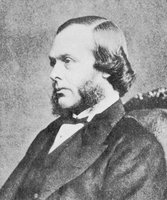
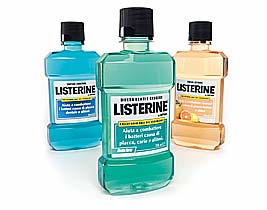
Joseph Lister: Introduced antiseptic techniques in surgery using carbolic acid.
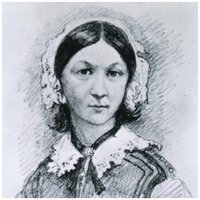
Florence Nightingale: Implemented antiseptic techniques in nursing and reformed hospital policies.
John Snow: Mapped cholera outbreaks, founding the field of epidemiology.
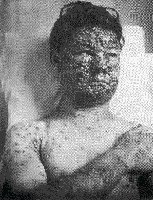
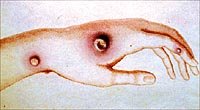
Edward Jenner: Developed the first vaccine for smallpox.
Louis Pasteur: Developed vaccines for cholera, anthrax, and rabies.
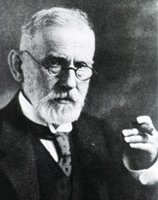
Paul Ehrlich: Developed differential staining and the concept of chemotherapy (“magic bullet” drugs).
Summary
The history of microbiology is marked by the invention of the microscope, the classification of microbes, and the discovery of their roles in disease and fermentation. Key figures such as Leeuwenhoek, Pasteur, Koch, and others laid the foundation for modern microbiology, leading to advances in infection control, taxonomy, and medical treatments.
