 Back
Chapter 1: A Brief History of Microbiology – Foundations, Key Scientists, and the Human Microbiome
Study Guide - Smart Notes
 Tailored notes based on your materials, expanded with key definitions, examples, and context.
Introduction to Microbiology
Definition and Scope
Microbiology is the study of organisms too small to be seen with the naked eye, including bacteria, archaea, fungi, protozoa, algae, viruses, and prions. This field explores the structure, function, classification, and roles of these microorganisms in health, disease, and the environment.
Microorganisms are ubiquitous and play essential roles in ecosystems, industry, and human health.
Microbiology is a subdivision of biology, with the prefix "micro-" indicating small size.
Importance of Microorganisms
Microorganisms are vital to humans, animals, plants, and the environment. They are involved in nutrient cycling, food production, biotechnology, and medicine.
Environmental roles: Decomposition, nitrogen fixation, and bioremediation.
Industrial uses: Production of antibiotics, enzymes, insulin, and other biopharmaceuticals.
Medical significance: Pathogens cause disease, but beneficial microbes aid digestion and immunity.
Agriculture: Pest control, soil fertility, and fermentation in food production.
Key Terms
Prokaryote: Microorganisms without a nucleus (e.g., bacteria, archaea).
Eukaryote: Organisms with a nucleus and membrane-bound organelles (e.g., fungi, protozoa, algae).
Pathogen: A microorganism that causes disease.
Pasteurization: Heat treatment to reduce microbial contamination in food and beverages.
Bioterrorism: The use of microbes or their toxins to intentionally cause harm.
Microbiome: The collection of all microorganisms living in association with a host (e.g., the human body).
Taxonomy: The science of classifying organisms.
Historical Foundations of Microbiology
Early Discoveries and the Golden Age
The development of microbiology as a science began with the invention of the microscope and the discovery of microorganisms.
Antoni van Leeuwenhoek: First to observe and describe microorganisms using simple microscopes in the late 17th century.
Louis Pasteur: Disproved spontaneous generation, developed pasteurization, and provided evidence for the germ theory of disease.
Robert Koch: Established Koch’s Postulates, a framework for linking specific microbes to specific diseases.
Other notable scientists: Ignaz Semmelweis (hand hygiene), Joseph Lister (antiseptics), John Snow (epidemiology), Edward Jenner (vaccination).
Germ Theory of Disease
The germ theory states that specific diseases are caused by specific kinds of microorganisms (pathogens). This concept revolutionized medicine and public health.
Evidence: Pasteur’s experiments with fermentation and spoilage; Koch’s work with anthrax and tuberculosis.
Koch’s Postulates
Koch’s Postulates are four criteria used to establish a causative relationship between a microbe and a disease:
The suspected pathogen must be present in every case of the disease and absent from healthy hosts.
The pathogen must be isolated and grown in pure culture.
The cultured pathogen must cause the disease when introduced into a healthy, susceptible host.
The same pathogen must be re-isolated from the experimentally infected host.
Modern limitations: Some pathogens cannot be cultured in the lab, and ethical considerations prevent testing in humans.
Classification and Characteristics of Microorganisms
Major Groups of Microbes
Bacteria: Unicellular prokaryotes with cell walls made of peptidoglycan; reproduce asexually; found in diverse environments.
Archaea: Unicellular prokaryotes with unique cell wall polymers; often inhabit extreme environments.
Fungi: Eukaryotic; includes molds (multicellular, filamentous) and yeasts (unicellular); obtain nutrients from other organisms.
Protozoa: Single-celled eukaryotes; motile via pseudopods, cilia, or flagella; live in water or as parasites.
Algae: Unicellular or multicellular; photosynthetic; important in aquatic ecosystems.
Helminths: Parasitic worms; multicellular animals studied in microbiology due to their disease-causing potential.
Viruses: Acellular, obligate intracellular parasites; infect all forms of life.
Table: Comparison of Major Microbial Groups
Group | Cell Type | Cell Wall | Reproduction | Habitat |
|---|---|---|---|---|
Bacteria | Prokaryotic | Peptidoglycan | Asexual | Everywhere |
Archaea | Prokaryotic | Unique polymers | Asexual | Extreme environments |
Fungi | Eukaryotic | Chitin | Sexual/Asexual | Soil, decaying matter |
Protozoa | Eukaryotic | None | Sexual/Asexual | Water, hosts |
Algae | Eukaryotic | Cellulose | Sexual/Asexual | Water |
Viruses | Acellular | None | Replication in host | Obligate parasites |
The Human Microbiome
Definition and Importance
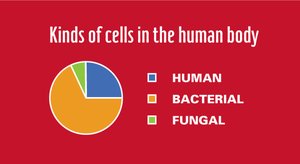
The human microbiome refers to the collective genomes of the microorganisms (bacteria, fungi, viruses, and others) that inhabit the human body. These microbes outnumber human cells and play crucial roles in health and disease.
Functions: Aid in digestion, synthesize vitamins, protect against pathogens, and modulate the immune system.
Variation: The composition of the microbiome varies between individuals and is influenced by genetics, diet, environment, and lifestyle.
Health implications: Disruptions in the microbiome are linked to diseases such as obesity, diabetes, inflammatory bowel disease, and even mental health conditions.
Microbial Cells in the Human Body
Microbial cells, especially bacteria, are abundant in and on the human body, often outnumbering human cells. Fungi are also present but in smaller numbers.
Applications and Future Directions
Forensics: Microbial "fingerprints" may help identify individuals or track disease outbreaks.
Biotechnology: Manipulation of the microbiome for health benefits (e.g., probiotics, fecal transplants).
Research: Ongoing studies explore the microbiome’s role in chronic diseases and overall well-being.
Microbiology in Society
Bioterrorism and Public Health
Microbiology is essential in combating bioterrorism, which involves the deliberate use of pathogens or toxins to cause harm. Understanding microbes enables detection, prevention, and response to biological threats.
Industrial and Environmental Applications
Bioremediation: Use of microbes to clean up environmental pollutants.
Food industry: Fermentation processes for dairy, bread, and beverages.
Medicine: Production of antibiotics, vaccines, and therapeutic proteins using microbes.
Summary Table: Fields of Microbiology
Field | Main Focus |
|---|---|
Environmental Microbiology | Nutrient cycles, bioremediation |
Biochemistry | Microbial metabolism, drug discovery |
Genetics/Biotechnology | Gene cloning, sequencing, biopharmaceuticals |
Immunology | Host response to infection |
Medicine | Human and animal health |
Agriculture/Food Industry | Food production, pest control |
Conclusion
Microbiology is a foundational biological science with profound impacts on health, industry, and the environment. Understanding the diversity, roles, and applications of microorganisms is essential for addressing current and future challenges in medicine, biotechnology, and public health.
