 Back
BackChapter 1: The Microbial World and You – Study Notes
Study Guide - Smart Notes
 Tailored notes based on your materials, expanded with key definitions, examples, and context.
Chapter 1: The Microbial World and You
Microbes in Our Lives
Microorganisms, or microbes, are organisms too small to be seen with the unaided eye. They play essential roles in various biological and ecological processes.
Definition: Microbes include bacteria, fungi, protozoa, microscopic algae, viruses, and prions.
Roles: Some microbes are pathogenic (disease-producing), while others cause food spoilage or serve as the basis of the food chain in aquatic environments.
Ecological Importance: Microbes decompose organic waste, incorporate nitrogen gas into organic compounds, and generate oxygen through photosynthesis.
Roles of Microbes
Microbes are involved in numerous beneficial processes and applications.
Industrial Production: Microbes produce chemical products such as ethanol, acetone, and vitamins.
Food Production: They are used to produce fermented foods like vinegar, cheese, yogurt, alcoholic beverages, and bread.
Manufacturing and Medicine: Microbes produce products used in manufacturing (e.g., cellulose) and disease treatment (e.g., insulin).
Recycling Vital Elements
Microbial ecology studies the relationship between microorganisms and their environment. Microbes are crucial for recycling elements necessary for life.
Element Cycling: Bacteria convert carbon, oxygen, nitrogen, sulfur, and phosphorus into forms usable by plants and animals.
Sewage Treatment: Using Microbes to Recycle Water
Sewage treatment relies on microbes to remove undesirable components and recycle water.
Process: Large solids are removed physically, and microbes convert leftover liquid and organic materials into by-products such as carbon dioxide, nitrates, phosphates, sulfates, ammonia, hydrogen sulfide, and methane.
Bioremediation: Using Microbes to Clean Up Pollutants
Microbes are used to degrade or detoxify pollutants in the environment.
Applications: Bacteria degrade organic matter in sewage and detoxify pollutants such as oil and mercury.
Insect Pest Control by Microorganisms
Microbes offer alternatives to chemical pesticides for controlling insect pests.
Bacillus thuringiensis: This bacterium produces protein crystals toxic to insects but harmless to animals and plants. The toxin gene has been inserted into some plants to confer insect resistance.
Biotechnology and Recombinant DNA Technology
Biotechnology uses microbes for practical applications, including food and chemical production. Recombinant DNA technology enables the production of proteins, vaccines, and enzymes.
Gene Therapy: Missing or defective genes in human cells can be replaced.
Agricultural Applications: Genetically modified bacteria protect crops from insects and freezing.
The First Observations
The discovery of microbes and the development of cell theory marked the beginning of microbiology.
Robert Hooke (1665): Reported that living things are composed of "cells."
Anton van Leeuwenhoek (1673–1723): Observed and documented "animalcules" (bacteria, protozoa) using magnifying lenses.
The Debate over Spontaneous Generation
Historically, scientists debated whether life could arise spontaneously from nonliving matter (spontaneous generation) or only from preexisting life (biogenesis).
Spontaneous Generation: Hypothesis that life arises from nonliving matter; a "vital force" is necessary for life.
Biogenesis: Hypothesis that living cells arise only from preexisting living cells.
Key Experiments:
Francesco Redi (1668): Filled jars with decaying meat to test the origin of maggots.
John Needham (1745): Boiled nutrient broth in covered flasks.
Lazzaro Spallanzani (1765): Boiled nutrient solutions in sealed flasks.
The Theory of Biogenesis
The theory of biogenesis was established through key scientific discoveries.
Rudolf Virchow (1858): Stated that living cells arise from preexisting cells.
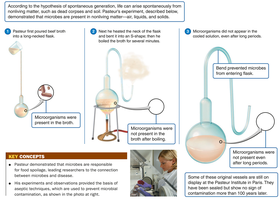
Louis Pasteur (1861): Demonstrated that microorganisms are present in the air and used S-shaped flasks to show that microbes originate from air or fluids, not mystical forces.
The Germ Theory of Disease
The germ theory of disease established that microorganisms cause specific diseases.
Agostino Bassi (1835): Showed that a silkworm disease was caused by a fungus.
Louis Pasteur (1865): Demonstrated that another silkworm disease was caused by a protozoan.
Ignaz Semmelweis (1840s): Advocated handwashing to prevent transmission of puerperal fever.
Joseph Lister (1860s): Used chemical antiseptic (phenol) to prevent surgical wound infections.
Robert Koch (1876): Discovered that a bacterium causes anthrax and developed Koch’s postulates to demonstrate causation of disease by specific microbes.
Vaccination
Vaccination is a method of inducing immunity against diseases.
Edward Jenner (1796): Inoculated a person with cowpox virus, conferring immunity to smallpox.
Immunity: The protection provided by vaccination.
A Fortunate Accident—Antibiotics
Antibiotics are substances produced by microbes that inhibit or kill other microbes.
Alexander Fleming (1928): Discovered penicillin, the first antibiotic, produced by the fungus Penicillium.
Penicillin: Kills Staphylococcus aureus; clinically tested and mass-produced in the 1940s.
Naming and Classifying Microorganisms
Microorganisms are named and classified using a standardized system.
Carolus Linnaeus (1735): Established the system of scientific nomenclature.
Binomial Nomenclature: Each organism has two names: the genus (capitalized) and the specific epithet (species, lowercase). Names are italicized or underlined and "Latinized."
Examples:
Escherichia coli: Honors Theodor Escherich; describes habitat (colon).
Staphylococcus aureus: Describes clustered spherical cells and gold-colored colonies.
Types of Microorganisms
Microorganisms are classified into several major groups based on their cellular structure and function.
Bacteria: Prokaryotes; unicellular; peptidoglycan cell walls; divide by binary fission; nutrition from organic/inorganic chemicals or photosynthesis; motile via flagella.
Archaea: Prokaryotes; lack peptidoglycan cell walls; often live in extreme environments; include methanogens, extreme halophiles, and extreme thermophiles; not known to cause disease in humans.
Fungi: Eukaryotes; chitin cell walls; absorb organic chemicals; yeasts (unicellular), molds and mushrooms (multicellular); molds consist of mycelia composed of hyphae.
Protozoa: Eukaryotes; absorb/ingest organic chemicals; motile via pseudopods, cilia, or flagella; free-living or parasitic; some photosynthetic; reproduce sexually or asexually.
Algae: Eukaryotes; photosynthetic; cellulose cell walls; produce oxygen and organic compounds.
Viruses: Acellular; DNA or RNA core; protein coat, sometimes lipid envelope; replicate only in living host cells; inert outside hosts.
Multicellular Animal Parasites: Eukaryotes; multicellular animals; include helminths (flatworms, roundworms); some microscopic stages.
Classification of Microorganisms
Microorganisms are classified into three domains based on cellular organization, as developed by Carl Woese in 1978.
Bacteria
Archaea
Eukarya: Includes protists, fungi, plants, and animals.
Summary Table: Types of Microorganisms
Type | Cell Type | Cell Wall | Reproduction | Key Features |
|---|---|---|---|---|
Bacteria | Prokaryote | Peptidoglycan | Binary fission | Motile via flagella; diverse nutrition |
Archaea | Prokaryote | None or pseudopeptidoglycan | Binary fission | Extreme environments; not pathogenic |
Fungi | Eukaryote | Chitin | Sexual/asexual | Absorb nutrients; multicellular or unicellular |
Protozoa | Eukaryote | None | Sexual/asexual | Motile; free-living or parasitic |
Algae | Eukaryote | Cellulose | Sexual/asexual | Photosynthetic; aquatic |
Viruses | Acellular | None | Host-dependent | DNA/RNA core; protein coat |
Helminths | Eukaryote | None | Complex life cycle | Multicellular; parasitic |
Additional info: The above notes expand on brief points with academic context, definitions, and examples to provide a comprehensive overview suitable for exam preparation.
