 Back
BackChapter 1 - The Microbial World and You
Study Guide - Smart Notes
 Tailored notes based on your materials, expanded with key definitions, examples, and context.
The Microbial World and You
Introduction to Microbiology
Microbiology is the study of microorganisms, which are organisms too small to be seen with the unaided eye. This field explores the diversity, structure, function, and impact of microbes on humans, other organisms, and the environment.
Microbes in Our Lives
Microbiome: The collection of microbes that live stably in and on the human body, playing essential roles in health and disease prevention.
Normal Microbiota: Microorganisms that permanently colonize the host without causing disease under normal conditions.
Transient Microbiota: Microbes that are present temporarily (days, weeks, or months).
Microorganisms: Include bacteria, fungi, protozoa, microscopic algae, and viruses.
Most microbes are beneficial, contributing to environmental balance, food chains, decomposition, oxygen production, and commercial applications (e.g., fermentation, biotechnology).
Knowledge of microbes helps prevent disease, food spoilage, and epidemics.
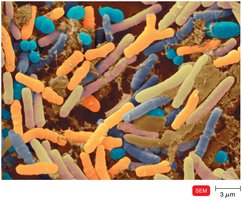
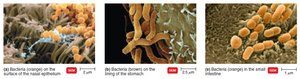
The Human Microbiome
The human body contains about 30 trillion body cells and harbors about 40 trillion bacterial cells.
The Human Microbiome Project studies the relationship between microbial communities and human health.
Normal microbiota are acquired at birth and can be permanent or transient.
Distribution and composition are influenced by nutrients, physical and chemical factors, host defenses, and mechanical factors.
Normal microbiota compete with pathogens (microbial antagonism), produce substances harmful to pathogens, and alter environmental conditions to inhibit pathogen survival.
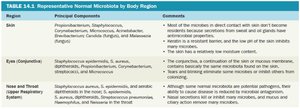
Representative Normal Microbiota by Body Region
The following tables summarize the principal components and comments for normal microbiota in various body regions:
Region | Principal Components | Comments |
|---|---|---|
Skin | Propionibacterium, Staphylococcus, Corynebacterium, Micrococcus, Acinetobacter, Brevibacterium, Candida (yeast), and Malassezia (fungus) | Most microbes in direct contact with skin don’t become residents; resistant to drying and high salt; sweat and oil glands have antimicrobial properties. |
Eyes (conjunctiva) | Staphylococcus epidermidis, S. aureus, Corynebacterium, Micrococcus, and Streptococcus, and Neisseria | Continuation of skin and mucous membrane; tears and blinking eliminate some microbes. |
Nose and Throat (upper respiratory system) | Staphylococcus, S. epidermidis, and S. aureus, Corynebacterium, and Neisseria in the throat | May include potential pathogens; mucous and ciliary action remove many microbes. |
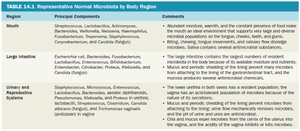
Region | Principal Components | Comments |
|---|---|---|
Mouth | Streptococcus, Lactobacillus, Actinomyces, Bacteroides, Neisseria, Haemophilus, and Candida (yeast) | Moist, warm, and nutrient-rich; supports large microbial populations. |
Large Intestine | Escherichia, Bacteroides, Fusobacterium, Enterococcus, Klebsiella, Proteus, Lactobacillus, Clostridium, and Candida (yeast) | Largest microbial population; anaerobic environment; mucus and periodic shedding prevent overgrowth. |
Urinary and Reproductive Systems | Staphylococcus, Micrococcus, Enterococcus, Lactobacillus, and some Gram-negative bacteria; Candida (yeast) | Lower urethra and vagina have resident populations; urine flow and vaginal secretions remove microbes. |
Naming and Classifying Microorganisms
Scientific Nomenclature: Established by Carolus Linnaeus in 1735; each organism has a genus (capitalized) and a specific epithet (lowercase), both italicized or underlined (e.g., Escherichia coli).
Names may honor scientists, describe features, or indicate habitat.
After first use, names may be abbreviated (e.g., E. coli).
Types of Microorganisms
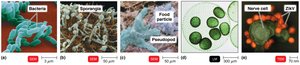
Bacteria: Prokaryotes, unicellular, peptidoglycan cell walls, divide by binary fission, various shapes (bacillus, coccus, spiral), may have flagella.
Archaea: Prokaryotes, lack peptidoglycan, often live in extreme environments (methanogens, extreme halophiles, extreme thermophiles), not known to cause disease in humans.
Fungi: Eukaryotes, chitin cell walls, unicellular (yeasts) or multicellular (molds, mushrooms), absorb organic chemicals, reproduce sexually or asexually.
Protozoa: Unicellular eukaryotes, absorb or ingest organic chemicals, may be motile (pseudopods, cilia, flagella), free-living or parasitic, some photosynthetic.
Algae: Photosynthetic eukaryotes, cellulose cell walls, found in water and soil, produce oxygen and carbohydrates.
Viruses: Acellular, consist of DNA or RNA core surrounded by protein coat (sometimes lipid envelope), replicate only in living host cells, inert outside hosts.
Multicellular Animal Parasites: Eukaryotes, multicellular animals (helminths: flatworms and roundworms), some stages are microscopic.
Classification of Microorganisms
Developed by Carl Woese in 1978, based on cellular organization:
Bacteria: Peptidoglycan cell walls
Archaea: Cell walls lack peptidoglycan
Eukarya: Includes protists, fungi, plants, and animals
Historical Foundations of Microbiology
Robert Hooke (1665): First observed cells, beginning cell theory (all living things are composed of cells).
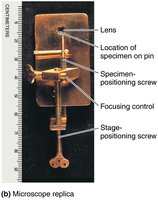
Anton van Leeuwenhoek (1623–1673): First observed microorganisms (“animalcules”) using magnifying lenses.
The Debate over Spontaneous Generation
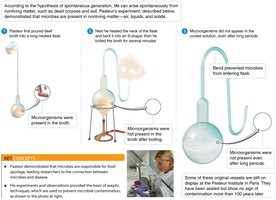
Spontaneous Generation: Hypothesis that life arises from nonliving matter.
Biogenesis: Hypothesis that living cells arise only from preexisting living cells.
Key experiments:
Francesco Redi (1668): Disproved spontaneous generation for larger organisms.
John Needham (1745) and Lazzaro Spallanzani (1765): Contradictory results on broth experiments.
Rudolf Virchow (1858): Proposed biogenesis.
Louis Pasteur (1861): Definitively disproved spontaneous generation using S-shaped flasks.
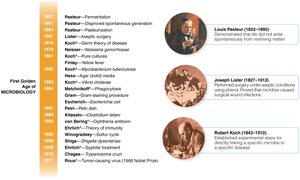
The Golden Age of Microbiology (1857–1914)
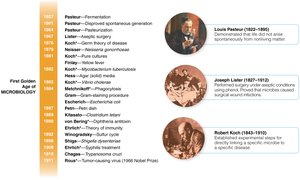
Major discoveries included the relationship between microbes and disease, immunity, and antimicrobial drugs.
Pasteur: Demonstrated fermentation, pasteurization, and the role of microbes in spoilage.
Germ Theory of Disease: Microorganisms cause disease.
Joseph Lister: Used phenol as an antiseptic in surgery.
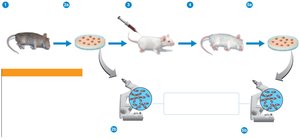
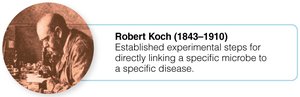
Robert Koch: Developed Koch’s postulates to link specific microbes to specific diseases (e.g., anthrax).
Vaccination and Chemotherapy
Edward Jenner (1796): Developed the first vaccine (cowpox for smallpox).
Immunity: Protection from disease provided by vaccination or previous infection.
Chemotherapy: Treatment of disease with chemicals (synthetic drugs or antibiotics).
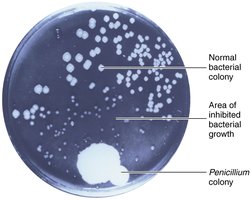
Antibiotics: Chemicals produced by microbes that inhibit or kill other microbes (e.g., penicillin discovered by Alexander Fleming in 1928).
Branches of Microbiology
Bacteriology: Study of bacteria
Mycology: Study of fungi
Parasitology: Study of protozoa and parasitic worms
Immunology: Study of immunity
Virology: Study of viruses
Molecular Genetics: Study of microbial inheritance and gene function
Microbial Ecology and Biotechnology
Microbial Ecology: Study of the relationship between microbes and their environment; microbes recycle vital elements (carbon, nitrogen, sulfur, phosphorus).
Biotechnology: Use of microbes for practical applications (e.g., food production, gene therapy, genetically modified organisms).
Recombinant DNA Technology: Combining DNA from different sources to produce proteins, vaccines, and enzymes.
Normal Microbiota and Biofilms
Normal microbiota prevent pathogen growth and produce essential growth factors (e.g., vitamins B and K).
Resistance: The body’s ability to ward off disease, involving skin, stomach acid, and antimicrobial chemicals.
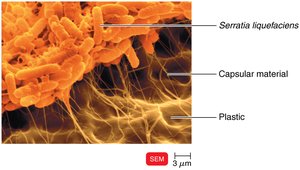
Biofilms: Microbes attached to surfaces, forming masses that can cause infections and resist antibiotics.
Emerging Infectious Diseases (EIDs)
Emerging Infectious Diseases: New or increasing diseases (e.g., Zika virus, MERS, H1N1 influenza, avian influenza, Ebola, MRSA).
Factors include microbial evolution, environmental changes, and increased human contact.
Summary Table: Key Terms and Concepts
Term | Definition |
|---|---|
Microbiome | Stable community of microbes in/on the human body |
Normal Microbiota | Permanent, non-disease-causing microbes |
Transient Microbiota | Temporary microbes |
Pathogen | Disease-causing microbe |
Biofilm | Microbial community attached to a surface |
Antibiotic | Microbe-produced chemical that inhibits/kills other microbes |
Immunity | Protection from disease |
