 Back
BackChapter 1: The Microbial World and You – Study Notes
Study Guide - Smart Notes
 Tailored notes based on your materials, expanded with key definitions, examples, and context.
The Microbial World and You
Introduction to Microbiology
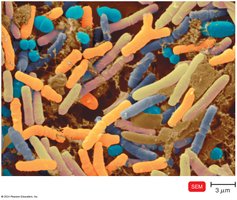
Microbiology is the study of microorganisms, which are organisms too small to be seen with the unaided eye. This field encompasses a diverse group of organisms, including bacteria, archaea, fungi, protozoa, algae, viruses, and prions. Microorganisms play essential roles in the environment, industry, and human health.
Microbes in Our Lives
Microorganisms are found everywhere and have profound effects on our lives.
They can be beneficial (e.g., decomposing waste, producing oxygen, and manufacturing products) or harmful (e.g., causing disease or food spoilage).
Microbes are the basis of the food chain in aquatic environments and are crucial for nutrient cycling.
They are used in the production of fermented foods (e.g., cheese, yogurt, bread) and industrial products (e.g., ethanol, acetone, insulin).
The Microbiome
The microbiome refers to the community of microorganisms that live on and inside the human body. These microbes help maintain health by preventing the growth of pathogens and training the immune system.
Normal microbiota: Microbes that are permanently or temporarily present in a healthy human.
Transient microbiota: Microbes that colonize the body for a short period.
Colonization depends on the availability of nutrients and suitable environmental conditions.
Scientific Nomenclature and Classification
Microorganisms are named using a binomial system established by Carolus Linnaeus, consisting of a genus and a specific epithet (species name). Names are italicized or underlined, with the genus capitalized and the species lowercase (e.g., Escherichia coli).
Scientific names may honor a scientist or describe an organism's characteristics or habitat.
Types of Microorganisms
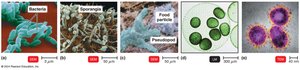
Bacteria: Prokaryotic, unicellular, peptidoglycan cell walls, reproduce by binary fission, may be motile via flagella.
Archaea: Prokaryotic, lack peptidoglycan, often live in extreme environments, not known to cause disease in humans.
Fungi: Eukaryotic, chitin cell walls, absorb organic chemicals, include unicellular yeasts and multicellular molds/mushrooms.
Protozoa: Eukaryotic, absorb or ingest organic chemicals, may be motile, reproduce sexually or asexually.
Algae: Eukaryotic, cellulose cell walls, photosynthetic, produce oxygen and carbohydrates.
Viruses: Acellular, DNA or RNA core, protein coat, replicate only in living host cells.
Multicellular Animal Parasites: Eukaryotic, include helminths (parasitic worms), some stages are microscopic.
Classification of Microorganisms
Carl Woese developed a three-domain system based on cellular organization:
Bacteria
Archaea
Eukarya (includes protists, fungi, plants, animals)
The taxonomic hierarchy is: Domain > Kingdom > Phylum > Class > Order > Family > Genus > Species.
A Brief History of Microbiology
Early Observations and Cell Theory
1665: Robert Hooke observed "cells" in cork, marking the beginning of cell theory (all living things are composed of cells).
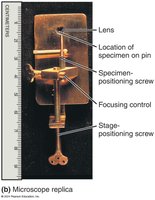
1673–1723: Anton van Leeuwenhoek observed the first living microorganisms ("animalcules") using magnifying lenses.
Spontaneous Generation vs. Biogenesis
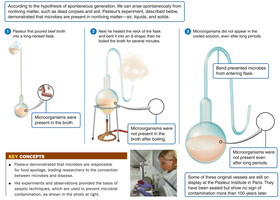
Spontaneous generation: Hypothesis that life arises from nonliving matter.
Biogenesis: Hypothesis that living cells arise only from preexisting living cells (Rudolf Virchow, 1858).
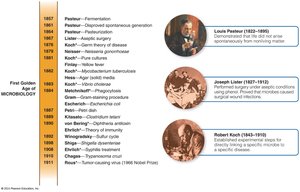
Louis Pasteur (1861) disproved spontaneous generation by demonstrating that microorganisms are present in the air and do not arise spontaneously in sterilized broth.
The First Golden Age of Microbiology (1857–1914)
Discovery of the relationship between microbes and disease.
Development of vaccines, aseptic techniques, and chemotherapeutic drugs.
Fermentation: Microbial conversion of sugar to alcohol in the absence of air.
Pasteurization: Application of high heat for a short time to kill harmful microbes in beverages.
Germ theory of disease: Microorganisms can cause disease (Joseph Lister, Robert Koch).
Koch's postulates: Experimental steps to prove a specific microbe causes a specific disease.
Vaccination and Chemotherapy
1796: Edward Jenner developed the first vaccine (cowpox for smallpox).
Chemotherapy: Treatment of disease with chemicals (synthetic drugs or antibiotics).
1928: Alexander Fleming discovered penicillin, the first antibiotic.
Development of antimicrobial resistance is a modern challenge.
Modern Fields in Microbiology
Bacteriology: Study of bacteria.
Mycology: Study of fungi.
Parasitology: Study of protozoa and parasitic worms.
Immunology: Study of immunity; includes vaccines and interferons.
Virology: Study of viruses.
Microbial genetics: Study of inheritance in microbes.
Molecular biology: Study of how genetic information is carried in DNA.
Genomics: Study of an organism’s genes; enables study of microbiomes and recombinant DNA technology.

Microbes and Human Welfare
Beneficial Activities of Microorganisms
Recycle vital elements (carbon, nitrogen, sulfur, phosphorus) for use by plants and animals.
Used in sewage treatment to recycle water and remove contaminants.
Bioremediation: Use of microbes to degrade or detoxify pollutants (e.g., oil spills, mercury).
Insect pest control: Microbes such as Bacillus thuringiensis are used as biological pesticides.
Biotechnology: Use of microbes for practical applications (e.g., producing foods, chemicals, recombinant DNA technology).

Normal Microbiota, Biofilms, and Emerging Infectious Diseases
Normal microbiota: Microbes normally present in and on the human body; prevent growth of pathogens and produce essential vitamins.
Resistance: The body's ability to ward off disease, involving skin, stomach acid, and immune chemicals.
Biofilms: Complex microbial communities attached to surfaces; can be beneficial (protect mucous membranes) or harmful (cause infections, resist antibiotics).
Emerging infectious diseases (EIDs): New or increasing diseases, often due to microbial evolution, resistance, or changes in human behavior and environment (e.g., COVID-19, Ebola, Zika, MRSA).
Summary Table: Major Groups of Microorganisms
Group | Cell Type | Cell Wall | Reproduction | Example |
|---|---|---|---|---|
Bacteria | Prokaryotic | Peptidoglycan | Binary fission | Escherichia coli |
Archaea | Prokaryotic | Varies (no peptidoglycan) | Binary fission | Methanogens |
Fungi | Eukaryotic | Chitin | Sexual/asexual spores | Yeasts, molds |
Protozoa | Eukaryotic | None | Sexual/asexual | Amoeba |
Algae | Eukaryotic | Cellulose | Sexual/asexual | Green algae |
Viruses | Acellular | Protein coat (capsid) | Host-dependent | Influenza virus |
Helminths | Eukaryotic | None | Complex life cycles | Tapeworms |
Additional info: This summary integrates foundational concepts from Chapter 1, providing a comprehensive overview suitable for exam preparation in an introductory microbiology course.
