 Back
Chapter 1: The Microbial World and You - Study Notes
Study Guide - Smart Notes
 Tailored notes based on your materials, expanded with key definitions, examples, and context.
Introduction to Microbiology
Overview of Microorganisms
Microbiology is the study of microscopic organisms, including bacteria, fungi, protozoa, algae, viruses, and multicellular parasites. These organisms play essential roles in the environment, industry, and human health.
Microbes decompose organic matter, recycle nutrients, and produce oxygen through photosynthesis.
They are used in industrial processes (e.g., production of ethyl alcohol, acetone), food fermentation (e.g., vinegar, cheese, bread), and manufacturing.
Most microbes are not harmful; many are beneficial to humans and ecosystems.
Scientific Nomenclature
The system of scientific nomenclature assigns each organism a two-part name: genus and species.
Genus: Always capitalized.
Species: Not capitalized.
Names are italicized or underlined (e.g., Escherichia coli).
Established by Carolus Linnaeus in 1735.
Classifying Microorganisms
The Three Domains
Organisms are classified into three domains based on cell type and characteristics:
Domain | Cell Type | Cell Wall | Antibiotic Sensitivity |
|---|---|---|---|
Archaea | Prokaryote | Varies; no peptidoglycan | No |
Bacteria | Prokaryote | Contains peptidoglycan | Yes |
Eukarya | Eukaryote | Varies; contains carbohydrates | No |
The Five Kingdoms
Prokaryotes
Fungi
Protists (Protozoa)
Plants
Animals
Types of Microorganisms
Bacteria: Unicellular prokaryotes; shapes include cocci, bacilli, and spiral; reproduce by binary fission; cell wall contains peptidoglycan.
Archaea: Unicellular prokaryotes; cell wall lacks peptidoglycan; live in extreme environments; not sensitive to antibiotics.
Fungi: Eukaryotes; unicellular (yeast) or multicellular (molds); cell wall contains chitin; molds reproduce by spores, yeast by budding.
Protozoa: Unicellular eukaryotes; classified by movement (flagella, cilia, pseudopodia); reproduce sexually or asexually.
Algae: Unicellular or multicellular photosynthetic eukaryotes; cell wall contains cellulose; produce oxygen.
Viruses: Acellular; obligate intracellular parasites; nucleic acid core (DNA or RNA) surrounded by protein coat.
Multicellular Animal Parasites: Eukaryotes; helminths (flatworms, roundworms); microscopic stages in life cycle.
History of Microbiology
Early Observations
Robert Hooke: Developed Cell Theory – all living things are composed of cells.
Antoni van Leeuwenhoek: First observed microorganisms using a simple magnifying lens.
Rudolf Virchow: Proposed Biogenesis – living things arise only from pre-existing cells.
Disproving Spontaneous Generation
The theory of spontaneous generation suggested that life could arise from nonliving matter. This was disproved by several key experiments.
Francesco Redi: Showed that maggots do not spontaneously arise from meat.
John Needham: Claimed microbes could arise from heated broth.
Lazzaro Spallanzani: Demonstrated that boiling broth prevented microbial growth.
Louis Pasteur: Used S-shaped flasks to show that microbes are present in the air and do not arise spontaneously in sterilized broth.
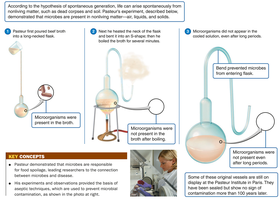
Pasteur's Experiment
Broth boiled in a flask with a long, curved neck did not spoil because airborne microbes were trapped in the bend.
When the neck was removed, microbes entered and broth spoiled.
Proved that microorganisms come from other microorganisms, not from nonliving matter.
Golden Age of Microbiology
Major Discoveries
Fermentation: Microbes convert sugars to alcohol in the absence of air.
Pasteurization: Heating liquids to kill harmful microbes without affecting quality.
Germ Theory of Disease: Specific microbes cause specific diseases.
Joseph Lister: Applied disinfectant to surgical dressings, reducing infections.
Ignaz Semmelweis: Promoted handwashing to prevent puerperal fever.
Robert Koch: Demonstrated that bacteria cause anthrax; developed Koch’s Postulates.
Edward Jenner: Developed the first vaccine (smallpox).
Paul Ehrlich: Developed chemotherapy for infectious diseases.
Alexander Fleming: Discovered penicillin, the first antibiotic.
Koch’s Postulates
The pathogen must be present in every case of the disease.
The pathogen must be isolated and grown in pure culture.
The cultured pathogen must cause disease in a healthy host.
The pathogen must be re-isolated from the experimentally infected host.
Modern Developments in Microbiology
Fields of Study
Bacteriology: Study of bacteria.
Mycology: Study of fungi.
Parasitology: Study of parasites.
Immunology: Study of immune system.
Virology: Study of viruses.
Microbial Ecology: Study of microbes in the environment.
Recombinant DNA Technology: Manipulation of genetic material for research and biotechnology.
Microbes and Human Welfare
Environmental and Industrial Roles
Recycling Vital Elements: Microbes participate in nitrogen, carbon, and oxygen cycles; sewage treatment.
Bioremediation: Use of microbes to clean up pollutants (e.g., oil spills).
Biological Insecticides: Microbes used to control pests.
Biotechnology and Genetic Engineering: Production of drugs, hormones, and genetically modified organisms.
Microbes and Human Disease
Normal Microbiota and Pathogens
Normal Microbiota: Microbes present in and on the human body; usually beneficial.
Biofilms: Communities of microbes attached to surfaces; can protect mucous membranes or cause harm (e.g., dental plaque, catheter infections).
Biofilms are resistant to antibiotics and immune responses.
Pathogens: Disease-causing organisms.
Opportunistic Pathogens: Normally harmless but can cause disease in susceptible hosts.
Resistance: The ability of the body to ward off disease.
Key Definitions
Bacteria: Unicellular prokaryotes with peptidoglycan cell walls.
Fungi: Eukaryotes with chitin cell walls; includes yeasts and molds.
Algae: Photosynthetic eukaryotes with cellulose cell walls.
Protozoa: Unicellular eukaryotes classified by movement.
Helminths: Multicellular animal parasites.
Viruses: Acellular, obligate intracellular parasites.
Biofilm: A complex aggregation of microbes attached to a surface.
Summary Table: Microorganism Groups
Group | Cell Type | Cell Wall | Reproduction | Nutrition |
|---|---|---|---|---|
Bacteria | Prokaryote | Peptidoglycan | Binary fission | Diverse |
Archaea | Prokaryote | No peptidoglycan | Binary fission | Extreme environments |
Fungi | Eukaryote | Chitin | Budding/spores | Absorption |
Protozoa | Eukaryote | No cell wall | Asexual/sexual | Ingestion |
Algae | Eukaryote | Cellulose | Asexual/sexual | Photosynthesis |
Viruses | Acellular | Protein coat | Host-dependent | Host-dependent |
Helminths | Eukaryote | No cell wall | Complex life cycle | Varied |
