 Back
BackChapter 13: Viruses, Viroids, and Prions - Structured Study Notes
Study Guide - Smart Notes
 Tailored notes based on your materials, expanded with key definitions, examples, and context.
Chapter 13: Viruses, Viroids, and Prions
Viruses: General Characteristics
Viruses are acellular infectious agents that require a host cell for replication. They are distinct from living cells and possess unique structural and functional properties.
NOT a Cell: Viruses lack cellular structure and metabolic machinery. They do not carry out cellular processes independently.
Obligate Intracellular Parasites: Viruses must infect a host cell to reproduce, relying on the host's metabolic systems.
Structure: Viruses consist of genetic material (DNA or RNA) surrounded by a protein coat called a capsid. Some viruses have an additional lipid envelope derived from the host cell membrane.
Size: Viruses are much smaller than prokaryotic and eukaryotic cells, typically measured in nanometers.
Host Specificity: Viruses are highly specific to their host species and cell types, determined by the presence of specific receptor molecules.
Example: Influenza virus infects respiratory epithelial cells in humans.
Viral Structure
Viruses display a variety of shapes and structural features, which influence their mode of infection and replication.
Capsid: The protein shell that encases the viral genome. Capsids are composed of subunits called capsomeres.
Envelope: Some viruses possess a lipid envelope surrounding the capsid, acquired from the host cell during viral release.
Genome: Viral genomes may be DNA or RNA, single-stranded or double-stranded, linear or circular.
Shapes: Viruses can be helical, polyhedral (icosahedral), or complex in structure.
Example: Bacteriophage T4 has a complex structure with a head, tail, and tail fibers.
Viral Life Cycle
The viral life cycle involves several distinct stages, each critical for successful infection and replication within the host cell.
Attachment: Virus binds to specific receptors on the host cell surface.
Entry: Viral genome enters the host cell, either by fusion with the membrane or endocytosis.
Replication: Viral genome is replicated using host cell machinery. DNA viruses typically replicate in the nucleus, while RNA viruses often replicate in the cytoplasm.
Synthesis: Viral proteins and nucleic acids are synthesized.
Assembly: New viral particles are assembled from synthesized components.
Release: Viruses exit the host cell, often destroying it in the process (lysis) or budding off (in enveloped viruses).
Example: HIV enters T cells via CD4 receptors, replicates its RNA genome, and buds from the cell membrane.
Viroids and Prions
Viroids and prions are infectious agents distinct from viruses, lacking traditional viral structures.
Viroids: Small, circular RNA molecules that infect plants. They do not encode proteins and cause disease by interfering with host gene expression.
Prions: Infectious proteins that cause neurodegenerative diseases in animals and humans. Prions induce abnormal folding of normal cellular proteins, leading to cell damage.
Example: Prion diseases include Creutzfeldt-Jakob disease in humans and mad cow disease in cattle.
Table: Comparison of Viruses, Viroids, and Prions
Agent | Genetic Material | Structure | Host | Diseases |
|---|---|---|---|---|
Virus | DNA or RNA | Capsid, sometimes envelope | Animals, plants, bacteria | Influenza, HIV, rabies |
Viroid | RNA | No capsid or envelope | Plants | Potato spindle tuber disease |
Prion | None | Protein only | Animals | Mad cow disease, CJD |
Key Terms and Definitions
Capsid: Protein shell surrounding viral genetic material.
Envelope: Lipid membrane acquired from host cell.
Capsomere: Subunit of the capsid.
Obligate Intracellular Parasite: Organism that can only reproduce inside a host cell.
Prion: Infectious protein causing neurodegenerative disease.
Viroid: Infectious RNA molecule affecting plants.
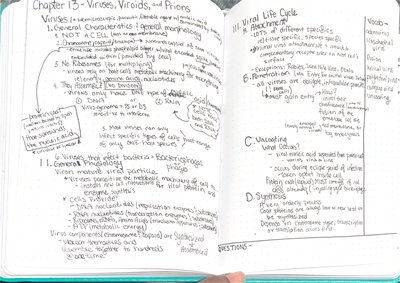
Additional info: Expanded explanations and examples were added for clarity and completeness. The table was inferred from the notes' comparison points.
