 Back
BackChapter 14: Infection, Infectious Diseases, and Epidemiology – Study Notes
Study Guide - Smart Notes
 Tailored notes based on your materials, expanded with key definitions, examples, and context.
Infection, Infectious Diseases, and Epidemiology
Introduction
This chapter explores the principles of infection, the nature of infectious diseases, and the science of epidemiology. It covers the interactions between microbes and hosts, mechanisms of disease transmission, and the methods used to track and control infectious diseases in populations.
Normal Microbiota and Host Interactions
Resident and Transient Microbiota
Resident microbiota: Microorganisms that colonize the body’s surfaces permanently without causing disease under normal conditions.
Transient microbiota: Microbes that are present temporarily; they do not persist due to competition, elimination by the immune system, or physical/chemical changes in the body.
Acquisition of normal microbiota occurs during birth and in the first months of life.
Normally Sterile Body Sites
Blood, cerebrospinal fluid, internal organs (e.g., heart, liver, kidneys), and the lower respiratory tract are typically sterile.
Conditions under which normal microbiota can cause disease:
Introduction into unusual body sites (e.g., Escherichia coli from the gut entering the urinary tract).
Immune suppression (e.g., HIV/AIDS, chemotherapy).
Changes in the normal microbiota (e.g., antibiotic use disrupting balance).
Pathogenicity and Virulence Factors
Definitions
Pathogen: A microorganism capable of causing disease.
Pathogenicity: The ability of a microbe to cause disease.
Virulence: The degree of pathogenicity; determined by virulence factors.
Virulence Factors
Adhesion proteins: Allow microbes to attach to host cells.
Biofilms: Communities of microbes that adhere to surfaces and resist host defenses.
Extracellular enzymes: Degrade host tissues (e.g., coagulase, collagenase, hyaluronidase).
Toxins: Chemicals that damage host tissues or trigger immune responses.
Capsules: Polysaccharide layers that protect bacteria from phagocytosis.
Exotoxins vs. Endotoxins
Exotoxins: Proteins secreted by bacteria; highly toxic and specific (e.g., botulinum toxin, diphtheria toxin).
Endotoxins: Lipopolysaccharide (LPS) components of Gram-negative bacterial outer membranes; released upon cell death, causing systemic effects (e.g., fever, shock).
Table: Comparison of Exotoxins and Endotoxins
Feature | Exotoxin | Endotoxin |
|---|---|---|
Chemical Nature | Protein | Lipopolysaccharide (LPS) |
Source | Mostly Gram-positive bacteria | Gram-negative bacteria |
Heat Stability | Unstable (destroyed by heat) | Stable |
Toxicity | High | Low (but can cause severe effects in large amounts) |
Examples | Botulinum toxin, tetanus toxin | LPS from E. coli |
Reservoirs and Transmission of Infectious Diseases
Reservoirs of Infection
Animal reservoirs: Zoonotic diseases transmitted from animals to humans (e.g., rabies, influenza).
Human carriers: Infected individuals who may be asymptomatic but can transmit pathogens (e.g., "Typhoid Mary").
Non-living reservoirs: Soil, water, and food contaminated with pathogens.

Portals of Entry and Exit
Entry: Skin, mucous membranes, placenta, parenteral route (direct introduction into tissues).
Exit: Often the same as entry; includes respiratory droplets, feces, urine, blood, and other secretions.
Modes of Transmission
Direct contact: Physical interaction between hosts.
Indirect contact: Via fomites (inanimate objects).
Droplet transmission: Respiratory droplets over short distances.
Vehicle transmission: Airborne, waterborne, or foodborne spread.
Vector transmission: Biological (e.g., mosquitoes) or mechanical (e.g., flies).
Occurrence and Epidemiology of Infectious Diseases
Key Terms
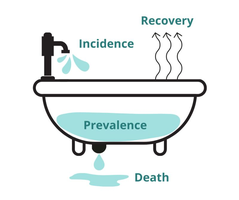
Incidence: Number of new cases in a population during a specific period.
Prevalence: Total number of cases (new and existing) in a population at a given time.
Etiology: Study of the cause of disease.
Communicable: Disease that can be transmitted from one host to another.
Noncommunicable: Disease not spread from host to host.
Contagious: Easily spread from person to person.
Severity and Extent of Disease
Acute: Rapid onset, short duration (e.g., influenza).
Chronic: Slow development, long duration (e.g., tuberculosis).
Subacute: Intermediate between acute and chronic.
Latent: Pathogen remains inactive for a time before causing symptoms (e.g., herpesvirus).
Stages of Disease
Incubation period
Prodromal period
Illness
Decline
Convalescence
Predisposing Factors
Age, genetics, immune status, lifestyle, and pre-existing conditions can increase susceptibility to infection.
Nosocomial (Healthcare-Associated) Infections
Overview
Acquired in healthcare settings (hospitals, clinics).
Sources: Normal microbiota, other patients, healthcare workers, environment.
Risk factors: Invasive procedures, immunosuppression, antibiotic use.
Prevention: Handwashing is the most effective measure.
Epidemiology and Public Health
Functions of the CDC and Other Agencies
Collect and analyze data on disease occurrence and transmission.
Recommend prevention and control measures.
Coordinate with state, national, and international health organizations.
Notifiable Infectious Diseases
Diseases that must be reported to public health authorities (e.g., AIDS, measles, tuberculosis, cholera).
Famous Figures in Epidemiology
Joseph Lister: Introduced surgical antisepsis.
Ignaz Semmelweis: Advocated handwashing to prevent puerperal fever.
John Snow: "Father of Epidemiology"; traced cholera outbreak in London.
Mary Mallon ("Typhoid Mary"): Asymptomatic carrier of Salmonella typhi who caused multiple outbreaks.
Key Concepts and Review
Understand the difference between incidence and prevalence.
Know the main reservoirs and modes of transmission for infectious diseases.
Be able to compare and contrast exotoxins and endotoxins.
Recognize the importance of public health measures in controlling disease spread.
Additional info: This guide integrates textbook context and expands on brief points for clarity and exam preparation.
