 Back
Chapter 17: Immunization – Principles and Applications
Study Guide - Smart Notes
 Tailored notes based on your materials, expanded with key definitions, examples, and context.
Immunization: Principles and Historical Context
Overview of Immunization
Immunization is a critical strategy in microbiology and public health, designed to protect individuals and populations from infectious diseases. It involves the administration of antigens or antibodies to induce immunity, either actively or passively.
Active Immunization: Administration of antigens so the patient actively mounts an adaptive immune response.
Passive Immunotherapy: Transfer of antibodies formed by an immune individual or animal to provide immediate, short-term protection.
Brief History of Immunization
The practice of immunization has evolved over centuries, beginning with observations of disease resistance and culminating in modern vaccine technology.
Early observations in China: Children who recovered from smallpox did not contract the disease again. This led to variolation, the deliberate infection with material from smallpox scabs.
1796: Edward Jenner developed the process of vaccination using cowpox to protect against smallpox.
1879: Louis Pasteur developed a vaccine against Pasteurella multocida.
Discovery that vaccines protect through the action of antibodies led to the development of antibody transfer techniques.
Despite advances, some developing nations lack access to vaccines, and effective vaccines for certain pathogens remain unavailable. Concerns about vaccine safety can also hinder development and uptake.
Impact of Immunization on Disease Prevalence
Vaccination programs have dramatically reduced the incidence of many infectious diseases, as illustrated by the decline in polio and measles cases following vaccine introduction.
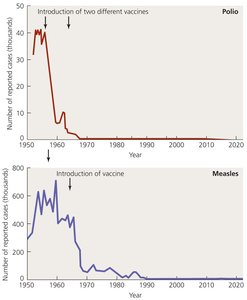
Example: The introduction of polio and measles vaccines in the United States led to a rapid and sustained decrease in reported cases.
Types of Vaccines and Their Characteristics
Attenuated (Modified Live) Vaccines
Attenuated vaccines use pathogens with reduced virulence, a process known as attenuation. These vaccines can cause mild infections but generally stimulate strong, long-lasting immune responses and may provide contact immunity.
Risk: Modified microbes may retain enough residual virulence to cause disease in susceptible individuals.
Inactivated (Killed) Vaccines
Inactivated vaccines are safer than live vaccines and come in two forms:
Whole agent vaccines: Contain inactivated but whole microbes.
Subunit vaccines: Contain antigenic fragments of microbes.
These vaccines often require multiple doses and may include adjuvants—chemicals that enhance antigenicity.
Toxoid Vaccines
Toxoid vaccines use chemically or thermally modified toxins to stimulate active immunity, particularly for bacterial diseases. They primarily induce antibody-mediated immunity and require multiple doses due to limited antigenic determinants.
Combination and Recombinant Vaccines
Combination vaccines: Simultaneously administer antigens from several pathogens.
Recombinant gene technology: Utilizes recombinant DNA techniques to improve vaccine efficacy, safety, and cost-effectiveness.
Vaccine Manufacture and Administration
Production Methods
Vaccines are mass-produced by growing microbes in culture vessels. Viruses are often cultured in chicken eggs, which can be problematic for individuals with egg allergies.
CDC-Recommended Immunization Schedule
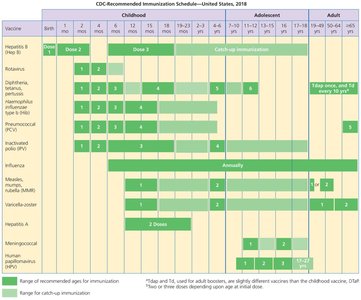
The Centers for Disease Control and Prevention (CDC) provides guidelines for vaccine administration across different age groups to maximize public health benefits.
Principal Vaccines to Prevent Human Diseases
The following table summarizes key vaccines, their target diseases, types, and methods of administration, as recommended by the CDC.
Vaccine | Disease Agent | Disease | Vaccine Type | Method of Administration |
|---|---|---|---|---|
Hepatitis B | Hepatitis B virus | Hepatitis B | Inactive subunit (recombinant yeast) | Intramuscular |
Rotavirus | Rotavirus | Gastroenteritis | Attenuated, recombinant | Oral |
DTaP | Diphtheria toxin, Tetanus toxin, Bordetella pertussis | Diphtheria, Tetanus, Whooping cough | Toxoid, Toxoid, Inactivated subunit | Intramuscular |
Hib | Haemophilus influenzae | Meningitis, pneumonia, epiglottitis | Inactivated subunit | Intramuscular |
Pneumococcal (PCV) | Streptococcus pneumoniae | Pneumonia | Inactivated subunit | Intramuscular |
Polio | Poliovirus | Poliomyelitis | Inactivated (attenuated also available) | Subcutaneous or intramuscular (attenuated: oral) |
Influenza | Influenzaviruses | Flu | Inactivated subunit | Intramuscular or oral |
MMR | Measles, Mumps, Rubella viruses | Measles, Mumps, Rubella | Attenuated | Subcutaneous |
Varicella-zoster | Chickenpox virus | Chickenpox, shingles | Attenuated | Subcutaneous |
Hepatitis A | Hepatitis A virus | Hepatitis A | Inactivated whole | Intramuscular |
HPV | Human papillomaviruses | Genital warts, cervical cancer | Inactive recombinant | Intramuscular |
Meningococcal | Neisseria meningitidis | Meningitis | Inactive | Subcutaneous or intramuscular |
Vaccine Safety and Limitations
Potential Problems with Immunization
Mild toxicity (e.g., soreness at injection site, fever)
Risk of anaphylactic shock (severe allergic reaction)
Residual virulence from attenuated viruses
Unsubstantiated allegations linking vaccines to autism, diabetes, and asthma
Extensive research has not confirmed a causal relationship between vaccines and these chronic conditions.
Passive Immunotherapy
Principles and Applications
Passive immunotherapy involves the administration of antiserum containing preformed antibodies, providing immediate but temporary protection against infection or disease.
Limitations include the risk of allergic reactions (serum sickness), rapid degradation of antibodies, and lack of long-term protection.
Development of hybridomas (cells that produce monoclonal antibodies) has helped overcome some limitations.
Summary Table: Active vs. Passive Immunity
Characteristic | Active Immunization | Passive Immunotherapy |
|---|---|---|
Source of Immunity | Antigen exposure (vaccine) | Preformed antibodies (antiserum) |
Onset of Protection | Delayed (days to weeks) | Immediate |
Duration of Protection | Long-term (memory cells) | Short-term (antibodies degrade) |
Memory Response | Yes | No |
