 Back
Chapter 2: Chemical Principles – Important Biological Molecules
Study Guide - Smart Notes
 Tailored notes based on your materials, expanded with key definitions, examples, and context.
Chemical Principles in Microbiology
Introduction
Chemical principles are foundational to understanding the structure and function of microorganisms. This chapter explores the properties of inorganic and organic molecules, the chemical basis of life, and the major classes of biological macromolecules essential for microbial life.
Inorganic Compounds
Definition and Importance
Inorganic molecules are relatively small compounds that typically lack carbon atoms.
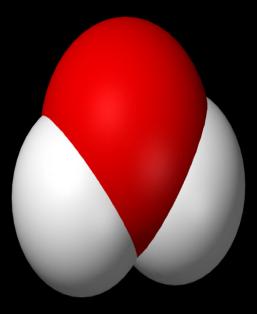
Water (H2O) is the most important inorganic molecule, making up 65-75% of a cell's mass.
Functions of water include acting as a solvent, a medium for chemical reactions, and a source of hydrogen and oxygen for biological reactions.
Properties of Water
Water molecules are polar, allowing them to form hydrogen bonds with each other.
High boiling point and temperature regulation properties are due to hydrogen bonding.
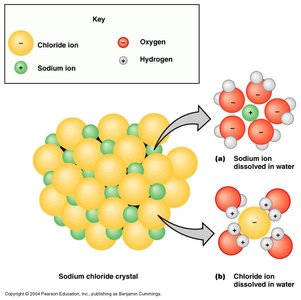
Excellent solvent for ionic and polar substances; many biological solutes are salts that dissociate in water.
Water participates directly in many chemical reactions, including hydrolysis and dehydration synthesis.
Water as a Solvent
Water dissolves ionic compounds by surrounding ions, facilitating their movement and reactions in cells.
Acids, Bases, and Salts
Acids release hydrogen ions (H+) in solution.
Bases release hydroxide ions (OH-).
Salts dissociate into cations and anions, neither of which is H+ or OH-.
pH and Biological Systems
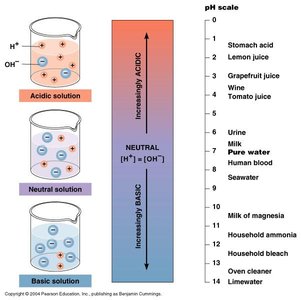
The pH scale measures the concentration of H+ ions in a solution, ranging from 0 (acidic) to 14 (basic).
Most organisms survive within a narrow pH range and use buffers to maintain pH balance.
Acidic solutions have more H+ than OH-; basic solutions have more OH- than H+.
Organic Compounds
Definition and Structure
Organic molecules always contain carbon and hydrogen, and often oxygen, nitrogen, sulfur, and phosphorus.
They form complex structures with carbon skeletons and functional groups that determine chemical properties.
Organic compounds make up 98-99% of the material in living cells.
Dehydration Synthesis and Hydrolysis
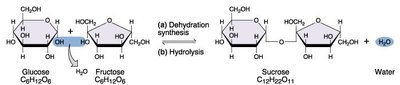
Dehydration synthesis joins monomers to form polymers by removing water.
Hydrolysis breaks polymers into monomers by adding water.
Major Classes of Biological Molecules
Carbohydrates
Composed of carbon, hydrogen, and oxygen in a 1:2:1 ratio (CH2O)n.
Types include monosaccharides (simple sugars), disaccharides (two sugars), and polysaccharides (many sugars).
Functions: energy source, structural components (e.g., cell walls), and building blocks for other molecules.
Examples: Glycogen (energy storage in animals and some bacteria), cellulose (plant cell walls), starch (plant energy storage).
Lipids
Composed of carbon, hydrogen, and oxygen; insoluble in water but soluble in organic solvents.
Main functions: energy storage, structural components of cell membranes, and signaling molecules.
Types of Lipids
Simple lipids (triglycerides): Glycerol head and three fatty acid tails.
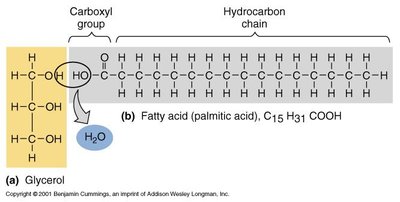
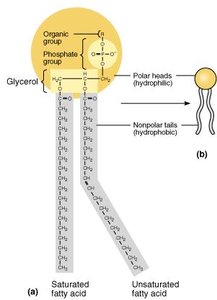
Complex lipids (phospholipids): Contain a polar (hydrophilic) head and nonpolar (hydrophobic) tails; form the phospholipid bilayer of cell membranes.
Proteins and Amino Acids
Amino acids are the building blocks of proteins; each contains an amino group (–NH2), a carboxyl group (–COOH), and a unique side chain (R group).
There are 20 different amino acids.
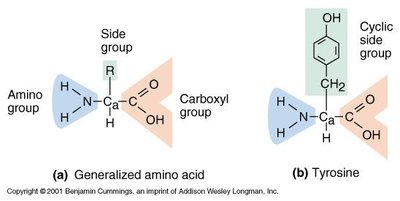
Amino acids are joined by peptide bonds (formed by dehydration synthesis) to create polypeptides and proteins.
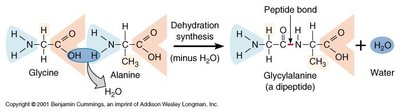
Functions of proteins: enzymes, transport, movement, cell structure, toxins, hormones, antibodies, and more.
Nucleic Acids
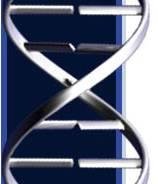
DNA (deoxyribonucleic acid) and RNA (ribonucleic acid) are the genetic material of cells.
Nucleic acids are polymers of nucleotides, each consisting of a base, a sugar, and a phosphate group.
DNA contains the bases adenine (A), thymine (T), cytosine (C), and guanine (G); RNA contains uracil (U) instead of thymine.
DNA is double-stranded and complementary; RNA is single-stranded and comes in three types (mRNA, rRNA, tRNA).
Adenosine Triphosphate (ATP)
ATP is the principal energy-carrying molecule in the cell.
Structure: adenine base, ribose sugar, and three phosphate groups.
Energy is released when high-energy phosphate bonds are broken:
The energy released is used for cellular processes or stored for later use.
Summary Table: Major Classes of Biological Molecules
Molecule | Elements | Monomer | Polymer | Main Functions |
|---|---|---|---|---|
Carbohydrates | C, H, O | Monosaccharide | Polysaccharide | Energy, structure |
Lipids | C, H, O | Glycerol + Fatty acids | Triglyceride, phospholipid | Energy storage, membranes |
Proteins | C, H, O, N, S | Amino acid | Polypeptide | Enzymes, structure, transport |
Nucleic Acids | C, H, O, N, P | Nucleotide | DNA, RNA | Genetic information |
ATP | C, H, O, N, P | — | — | Energy transfer |
Recap
Defined inorganic and organic molecules.
Discussed properties of water, acids, bases, and salts.
Explained dehydration synthesis and hydrolysis in biological molecule formation.
Described the composition and function of carbohydrates, lipids, amino acids, proteins, nucleic acids, and ATP.
