 Back
BackChapter 4: Parasites and Fungi – Microbiology Study Notes
Study Guide - Smart Notes
 Tailored notes based on your materials, expanded with key definitions, examples, and context.
Parasites
Definition and Significance
Parasites are organisms that live at the expense of another organism, known as the host. They range from causing little harm to severe damage, and those that cause disease are termed pathogens. The study of parasites is called parasitology.
Key Point 1: Parasitic infections are widespread, with more cases than the global human population.
Key Point 2: Parasitism impacts global health and economy, restricting land use and affecting humans and animals.
Example: Malaria, caused by a protozoan parasite, is a major global health concern.
Types of Parasites
Parasites are classified based on their relationship with the host and their life cycle.
Ectoparasites: Live on the surface of the host (e.g., ticks, lice).
Endoparasites: Live inside the host (e.g., protozoa, worms).
Obligate parasites: Must spend part of their life cycle in/on a host.
Facultative parasites: Can live freely but may use a host for nutrients (e.g., some fungi).
Permanente parasites: Remain in/on the host once invaded (e.g., tapeworms).
Temporary parasites: Feed and then leave the host (e.g., biting insects).
Accidental parasites: Invade organisms other than their normal hosts (e.g., ticks on humans).
Hyperparasitism: Parasites themselves have parasites (e.g., mosquitoes carrying malaria).
Vectors: Agents of transmission for many parasitic diseases (e.g., mosquitoes).
Host Specificity
Host specificity refers to the range of hosts in which a parasite can mature. Some parasites are highly host-specific, maturing only in one host species.
Protists
Animal-like Protists
Protists include algae, slime molds, and protozoans. Animal-like protists are heterotrophic and mostly unicellular. Apicomplexans (sporozoans) are parasitic and immobile, such as Plasmodium, the malaria parasite.
Key Point: Plasmodium requires both human and mosquito hosts for its complex life cycle.
Life Cycle of Malaria Parasite
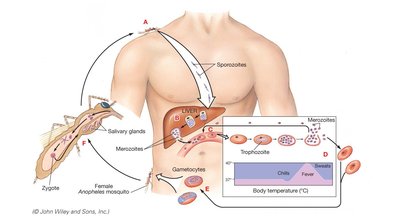
The malaria parasite (Plasmodium) undergoes a complex life cycle involving both humans and mosquitoes.
Sporozoites are transmitted by female Anopheles mosquitoes and travel to the human liver.
In the liver, sporozoites multiply and become merozoites, which enter the bloodstream when liver cells rupture.
Merozoites infect red blood cells, become trophozoites, and produce more merozoites, causing cycles of chills, fever, and sweating.
After several asexual cycles, gametocytes (sexual stages) are produced and ingested by mosquitoes, forming zygotes and new sporozoites in the mosquito's salivary glands.
Animals: Parasitic Helminths
Overview of Parasitic Helminths
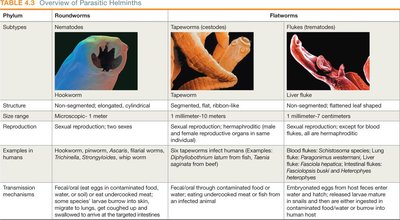
Helminths are parasitic worms, bilaterally symmetrical, with head and tail ends and differentiated tissue layers. They are divided into two main groups: flatworms and roundworms.
Flatworms: Lack a coelom, have a simple digestive tract, and are hermaphroditic. Includes tapeworms and flukes.
Roundworms: Have a pseudocoelom, separate sexes, and a cylindrical body. Includes hookworms, pinworms, and other intestinal and lymphatic parasites.
Phylum | Subtypes | Structure | Size range | Reproduction | Examples in humans | Transmission mechanism |
|---|---|---|---|---|---|---|
Roundworms (Nematodes) | Hookworm | Non-segmented, elongated, cylindrical | Microscopic - 1 meter | Sexual reproduction; two sexes | Pinworm, Ascaris, filarial worms, Trichinella, Strongyloides, whip worm | Fecal-oral (eggs in contaminated food), larvae enter via skin or bite, migrate to lungs and are swallowed to enter the intestinal tract |
Tapeworms (Cestodes) | Tapeworm | Segmented, flat, ribbon-like | 1 millimeter - 10 meters | Hermaphroditic; hermaphroditic (male and female reproductive organs in each segment) | Taenia species (beef and pork tapeworms), Diphyllobothrium latum (fish tapeworm) | Fecal-oral through contaminated food or water, ingestion of undercooked meat or fish |
Flatworms (Trematodes) | Fluke | Non-segmented, flattened leaf-shaped | 1 millimeter - 7 centimeters | Sexual reproduction; except for blood flukes, hermaphroditic | Blood flukes: Schistosoma species; Liver flukes: Fasciola hepatica, Clonorchis sinensis | Larvae penetrate skin or are ingested; blood flukes enter via burrow into human host |
Flukes
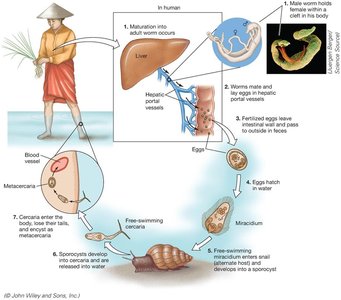
Flukes are a type of flatworm with two main types of infection:
Tissue flukes: Attach to bile duct, lungs, or other tissues.
Blood flukes: Found in blood during some stages of their life cycle.
Tapeworms
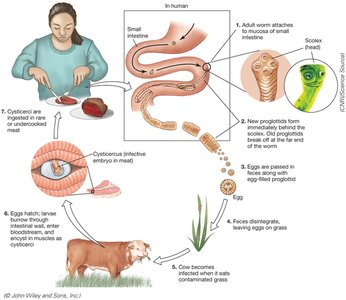
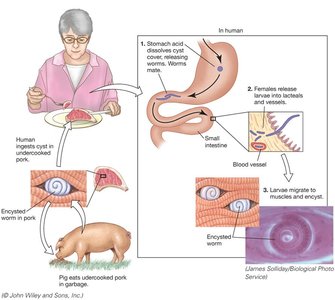
Tapeworms are segmented, ribbon-like flatworms that attach to the intestinal wall and absorb nutrients from the host.
Key Point: Tapeworms can be acquired by ingesting undercooked meat containing cysticerci.
Roundworms
Roundworms are cylindrical, non-segmented worms with separate sexes. They infect the intestinal tract and lymphatics.
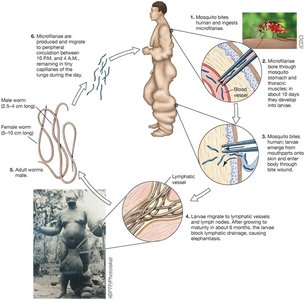
Key Point: Some roundworms, such as filarial worms, block lymphatic drainage, causing diseases like elephantiasis.
Roundworms: Lymphatic Blockage
Filarial worms can block lymphatic drainage, leading to severe swelling and chronic conditions such as elephantiasis.
Fungi
General Characteristics
Fungi are a diverse group of organisms, with over 600,000 species. Most are multicellular, except yeasts, which are unicellular. Fungi do not perform photosynthesis and absorb nutrients from their environment. They include both pathogens and saprobes.
Hyphae Structure
Most fungi grow as tubular structures called hyphae. There are two types:
Septate hyphae: Have divisions between cells, appearing as a string of individual cells.
Aseptate hyphae: Lack divisions, forming a continuous chain with many nuclei.
Asexual Spores
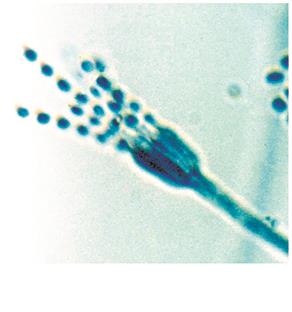
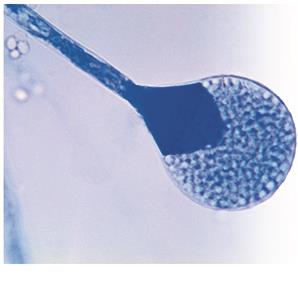
Asexual spores arise from mitosis and do not result in genetic variation. Types include:
Conidiospores: Form chains of spores not enclosed in a sac. Example: Penicillium.
Sporangiospores: Form within a sac called a sporangium. Example: Absidia.
Sexual Spores
Sexual spores arise from meiosis, resulting in genetic variation. Types include:
Zygospores: Haploid gametes found at the tips of hyphae. Example: Rhizopus.
Ascospores: Form within a sac called an ascus. Example: cup fungi.
Basidiospores: Bud off a pedestal structure called the basidium. Example: mushrooms.
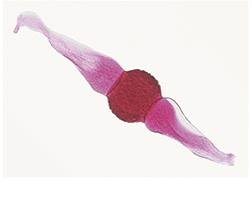
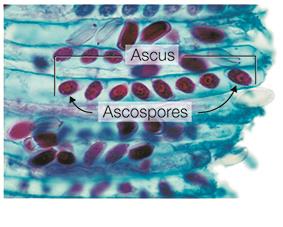
Fungal Spores Table
Type | Name | Form | Examples |
|---|---|---|---|
Asexual Fungal Spores | Conidiospores | Chains of spores; not enclosed in a sac | Penicillium, Aspergillus |
Asexual Fungal Spores | Sporangiospores | Spores formed within a sac called a sporangium | Absidia |
Sexual Fungal Spores | Zygospores | Haploid gametes found at the tips of hyphae | Rhizopus |
Sexual Fungal Spores | Ascospores | Haploid gametes form within a sac called an ascus | Truffles, morels, yeasts, cup fungi |
Sexual Fungal Spores | Basidiospores | Bud off of a pedestal structure called the basidium | Mushrooms |
Fungal Diseases (Mycoses)
Diseases caused by fungi are called mycoses. Most occur in immunocompromised individuals or those with disrupted normal microbiota.
Key Point: Some fungi are true pathogens and can infect healthy hosts (e.g., histoplasmosis, coccidioidomycosis).
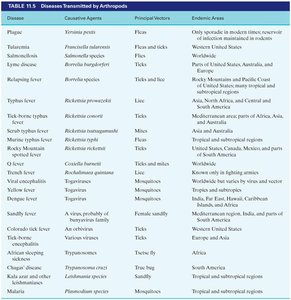
Additional info: Fungal diseases can range from superficial skin infections to life-threatening systemic infections, especially in immunocompromised patients.
