 Back
BackChapter 5 Microbial Metabolism & Enzyme Regulation Study Guide
Study Guide - Smart Notes
 Tailored notes based on your materials, expanded with key definitions, examples, and context.
Review Q2: Enzyme Inhibition and Substrate Binding
Background
Topic: Enzyme structure and inhibition
This question tests your understanding of how substrates and inhibitors interact with enzymes, including the difference between competitive and noncompetitive inhibition, and the concept of feedback inhibition.
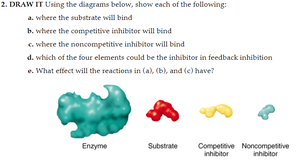
Key Terms and Concepts:
Substrate: The molecule upon which an enzyme acts.
Active Site: The region on the enzyme where the substrate binds.
Competitive Inhibitor: A molecule that resembles the substrate and competes for binding at the active site.
Noncompetitive Inhibitor: A molecule that binds to a different site on the enzyme, changing its shape and reducing activity.
Feedback Inhibition: A regulatory mechanism where the end product of a pathway inhibits an earlier step.
Step-by-Step Guidance
Identify the active site on the enzyme model, which is the location where the substrate (red) will fit and bind.
Determine where the competitive inhibitor (yellow) would bind. Recall that it competes directly with the substrate for the active site.
Locate where the noncompetitive inhibitor (light blue) would bind. This site is different from the active site and is often called the allosteric site.
Consider which of the four elements (substrate, competitive inhibitor, noncompetitive inhibitor, enzyme) could act as the inhibitor in feedback inhibition. Think about which type of inhibitor is commonly involved in feedback regulation of metabolic pathways.
Reflect on the effects of the interactions in (a), (b), and (c) on enzyme activity. For each, consider whether the enzyme will be able to catalyze the reaction and why.
Try solving on your own before revealing the answer!
Final Answer:
a. The substrate binds at the active site of the enzyme (the pocket that matches the substrate's shape).
b. The competitive inhibitor binds at the same active site as the substrate, blocking substrate access.
c. The noncompetitive inhibitor binds at a different site (allosteric site), not the active site, causing a conformational change in the enzyme.
d. The noncompetitive inhibitor is most often the type involved in feedback inhibition, as it can regulate enzyme activity from a distance.
e. (a) allows the reaction to proceed; (b) blocks the reaction by preventing substrate binding; (c) reduces or stops enzyme activity by altering the enzyme's shape.
Competitive inhibitors compete with the substrate for the active site, while noncompetitive inhibitors bind elsewhere and change the enzyme's function. Feedback inhibition typically involves noncompetitive inhibition to regulate metabolic pathways.
