 Back
BackChapter 7: The Control of Microbial Growth – Study Notes
Study Guide - Smart Notes
 Tailored notes based on your materials, expanded with key definitions, examples, and context.
Chapter 7: The Control of Microbial Growth
Introduction
The control of microbial growth is essential in medical, industrial, and food settings to prevent infection, spoilage, and contamination. This chapter explores the terminology, mechanisms, and physical methods used to control microbial populations.
Key Terminology in Microbial Control
Definitions and Concepts
Sepsis: Refers to microbial contamination, specifically the growth and spread of bacteria in blood and tissues, leading to a systemic inflammatory response.
Asepsis: The absence of significant contamination. Aseptic techniques are used in surgery to prevent microbial contamination of wounds.
Antisepsis: Removal of pathogens from living tissue, such as skin disinfection before injection.
Sterilization: The complete removal or destruction of all microbial life, including endospores.
Commercial Sterilization: A process used in the food industry, especially for canned foods, to kill Clostridium botulinum endospores and vegetative cells.
Disinfection: Removal of pathogens from non-living surfaces.
Degerming: Removal of microbes from a limited area, such as swabbing skin with alcohol before an injection.
Sanitization: Reducing microbial counts on eating utensils and food preparation areas to safe public health levels.
Biocide/Germicide: Substance that kills microbes.
Bacteriostasis: Inhibition of bacterial growth without killing the organisms.

The Rate of Microbial Death
Microbial Death Kinetics
Bacterial populations subjected to heat or antimicrobial chemicals typically die at a constant rate. This rate can be described mathematically and is important for determining the effectiveness of sterilization and disinfection procedures.
The time required to kill a microbial population is proportional to the number of microbes present.
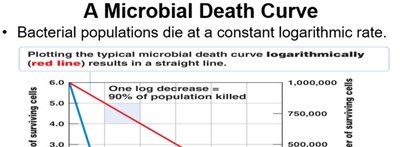
Death curves, when plotted logarithmically, show a straight line, indicating a constant death rate.
Different microbial species and life cycle phases (e.g., endospores) have varying susceptibilities to control methods.
Organic matter can interfere with heat and chemical treatments.
Longer exposure to lower heat can have the same effect as shorter exposure to higher heat.

Population Death Rate Table
Time (min) | Deaths per Minute | Number of Survivors |
|---|---|---|
0 | 0 | 1,000,000 |
1 | 900,000 | 100,000 |
2 | 90,000 | 10,000 |
Microbial Death Curve
Logarithmic plotting of microbial death results in a straight line, indicating a constant percentage of the population is killed per unit time.
One log decrease equals 90% of the population killed.
Factors Affecting Antimicrobial Effectiveness
Number of microbes present
Environmental factors (organic matter, temperature, biofilms)
Time of exposure
Microbial characteristics (e.g., endospore formation, cell wall structure)

Actions of Microbial Control Agents
Mechanisms of Action
Alteration of membrane permeability: Disrupts the plasma membrane, leading to leakage of cellular contents and cell death.
Damage to proteins: Some agents denature proteins by breaking hydrogen and covalent bonds, inactivating enzymes and structural proteins.
Damage to nucleic acids: Some agents interfere with DNA and RNA, inhibiting replication and protein synthesis.

Physical Methods of Microbial Control
Heat
Heat is one of the most common methods for controlling microbial growth. It works primarily by denaturing proteins and enzymes.
Moist heat kills microbes by denaturing enzymes.
Thermal death point (TDP): Lowest temperature at which all cells in a culture are killed in 10 minutes.
Thermal death time (TDT): Minimal length of time required to kill all bacteria in a liquid culture at a given temperature.
Decimal reduction time (DRT): Minutes to kill 90% of a population at a given temperature.
Boiling (100°C) kills many vegetative cells and viruses within 10 minutes.
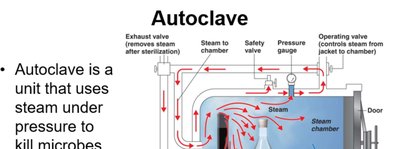
Autoclaving (steam under pressure) is the most effective method of moist heat sterilization. The steam must directly contact the material to be sterilized.
Pressure vs. Temperature of Steam Table
Pressure (psi in Excess of Atmospheric Pressure) | Temperature (°C) |
|---|---|
0 | 100 |
5 | 110 |
10 | 116 |
15 | 121 |
20 | 126 |
30 | 135 |

Additional info: At higher altitudes, atmospheric pressure is lower, so higher gauge pressure is needed to achieve the same sterilizing temperature in an autoclave.
Pasteurization
Pasteurization reduces spoilage organisms and pathogens in foods by applying heat that kills vegetative cells but not endospores.
Common methods include:
63°C for 30 min (Low-temperature long-time, LTLT)
72°C for 15 sec (High-temperature short-time, HTST)
140°C for <1 sec (Ultra-high-temperature, UHT)
Thermoduric (heat-resistant) organisms may survive but do not grow at storage temperatures.
Dry Heat Sterilization
Dry heat kills by oxidation and is used for materials that can withstand high temperatures without damage.
Flaming (e.g., sterilizing inoculating loops)
Incineration (e.g., decontaminating paper cups, dressings)
Hot-air sterilization (e.g., glassware)
Hot-air | Autoclave | |
|---|---|---|
Equivalent treatments | 180°C for 90 minutes 170°C for 2 hours 160°C for 3 hours | 121°C, 15 min |

Low Temperature
Low temperatures inhibit microbial growth by slowing metabolism and reproduction.
Refrigeration: Slows growth of most pathogens (0–7°C), but Listeria can still grow.
Deep freezing: Preserves microbes for long-term storage.
Lyophilization: Freeze-drying for preservation of cultures.
Effectiveness depends on the microorganism and application intensity.
Many microbes survive but do not grow at subzero temperatures.
Filtration
Filtration removes microbes from liquids or gases by passing them through filters with pores small enough to retain microorganisms.
Used for heat-sensitive materials (e.g., enzymes, vaccines, antibiotics).
HEPA filters remove microbes from air.
Membrane filters (pore size 0.22 µm or 0.45 µm) are used for fluids; some can retain viruses and large proteins.
Desiccation
Desiccation (drying) prevents microbial growth by removing water, but many microbes can remain viable and resume growth when water is available. Endospores are more resistant than viruses to desiccation.
Osmotic Pressure
High concentrations of salts and sugars create a hypertonic environment, causing plasmolysis (shrinkage of the cell membrane from the cell wall) and inhibiting microbial growth. This method is used to preserve foods such as meats (salt) and fruits (sugar).
Summary Table: Physical Methods of Microbial Control
Method | Mechanism | Application |
|---|---|---|
Moist Heat (Autoclave) | Protein denaturation | Culture media, linens, dressings, utensils |
Dry Heat | Oxidation | Glassware, metal instruments |
Filtration | Physical removal | Heat-sensitive liquids, air |
Low Temperature | Inhibits metabolism | Food preservation, culture storage |
Osmotic Pressure | Plasmolysis | Food preservation |
Desiccation | Prevents metabolism | Food preservation |
Additional info: For exam preparation, focus on the definitions, mechanisms, and applications of each physical method, and understand the importance of microbial death kinetics in designing effective sterilization protocols.
