 Back
BackChapter 7: The Control of Microbial Growth – Study Notes
Study Guide - Smart Notes
 Tailored notes based on your materials, expanded with key definitions, examples, and context.
The Control of Microbial Growth
Terminology of Microbial Control
Understanding the terminology of microbial control is essential for interpreting laboratory and clinical procedures. These terms describe various methods and outcomes related to the reduction or elimination of microorganisms.
Sepsis: Refers to bacterial contamination.
Asepsis: The absence of significant contamination; aseptic techniques prevent microbial contamination of wounds.
Sterilization: Removal and destruction of all microbial life, including endospores.
Commercial Sterilization: Killing Clostridium botulinum endospores in canned goods.
Disinfection: Destruction of harmful microorganisms on inanimate surfaces.
Antisepsis: Destruction of harmful microorganisms from living tissue.
Degerming: Mechanical removal of microbes from a limited area (e.g., hand washing).
Sanitization: Lowering microbial counts on eating utensils to safe levels.
Biocide (Germicide): Treatments that kill microbes.
Bacteriostasis: Inhibiting, not killing, microbes.
Patterns and Rate of Microbial Death
Microbial control agents cause a predictable rate of microbial death, which is influenced by several factors.
Number of microbes: Higher populations require longer treatment.
Environment: Presence of organic matter, temperature, and biofilms affect efficacy.
Time of exposure: Longer exposure increases effectiveness.
Microbial characteristics: Endospores and cell wall composition affect resistance.
Microbial control agents act by:
Damaging plasma membranes, causing leakage and interfering with cell growth.
Damaging proteins (enzymes), leading to loss of function.
Damaging nucleic acids, preventing replication and function.
Physical Methods of Microbial Control
Physical methods are widely used to control microbial growth in laboratory and clinical settings.
Heat
Heat denatures enzymes and proteins, leading to microbial death. Key concepts include:
Thermal Death Point (TDP): Lowest temperature at which all cells in a liquid culture are killed in 10 minutes.
Thermal Death Time (TDT): Minimal time for all bacteria in a liquid culture to be killed at a particular temperature.
Decimal Reduction Time (DRT): Minutes to kill 90% of a specific population of bacteria at a given temperature.
Moist Heat Sterilization
Moist heat coagulates and denatures proteins. Methods include:
Boiling: Kills most pathogens but not all endospores.
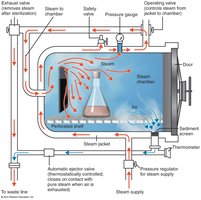
Autoclaving: Steam under pressure (15 psi, 15 min) kills all organisms and endospores. Steam must contact the item’s surface.
Pasteurization reduces spoilage organisms and pathogens in milk and juices. Methods include:
High-Temperature Short-Time (HTST): 15 seconds at high temperature.
Ultra-High-Temperature (UHT): 140°C for 4 seconds, followed by rapid cooling; sterilizes milk and juices for storage without refrigeration.
Dry Heat Sterilization
Dry heat kills by oxidation. Methods include:
Flaming: Used for sterilizing inoculating loops.
Incineration: Complete destruction of material.
Hot-air sterilization: Oven at 170°C for 2 hours.
Filtration
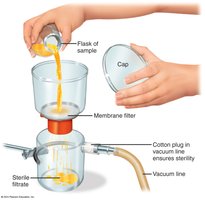
Filtration is used for heat-sensitive materials. It involves passage through a screenlike material.
HEPA filters: Remove microbes from air.
Membrane filters: Remove microbes from liquids; pore sizes can filter out viruses and large proteins.
Other Physical Methods
Low temperature: Bacteriostatic effect (refrigeration, deep-freezing, lyophilization).
High pressure: Denatures proteins and alters carbohydrate structure.
Desiccation: Absence of water prevents metabolism.
Osmotic pressure: High concentrations of salts and sugars create a hypertonic environment, causing plasmolysis.
Radiation
Radiation damages DNA and is used for sterilization.
Ionizing radiation: (X-rays, gamma rays, electron beams) creates reactive hydroxyl radicals, causing lethal mutations.
Nonionizing radiation: (UV, 260 nm) creates thymine dimers in DNA; effective for surfaces.
Visible blue light: Kills bacteria by forming singlet oxygen.
Microwaves: Kill by heat, not especially antimicrobial.
Chemical Methods of Microbial Control
Chemical agents are used for disinfection, antisepsis, and sterilization. Their effectiveness depends on several factors:
Concentration of disinfectant
Presence of organic matter
pH
Temperature
Time of exposure
Disk-Diffusion Method
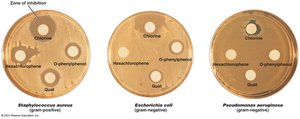
This method evaluates the efficacy of chemical agents by measuring the zone of inhibition around filter paper disks soaked in chemicals.
Phenol and Phenolics
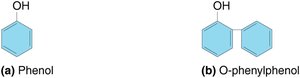
Phenol was first used by Joseph Lister for surgical infection control. Phenolics are derivatives with reduced irritation and increased effectiveness.
Injure lipids of plasma membranes, causing leakage.
Remain active in the presence of organic matter.
Example: O-phenylphenol (ingredient in Lysol®).
Bisphenols
Bisphenols contain two phenol groups connected by a bridge and disrupt plasma membranes.
Hexachlorophene: Used for skin infections caused by staphylococci and streptococci.
Triclosan: Formerly used in antimicrobial soaps and products; use discontinued except in toothpaste.
Biguanides
Effective against gram-positive bacteria, many gram-negative bacteria, and enveloped viruses. Disrupt plasma membranes.
Chlorhexidine: Used in surgical hand scrubs and preoperative skin preparations.
Alexidine: Works faster than chlorhexidine.
Essential Oils
Mixtures of hydrocarbons extracted from plants, used for centuries in traditional medicine and food preservation.
Microbial action primarily due to phenolics and terpenes.
Stronger activity against gram-positive bacteria.
Tea tree oil and pine oil: Broad spectrum activity.
Halogens
Halogens are effective antimicrobial agents.
Iodine: Impairs protein synthesis and alters membranes. Used as tincture or iodophor (e.g., Betadine®).
Chlorine: Oxidizing agent; shuts down cellular enzyme systems. Used as bleach (hypochlorous acid) and chloramine for water disinfection.
Alcohols
Alcohols denature proteins and dissolve lipids. They are not effective against endospores and nonenveloped viruses.
Ethanol and isopropanol require water for effectiveness.
Alcohol-based hand sanitizers (about 62% alcohol) are effective against most bacteria.
Not effective against Clostridium difficile or Norovirus.
Heavy Metals and Their Compounds
Heavy metals exert antimicrobial activity in very small amounts (oligodynamic action) by denaturing proteins.
Silver nitrate: Prevents ophthalmia neonatorum.
Mercuric chloride: Limited use due to toxicity.
Copper sulfate: Algicide.
Zinc chloride: Found in mouthwash.
Surface-Active Agents
Surface-active agents (surfactants) lower surface tension, aiding in the removal of microbes.
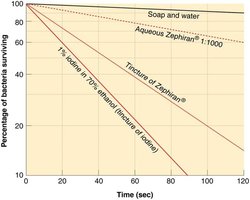
Chemical Food Preservatives
Used to prevent spoilage and microbial growth in foods.
Sulfur dioxide: Prevents wine spoilage.
Organic acids: Inhibit metabolism (sorbic acid, benzoic acid, calcium propionate).
Nitrites and nitrates: Prevent endospore germination in meats; preserve red color.
Antibiotics for Food Preservation
Used exclusively for food preservation, not for treating disease.
Bacteriocins: Proteins produced by one bacterium that inhibit another.
Nisin and natamycin: Prevent spoilage of cheese.
Aldehydes
Aldehydes inactivate proteins by cross-linking with functional groups.
Formalin: Used for preserving specimens; limited use due to cancer risk.
Glutaraldehyde: Liquid chemical sterilizing agent; sporicidal in 3–10 hours.
Used for medical equipment that cannot be autoclaved.
Gaseous Chemosterilants
Gaseous sterilants cause alkylation, cross-linking nucleic acids and proteins.
Ethylene oxide: Used in sealed chambers for large equipment.
Chlorine dioxide: Used for building areas and water treatment.
Plasma
Plasma is an electrically excited gas; free radicals destroy microbes. Used for sterilizing tubular instruments.
Supercritical Fluids
Supercritical fluids have both gaseous and liquid properties. Used in the food industry and for sterilizing medical implants.
Peroxygens and Other Forms of Oxygen
Peroxygens are oxidizing agents used for disinfection and sterilization.
Hydrogen peroxide: Good disinfectant for nonliving surfaces.
Peracetic acid: Effective liquid sterilant for food processing and medical equipment.
Benzoyl peroxide: Used in topical acne medications.
Ozone: Used for water disinfection.
Microbial Characteristics and Microbial Control
The type of microbe affects the control of microbial growth. Some microbes are more resistant to biocides than others.
Gram-negative bacteria: More resistant due to lipopolysaccharide in their outer membrane.
Pseudomonas and Burkholderia: Unusually resistant.
Mycobacteria: Considerable resistance; require special testing.
Bacterial endospores: Very resistant to many biocides.
Nonenveloped viruses: More resistant than enveloped viruses.
Prions: Problematic for disinfection; require immersion in NaOH and autoclaving for 1 hour.
