 Back
BackChapter 8: Recombinant DNA Technology – Tools, Techniques, and Applications
Study Guide - Smart Notes
 Tailored notes based on your materials, expanded with key definitions, examples, and context.
Recombinant DNA Technology and Biotechnology
Introduction to Recombinant DNA Technology
Recombinant DNA technology is a cornerstone of modern biotechnology, involving the intentional modification of genomes for practical purposes. It enables scientists to eliminate undesirable traits, combine beneficial traits, and create organisms capable of synthesizing products needed by humans.
Biotechnology: The use of microorganisms to produce practical products.
Recombinant DNA Technology: Genetic engineering to modify genomes for specific goals.
Main Goals:
Eliminate undesirable phenotypic traits
Combine beneficial traits from multiple organisms
Create organisms that synthesize products for human use
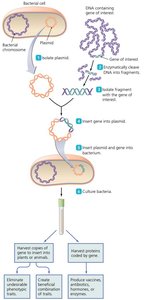
Tools of Recombinant DNA Technology
Mutagens
Mutagens are physical or chemical agents that induce mutations in DNA. Scientists use mutagens to create genetic diversity and select for beneficial traits in microbes.
Mutagens: Used to change microbial genomes and phenotypes.
Applications: Isolation of mutated genes for further study.
Reverse Transcriptase and cDNA Synthesis
Reverse transcriptase, isolated from retroviruses, synthesizes complementary DNA (cDNA) from an RNA template. This process is essential for cloning eukaryotic genes in prokaryotes, as cDNA lacks introns.
Reverse Transcriptase: Enzyme that creates cDNA from mRNA.
cDNA: Introns removed, allowing expression in prokaryotic cells.
Synthetic Nucleic Acids
Synthetic nucleic acids are artificially produced DNA or RNA molecules used for various purposes, including elucidating the genetic code, creating genes, and designing probes and PCR primers.
Applications:
Genetic code analysis
Gene creation for specific proteins
DNA/RNA probes for sequence identification
Antisense molecules and PCR primers
Restriction Enzymes
Restriction enzymes are bacterial proteins that cut DNA at specific palindromic sequences, producing either sticky or blunt ends. These enzymes are fundamental for creating recombinant DNA molecules.
Sticky Ends: Overhanging sequences that facilitate joining DNA fragments.
Blunt Ends: Straight cuts, less efficient for ligation.
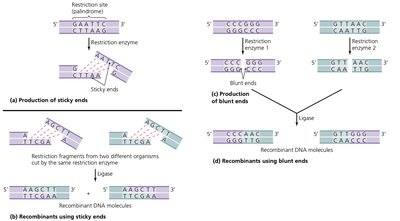
Vectors
Vectors are nucleic acid molecules (such as plasmids, viral genomes, or transposons) used to deliver genes into cells. They are engineered to be small, stable, and contain genetic markers for selection.
Properties: Manipulable, survivable in cells, contain markers, ensure gene expression.
Types: Plasmids, viral genomes, transposons.
CRISPR-Cas System
CRISPR is a primitive immune system in prokaryotes that protects against viral infection. It is now used for precise genome editing in many organisms, with potential applications in treating genetic diseases.
Functions: Inactivate or replace target genes.
Applications: Genetic disease therapy.

Gene Libraries
Gene libraries are collections of bacterial or phage clones, each containing a gene or fragment of an organism’s genome. They provide a ready source of genetic material for research and biotechnology.
Types: Complete chromosome libraries, cDNA libraries.
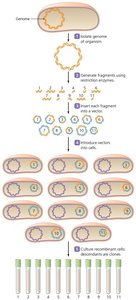
Techniques of Recombinant DNA Technology
Polymerase Chain Reaction (PCR)
PCR is a technique used to amplify DNA in vitro, producing millions of copies from a small sample. It is essential for diagnostics, research, and forensic applications.
Steps:
Denaturation: Heating to separate DNA strands
Priming: Addition of primers
Extension: DNA polymerase synthesizes new strands
Automated: Performed using a thermocycler.
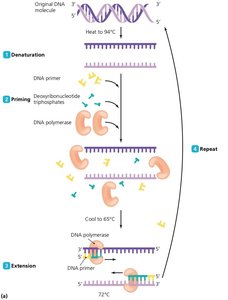
Gel Electrophoresis and Southern Blot
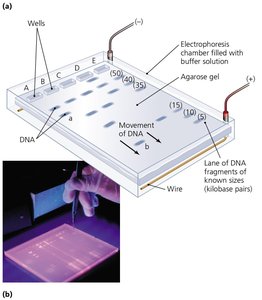
Gel electrophoresis separates DNA fragments by size, charge, and shape using an agarose gel. The Southern blot transfers DNA from the gel to a membrane for identification using probes.
Gel Electrophoresis: Smaller fragments migrate faster.
Southern Blot: Detects specific DNA sequences.
Northern Blot: Used for RNA detection.
DNA Microarrays
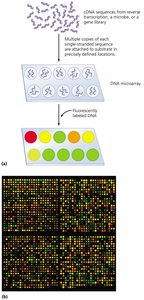
DNA microarrays consist of immobilized single-stranded DNA molecules. Fluorescently labeled DNA binds to complementary sequences, allowing monitoring of gene expression, diagnosis, and identification of organisms.
Applications: Gene expression analysis, infection diagnosis, environmental sampling.
Inserting DNA into Cells
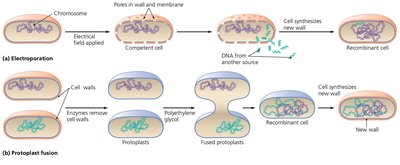
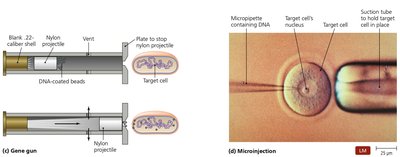
Insertion of DNA into cells is achieved by natural methods (transformation, transduction, conjugation) or artificial methods (electroporation, protoplast fusion, gene gun, microinjection, heat shock).
Natural Methods: Transformation, transduction, conjugation.
Artificial Methods: Electroporation, protoplast fusion, gene gun, microinjection, heat shock.
Applications of Recombinant DNA Technology
Genetic Mapping and Genomics
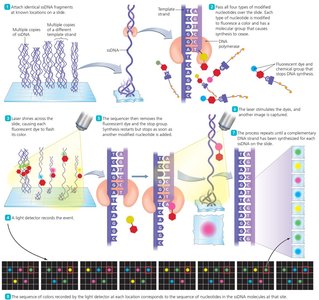
Genetic mapping locates genes on nucleic acid molecules, providing insights into metabolism, growth, and relatedness. Genomics involves sequencing and analyzing genomes, especially of pathogens.
Methods: Restriction fragmentation, FISH, next-generation sequencing.
Functional Genomics: Determines gene product functions using knockouts and overexpression.
Microbial Community Studies
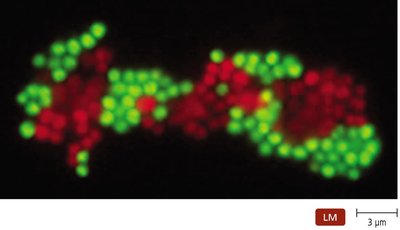
Many microorganisms are identified only by their DNA fingerprints. Next-generation sequencing enables comprehensive analysis of microbiomes, such as the human mouth.
Applications: Identification of uncultivable microbes, microbiome analysis.
Pharmaceutical and Therapeutic Applications
Recombinant DNA technology is used for protein synthesis, vaccine production, genetic screening, gene therapy, medical diagnosis, xenotransplants, and biomedical animal models.
Protein Synthesis: Bacteria and yeast produce synthetic proteins.
Vaccine Production: Safer vaccines, subunit vaccines, and edible vaccines.
Genetic Screening: DNA microarrays detect inherited diseases and viral DNA.
Gene Therapy: Replacement of defective genes.
Medical Diagnosis: Detection of pathogen-specific gene sequences.
Xenotransplants: Animal tissues used in humans.
Biomedical Models: Animals used for disease research.
Agricultural Applications
Transgenic organisms (GMOs) are created by adding genes from other organisms. Applications include herbicide tolerance, pest resistance, salt tolerance, freeze resistance, improved nutrition, and increased yield.
Herbicide Tolerance: Resistance genes allow selective weed control.
Pest Resistance: Bacillus thuringiensis (Bt) toxin gene inserted into crops.
Salt and Freeze Resistance: Genes confer environmental tolerance.
Improved Nutrition: Genes for vitamin A precursor (β-carotene) inserted into rice.
Yield Enhancement: Bovine growth hormone increases cattle productivity.

Ethics and Safety of Recombinant DNA Technology
Ethical and Safety Considerations
The long-term effects of transgenic manipulations are unknown, and natural genetic transfer could spread modified genes. Ethical issues include genetic privacy, routine screening, and forced correction of abnormalities. Standards are imposed to ensure safety, but the technology could be misused for biological weapons.
Potential Risks: Allergies, pathogenicity, environmental impact.
Ethical Questions: Privacy, screening, alteration types, profit, and responsibility.
Summary Table: Tools and Techniques of Recombinant DNA Technology
Tool or Technique | Description | Potential Application |
|---|---|---|
Mutagen | Chemical or physical agent that creates mutations | Creating novel genotypes and phenotypes |
Reverse transcriptase | Enzyme synthesizes cDNA from RNA template | Synthesizing a gene using mRNA template |
Synthetic nucleic acid | DNA molecule prepared in vitro | Creating DNA probes to localize genes |
Restriction enzyme | Bacterial enzyme cleaves DNA at specific sites | Creating recombinant DNA by joining fragments |
Vector | Transposon, plasmid, or virus carries DNA into cells | Altering the genome of a cell |
Gene library | Collection of cells or viruses with genome fragments | Source of genetic material |
PCR | Produces multiple copies of DNA | Multiplying DNA for various applications |
Gel electrophoresis | Separates molecules by size | Separating DNA fragments |
Electroporation | Uses electrical current to make cells competent | Inserting a novel gene into a cell |
Protoplast fusion | Fuses two cells to create recombinants | Inserting a novel gene into a cell |
Gene gun | Blasts genes into target cells | Inserting a novel gene into a cell |
Microinjection | Injects genes into cells | Inserting a novel gene into a cell |
Southern blot | Localizes DNA sequences on a membrane | Identifying pathogen strains |
Nucleic acid probes | Labeled RNA or DNA molecules | Localizing genes in a Southern blot |
Genetic mapping | Uses restriction enzymes to locate sites | Locating genes in a genome |
DNA sequencing | Determines nucleotide sequence | Comparing genomes |
DNA microarray | Reveals presence of DNA/RNA molecules | Diagnosing infection |
Micro Matters: DNA Fingerprinting in Epidemiology
DNA fingerprinting, gel electrophoresis, and horizontal gene transfer are used to compare bacterial genomes and trace outbreaks, such as salmonellosis. Pathogenic strains contain virulence plasmids and pathogenicity islands.
Applications: Outbreak investigation, pathogen identification.
