 Back
BackCharacterizing and Classifying Eukaryotes: Structure, Reproduction, and Diversity
Study Guide - Smart Notes
 Tailored notes based on your materials, expanded with key definitions, examples, and context.
General Characteristics of Eukaryotic Organisms
Overview of Eukaryotic Microorganisms
Eukaryotic microorganisms include protozoa, fungi, algae, water molds, slime molds, parasitic helminths, and arthropod vectors. These organisms are significant both as human pathogens and as vital contributors to ecological and industrial processes.
Protozoa, fungi, algae, and water molds are the primary microbial eukaryotes.
Some eukaryotes, such as parasitic helminths and arthropod vectors, are of medical importance due to their roles in disease transmission.
Genetic Organization and Reproduction
Eukaryotic DNA is organized into chromosomes within a membrane-bound nucleus. Eukaryotes exhibit both asexual and sexual reproduction, with complex mechanisms involving nuclear and cytoplasmic division.
Chromatin: DNA packaged with histone proteins.
Asexual reproduction: Common in all eukaryotes; methods include mitosis, budding, and spore formation.
Sexual reproduction: Involves gamete and zygote formation; many eukaryotes alternate between sexual and asexual cycles.
Types of Nuclear Division: Mitosis and Meiosis
Eukaryotic cell division involves two main processes: mitosis and meiosis. Both begin after interphase, during which DNA is replicated.
Mitosis: Produces two genetically identical diploid daughter cells.
Meiosis: Produces four genetically unique haploid daughter cells, involving two consecutive divisions and genetic recombination (crossing over).
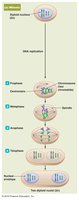
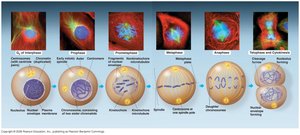
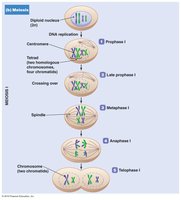
Comparison of Mitosis and Meiosis
Feature | Mitosis | Meiosis |
|---|---|---|
DNA Replication | Occurs during interphase, before nuclear division | Occurs during interphase, before meiosis I begins |
Number of Divisions | One | Two (meiosis I and II) |
Crossing Over | Does not occur | Occurs during prophase I |
Resulting Cells | Two diploid, genetically identical | Four haploid, genetically unique |

Cytokinesis and Special Forms of Division
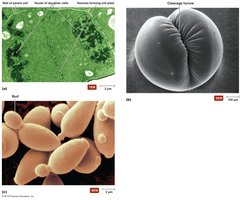
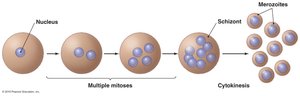
Cytokinesis is the division of the cytoplasm, which may occur differently in various eukaryotes. In some protozoa, a special type of division called schizogony occurs, resulting in multiple daughter cells from a single parent cell.
Animal cells: Form a cleavage furrow via actin microfilaments.
Plant cells: Form a cell plate that develops into a new cell wall.
Yeast: Budding produces new cells.
Schizogony: Multiple mitoses without cytokinesis, followed by sudden cytokinesis to produce many daughter cells (merozoites).
Classification of Eukaryotic Microorganisms
Historical and Modern Classification
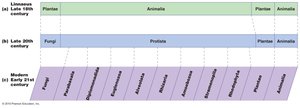
The classification of eukaryotic microbes has evolved from simple plant/animal groupings to complex systems based on genetic and ultrastructural data. Modern taxonomy recognizes multiple kingdoms and supergroups.
Early systems grouped algae and fungi as plants, protozoa as animals.
Modern systems use molecular data (e.g., 18S rRNA) and cellular features.
Protozoa
General Characteristics
Protozoa are unicellular, eukaryotic organisms lacking cell walls. They are highly diverse in morphology, life cycle, and ecological roles.
Motility via cilia, flagella, or pseudopods (except apicomplexans).
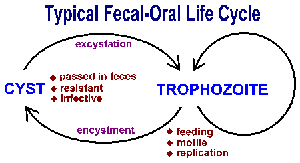
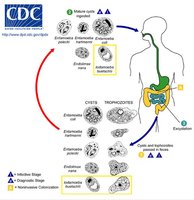
Life cycle stages: trophozoite (active, feeding) and cyst (dormant, resistant).
Nutrition and Reproduction
Most protozoa are chemoheterotrophs, obtaining nutrients by ingesting other organisms or organic matter. Some are photoautotrophic. Reproduction is primarily asexual (binary fission, schizogony), but sexual processes (gamete fusion, conjugation) also occur.
Classification of Protozoa
Protozoa are classified into several groups based on genetic and structural features:
Parabasala: Lack mitochondria, have a parabasal body. Example: Trichomonas vaginalis.
Diplomonadida: Lack mitochondria, Golgi, and peroxisomes; have two nuclei. Example: Giardia intestinalis.
Euglenozoa: Have flagella with crystalline rods, disk-shaped mitochondrial cristae. Includes euglenids (photoautotrophs) and kinetoplastids (e.g., Trypanosoma).
Alveolata: Have alveoli beneath the plasma membrane. Includes ciliates, apicomplexans, and dinoflagellates.
Rhizaria: Amoebae with threadlike pseudopods, often with shells (foraminifera, radiolaria).
Amoebozoa: Amoebae with lobe-shaped pseudopods, no shells; includes slime molds.
Fungi
General Characteristics and Significance
Fungi are eukaryotic, chemoheterotrophic organisms with cell walls composed of chitin. They play essential roles in decomposition, nutrient cycling, and biotechnology, but also include important pathogens.
Body forms: Hyphae (filamentous), yeast (unicellular), and dimorphic (both forms).
Reproduction: Asexual (budding, spore formation) and sexual (spore formation after nuclear fusion and meiosis).
Classification of Fungi
Fungi are divided into major groups based on reproductive structures:
Zygomycota: Coenocytic molds, reproduce via zygospores.
Ascomycota: Form ascospores in asci; includes many yeasts and molds.
Basidiomycota: Produce basidiospores on basidia; includes mushrooms.
Deuteromycetes: Fungi with unknown sexual stages.
Lichens
Lichens are symbiotic associations between fungi and photosynthetic microbes (algae or cyanobacteria). They are ecologically important as pioneer species and bioindicators.
Algae
General Characteristics
Algae are simple, eukaryotic phototrophs that perform oxygenic photosynthesis. They differ from plants in their reproductive structures and life cycles.
Distribution: Mostly aquatic, found in various water bodies.
Morphology: Unicellular, colonial, or multicellular (thalli).
Reproduction: Asexual (mitosis, fragmentation) and sexual (alternation of generations).
Classification of Algae
Algae are classified based on pigments, storage products, and cell wall composition:
Chlorophyta (green algae): Chlorophylls a and b, cellulose walls.
Rhodophyta (red algae): Phycoerythrin pigment, agar/carrageenan walls.
Phaeophyta (brown algae): Chlorophylls a and c, alginic acid in walls.
Chrysophyta (golden algae, diatoms): Chrysolaminarin storage, silica walls.
Water Molds
Water molds are fungus-like organisms classified in the kingdom Stramenopila. They differ from true fungi in mitochondrial structure, cell wall composition, and life cycle. Some are important plant pathogens.
Parasitic Helminths and Arthropod Vectors
Parasitic helminths (worms) and arthropod vectors are medically important eukaryotes. Helminths are diagnosed by their eggs or larvae, while arthropods transmit various pathogens as mechanical or biological vectors.
Arachnids: Ticks and mites; vectors for bacterial, viral, and protozoan diseases.
Insects: Fleas, lice, flies, mosquitoes, and kissing bugs; major disease vectors.
