 Back
BackCharacterizing and Classifying Prokaryotes
Study Guide - Smart Notes
 Tailored notes based on your materials, expanded with key definitions, examples, and context.
General Characteristics of Prokaryotes
Overview of Prokaryotes
Prokaryotes are the most numerous and diverse group of cellular microbes, thriving in a wide variety of habitats. While most prokaryotes are harmless or beneficial, only a small subset are capable of colonizing humans and causing disease.
Definition: Prokaryotes are unicellular organisms lacking a membrane-bound nucleus and organelles.
Habitats: Found in soil, water, extreme environments (hot springs, salt lakes), and as symbionts or pathogens in other organisms.
Importance: Essential for nutrient cycling, biotechnology, and as model organisms in research.
Endospores
Formation and Significance
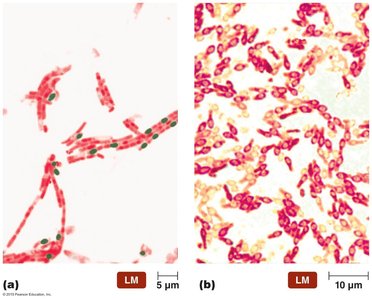
Endospores are highly resistant, dormant structures formed by certain Gram-positive bacteria, such as Bacillus and Clostridium. They serve as a defensive strategy against unfavorable environmental conditions.
Formation: Each vegetative cell transforms into one endospore; each endospore can germinate to form one vegetative cell.
Resistance: Endospores are extremely difficult to destroy, withstanding heat, desiccation, chemicals, and radiation.
Relevance: Endospores are a major concern for food processors, healthcare professionals, and governments due to their persistence and potential to cause disease.
Example: Bacillus anthracis (anthrax) and Clostridium botulinum (botulism) produce endospores.
Reproduction of Prokaryotes
Modes of Asexual Reproduction
All prokaryotes reproduce asexually, employing several different methods to ensure survival and genetic continuity.
Binary Fission: The most common method, involving DNA replication, elongation of the cell, and division into two daughter cells.
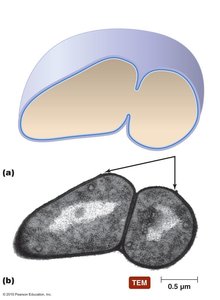
Snapping Division: A variation of binary fission where the inner cell wall layer forms a cross wall, and the outer layer ruptures, causing cells to remain attached in a hinge-like fashion.
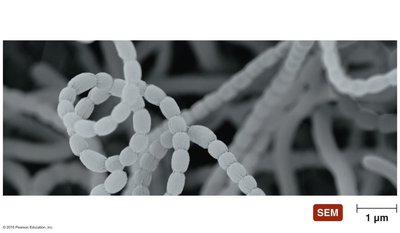
Reproductive Spores: Some filamentous bacteria (e.g., actinomycetes) produce spores for reproduction.
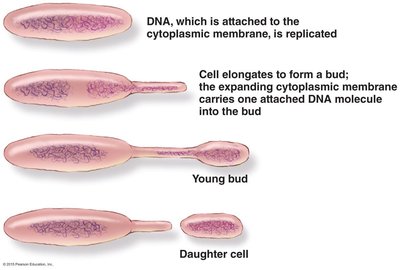
Budding: A new cell develops from a bud due to localized cell growth.
Viviparity: Rare; observed in Epulopiscium, where live offspring emerge from the parent cell.
Binary Fission
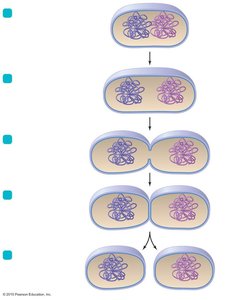
Binary fission is the primary method of prokaryotic cell division, resulting in two genetically identical daughter cells.
Steps:
Cell replicates its DNA.
The cytoplasmic membrane elongates, separating DNA molecules.
A cross wall forms and the membrane invaginates.
The cross wall completes, dividing the cell.
Daughter cells may separate or remain attached.
Snapping Division
Snapping division is a unique form of cell division seen in some Gram-positive bacteria, where the outer cell wall ruptures unevenly, leaving cells attached at a hinge.
Characteristic: Results in angular arrangements of cells.
Reproductive Spores
Filamentous bacteria, such as actinomycetes, form reproductive spores that can disperse and germinate into new cells.
Example: Streptomyces species produce chains of spores.
Budding
Budding is a process where a new cell develops from a localized outgrowth (bud) on the parent cell, eventually detaching as a daughter cell.
Example: Observed in some bacteria and yeasts.
Arrangements of Prokaryotic Cells
Cellular Arrangements
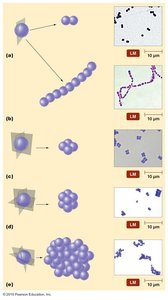
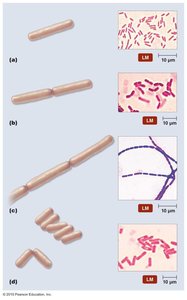
The arrangement of prokaryotic cells is determined by the planes in which cells divide and whether daughter cells remain attached after division.
Cocci (spherical): Arrangements include diplococci (pairs), streptococci (chains), tetrads (groups of four), sarcinae (cubical packets), and staphylococci (clusters).
Bacilli (rod-shaped): Arrangements include single bacilli, diplobacilli (pairs), streptobacilli (chains), palisades (side-by-side), and V-shapes.
Modern Prokaryotic Classification
Taxonomy and Systematics
Modern classification of prokaryotes is primarily based on genetic relatedness, especially rRNA sequence analysis. This approach has led to the recognition of three domains: Archaea, Bacteria, and Eukarya.
Three Domains: Archaea, Bacteria, Eukarya.
Reference: Bergey’s Manual of Systematic Bacteriology is the standard for prokaryotic classification.
Hierarchy: Domain → Phylum → Class → Order → Family → Genus → Species.
Example: Escherichia coli is classified as Domain Bacteria, Phylum Proteobacteria, Class Gammaproteobacteria, Order Enterobacterales, Family Enterobacteriaceae, Genus Escherichia, Species E. coli.
Rank | Name |
|---|---|
Domain | Bacteria |
Phylum | Proteobacteria |
Class | Gammaproteobacteria |
Order | Enterobacterales |
Family | Enterobacteriaceae |
Genus | Escherichia |
Species | E. coli |
Additional info: rRNA gene sequencing is a powerful tool for determining evolutionary relationships among prokaryotes, leading to the discovery of deeply branching lineages and the separation of Archaea from Bacteria.
