 Back
BackCharacterizing and Classifying Prokaryotes: Structure, Reproduction, and Diversity
Study Guide - Smart Notes
 Tailored notes based on your materials, expanded with key definitions, examples, and context.
Characterizing and Classifying Prokaryotes
General Characteristics of Prokaryotes
Prokaryotes are the most diverse group of cellular microbes, thriving in a wide range of habitats. While only a few prokaryotes are capable of colonizing humans and causing disease, they exhibit a remarkable diversity in morphology and physiology.
Diversity: Prokaryotes include both Bacteria and Archaea, with a wide variety of shapes and metabolic capabilities.
Habitats: Found in soil, water, extreme environments, and as part of the normal flora of humans and animals.
Pathogenicity: Only a minority are pathogenic to humans.
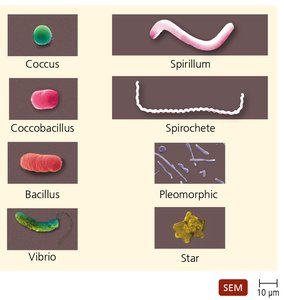
Morphology: Includes cocci, bacilli, spirilla, spirochetes, vibrios, and pleomorphic forms.
Endospores
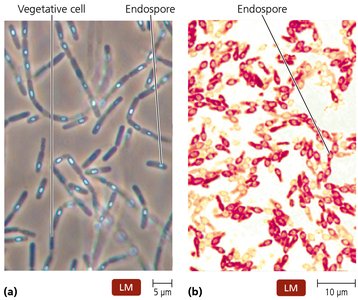
Endospores are highly resistant, dormant structures formed by certain Gram-positive bacteria, such as Bacillus and Clostridium. They allow survival in harsh conditions and are a significant concern in healthcare due to their resistance to disinfection and their role in disease transmission.
Formation: Each vegetative cell forms one endospore; each endospore can germinate to form one vegetative cell.
Function: Defensive strategy against unfavorable conditions (e.g., heat, desiccation, chemicals).
Medical Importance: Endospores are difficult to eradicate and can cause diseases such as anthrax, tetanus, and botulism.
Reproduction of Prokaryotic Cells
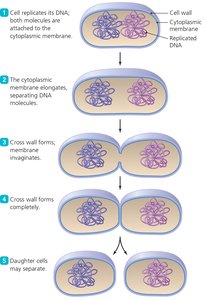
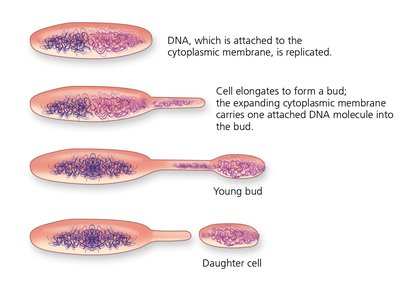
All prokaryotes reproduce asexually, utilizing several methods. The most common is binary fission, but other mechanisms include snapping division, spore formation, fragmentation, and budding.
Binary Fission: The cell duplicates its DNA, elongates, and divides into two genetically identical daughter cells.
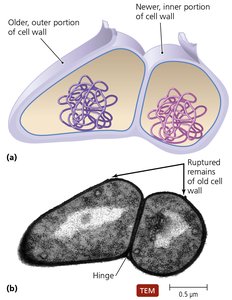
Snapping Division: A variation of binary fission where the inner cell wall layer forms a cross wall, causing the cell to snap apart.
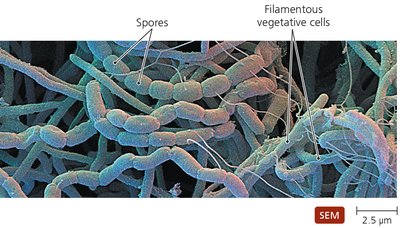
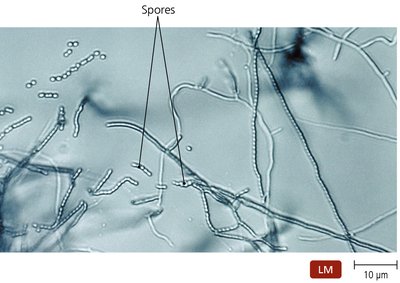
Spores: Some prokaryotes (not endospores) reproduce by forming reproductive spores.
Fragmentation and Budding: Less common; cells split into fragments or form buds that develop into new cells.
Arrangements of Prokaryotic Cells
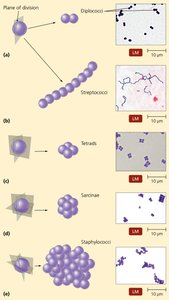
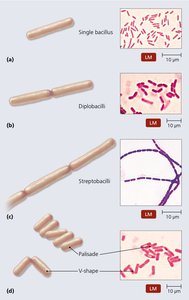
The arrangement of prokaryotic cells results from the planes in which cells divide and whether daughter cells remain attached. Common arrangements include diplococci, streptococci, tetrads, sarcinae, and staphylococci for cocci; and single, diplo-, strepto-, palisade, and V-shaped for bacilli.
Planes of Division: Single, multiple, or random planes lead to different arrangements.
Separation: Complete or incomplete separation of daughter cells determines the final arrangement.
Classification of Prokaryotes
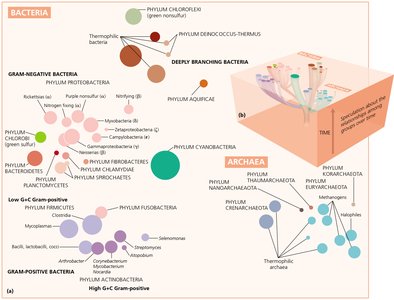
Modern classification of prokaryotes is based primarily on genetic relatedness, especially rRNA gene sequences. The three domains of life are Archaea, Bacteria, and Eukarya.
Domains: Archaea (ancient prokaryotes), Bacteria (true bacteria), and Eukarya (eukaryotes).
Phylogenetic Relationships: Determined by molecular techniques, especially 16S rRNA sequencing.
Survey of Bacteria
Gram-Positive Bacteria
Gram-positive bacteria are divided into two groups based on their G+C content: Low G+C and High G+C Gram-positive bacteria. They include many medically and industrially important genera.
Low G+C Gram-Positive Bacteria
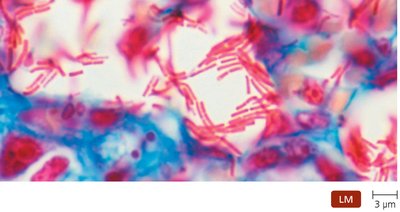
Clostridia: Obligate anaerobic rods, form endospores. Clostridium botulinum (botulism), C. tetani (tetanus).
Bacillus: Aerobic, endospore-forming rods. B. anthracis (anthrax), B. cereus (food poisoning).
Mycoplasmas: Lack cell walls, smallest free-living cells, colonize mucous membranes.
Streptococcus & Enterococcus: Catalase-negative cocci, cause various diseases, often multi-drug resistant.
Staphylococcus: Catalase-positive cocci in clusters, common human inhabitant, produces toxins and enzymes.
Listeria: Pathogenic, can cross placenta, contaminates food.
Lactobacillus: Used in food production, rarely pathogenic.
High G+C Gram-Positive Bacteria (Actinobacteria)
Corynebacterium: Pleomorphic rods, snapping division, diphtheria.
Mycobacterium: Waxy cell walls (mycolic acid), slow-growing, tuberculosis and leprosy.
Actinomycetes: Branching filaments, produce spores, important for antibiotic production (e.g., Streptomyces).
Nocardia: Degrade pollutants, cause lesions.
Selected Gram-Positive Bacteria Table
Phylum/Class | G+C % | Representative Genera | Special Characteristics | Diseases |
|---|---|---|---|---|
Clostridia | Low (<50%) | Clostridium | Obligate anaerobic rod; endospore former | Tetanus, botulism, gangrene, severe diarrhea |
Mollicutes | Low (<50%) | Mycoplasma | Lacks cell walls; pleomorphic; smallest free-living cell | Pneumonia, urinary tract infections |
Bacilli | Low (<50%) | Bacillus | Facultative anaerobic rod; endospore former | Anthrax |
Bacilli | Low (<50%) | Listeria | Contaminates dairy products | Listeriosis |
Bacilli | Low (<50%) | Lactobacillus | Produces yogurt, buttermilk, pickles, sauerkraut | Rare blood infections |
Bacilli | Low (<50%) | Streptococcus | Cocci in chains | Strep throat, scarlet fever, and others |
Bacilli | Low (<50%) | Staphylococcus | Cocci in clusters | Bacteremia, food poisoning, and others |
Actinobacteria | High (>50%) | Corynebacterium | Snapping division; metachromatic granules | Diphtheria |
Actinobacteria | High (>50%) | Mycobacterium | Waxy cell walls (mycolic acid) | Tuberculosis, leprosy |
Actinobacteria | High (>50%) | Actinomyces | Filaments | Actinomycosis |
Actinobacteria | High (>50%) | Nocardia | Filaments; degrade pollutants | Lesions |
Actinobacteria | High (>50%) | Streptomyces | Produce antibiotics | Rare sinus infections |
Gram-Negative Bacteria
Gram-negative bacteria are highly diverse and include several major groups, with Proteobacteria being the largest and most varied. Other important groups include Chlamydias, Spirochetes, and Bacteroids.
Proteobacteria
Six Classes: Alphaproteobacteria, Betaproteobacteria, Gammaproteobacteria, Deltaproteobacteria, Epsilonproteobacteria, Zetaproteobacteria.
Alphaproteobacteria: Includes Rickettsia (obligate intracellular, arthropod-borne diseases) and Brucella (zoonotic pathogen).
Betaproteobacteria: Includes Neisseria (diplococci, mucous membranes, many diseases), Bordetella (pertussis), Burkholderia (cystic fibrosis infections).
Gammaproteobacteria: Largest class; includes Legionella (Legionnaires’ disease), Coxiella (Q fever), Pseudomonas (opportunistic infections), and glycolytic facultative anaerobes (e.g., Escherichia, Salmonella, Shigella, Yersinia, Klebsiella).
Deltaproteobacteria: Diverse metabolic types.
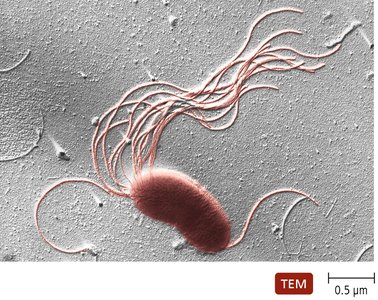
Epsilonproteobacteria: Includes Campylobacter and Helicobacter.
Zetaproteobacteria: Rare, mostly found in marine environments.
Gammaproteobacteria: Glycolytic Facultative Anaerobes Table
Family | Special Characteristics | Representative Genera | Typical Human Diseases |
|---|---|---|---|
Enterobacteriaceae | Straight rods; oxidase negative; peritrichous flagella or nonmotile | Escherichia | Gastroenteritis |
Enterobacteriaceae | Salmonella | Enteritis | |
Enterobacteriaceae | Proteus | Urinary tract infection | |
Enterobacteriaceae | Shigella | Shigellosis | |
Enterobacteriaceae | Yersinia | Plague | |
Enterobacteriaceae | Klebsiella | Pneumonia | |
Vibrionaceae | Vibrios; oxidase positive; polar flagella | Vibrio | Cholera |
Pasteurellaceae | Cocci or straight rods; oxidase positive; nonmotile | Haemophilus | Meningitis in children, middle ear infections, pneumonia |
Other Gram-Negative Bacteria
Chlamydias: Obligate intracellular pathogens, some smaller than viruses, cause sexually transmitted infections.
Spirochetes: Motile, corkscrew-shaped, cause diseases such as syphilis (Treponema) and Lyme disease (Borrelia).
Bacteroids: Common in digestive tracts, some species are opportunistic pathogens.
Quiz Review: Key Concepts
Spores vs. Endospores: Spores are reproductive structures; endospores are stable resting structures.
Staphylococci Formation: Staphylococci form when planes of cell division are random.
Betaproteobacteria: They are Gram-negative, differ from alphaproteobacteria in rRNA sequences, and include bacteria that can recycle sulfur.
Summary
This guide provides an overview of the diversity, structure, reproduction, and classification of prokaryotes, with emphasis on medically important groups. Understanding these foundational concepts is essential for further study in microbiology, infectious diseases, and microbial ecology.
