 Back
BackChemical Control of Microbial Growth
Study Guide - Smart Notes
 Tailored notes based on your materials, expanded with key definitions, examples, and context.
Chemical Control of Microbial Growth
Introduction to Chemical Control
Chemical agents are widely used to control microbial growth on both living tissues and inanimate objects. While most chemical agents do not achieve sterilization, they are effective in reducing microbial populations or removing vegetative cells. The selection of an appropriate chemical agent depends on the target organisms, the nature of the material to be disinfected, and environmental factors.
Disinfectants are chemicals used on inanimate objects to destroy most microorganisms (excluding spores).
Antiseptics are chemicals applied to living tissue to reduce the risk of infection.
No single disinfectant is universally effective; labels indicate their spectrum of activity.
Proper dilution and contact time are critical for effectiveness.
Factors affecting chemical control:
Nature of the material (e.g., presence of organic matter can inhibit disinfectant action)
pH of the environment
Contact time between disinfectant and microbes
Pre-cleaning may be necessary for optimal results
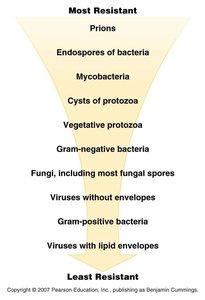
Effects of Microbe Type on Chemical Control
Microbial control methods vary in their effectiveness against different groups of organisms. The structural characteristics of microbes, such as the presence of an outer membrane or waxy cell wall, influence their susceptibility to chemical agents.
Gram-positive bacteria are generally more susceptible to biocides than gram-negative bacteria due to the protective outer membrane (LPS layer) in gram-negatives.
Pseudomonas and Burkholderia species are highly resistant to many disinfectants.
Mycobacteria possess a waxy cell wall (mycolic acids), making them resistant to many chemicals.
Evaluation of Disinfectants
Several laboratory tests are used to evaluate the effectiveness of chemical disinfectants:
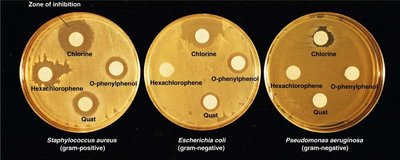
Disk Diffusion Test: Bacterial lawns are exposed to filter disks soaked in different disinfectants. The zone of inhibition around each disk indicates the effectiveness of the agent.
Use-Dilution Test: Metal cylinders are contaminated with test bacteria, exposed to disinfectants, and then incubated in broth to assess survival.
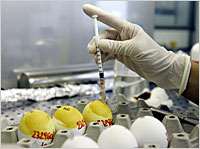
Use-Dilution Test for Virucides: Similar to the bacterial test, but uses viruses and embryonated eggs to detect viral survival.
Major Classes of Chemical Agents
Chemical agents used for microbial control can be classified into several major groups, each with distinct mechanisms of action and applications.
Phenolics
Bisphenols
Biguanides
Halogens
Alcohols
Heavy metals
Aldehydes
Surface-active agents
Chemical food preservatives
Gaseous chemosterilizers
Peroxygens
Antibiotics
Phenolics and Bisphenols
Phenolics
Phenolics are derivatives of phenol (carbolic acid), first used by Joseph Lister in surgery. They are lipid-soluble compounds that disrupt cell membranes and denature proteins, making them effective against a broad range of microbes, including mycobacteria.
Phenolics are stable and remain active in the presence of organic matter.
Cresols (e.g., o-phenylphenol) are more effective and less irritating than phenol.
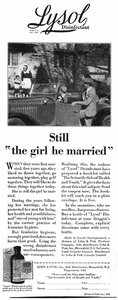
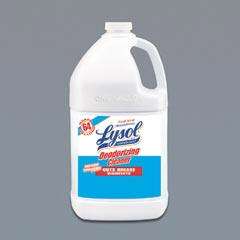
Commonly used in surface disinfectants (e.g., Lysol).

Bisphenols
Bisphenols consist of two phenolic groups connected by a bridge. They are commonly used in household and healthcare products.
Hexachlorophene: Effective against gram-positive staphylococci and streptococci; used in skin cleansers but can cause neurological damage if absorbed through the skin, especially in infants.
Triclosan: Found in antibacterial soaps, toothpaste, and other products. It inhibits an enzyme required for membrane lipid synthesis and is effective against gram-positive bacteria, some gram-negatives, and fungi. However, Pseudomonas is resistant.
Issues with Bisphenols
Triclosan is being removed from many products due to concerns about resistance and health risks.
Potential for cross-resistance to antibiotics.
Detectable in human tissues and the environment; may disrupt immune and endocrine function.
Biguanides
Chlorhexidine
Chlorhexidine is a bisbiguanide used for skin and mucous membrane disinfection. It disrupts cell membranes and affects enzymes involved in aerobic respiration and lipid synthesis.
Used in surgical hand scrubs, skin preparations, and oral rinses.
Effective against vegetative bacteria, yeast, and enveloped viruses.
Ineffective against mycobacteria, endospores, non-enveloped viruses, and Pseudomonas aeruginosa.
Halogens
Iodine
Iodine is a potent antimicrobial agent that impairs protein synthesis and alters cell membranes. It is effective against most bacteria, some endospores, fungi, and viruses.
Tincture: Iodine dissolved in alcohol.
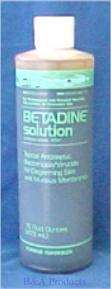
Iodophore: Iodine complexed with an organic molecule (e.g., povidone-iodine, Betadine) for slower release and reduced irritation.
Used for skin disinfection and wound treatment.
Chlorine
Chlorine is used in various forms for disinfection and sterilization. In water, it forms hypochlorous acid (HOCl), a strong oxidizing agent that disrupts microbial enzymes.
Used to disinfect municipal drinking water, dairy equipment, and food processing facilities.
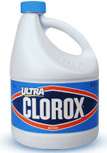
Sodium hypochlorite (bleach): Common household and industrial disinfectant.
Calcium hypochlorite: Used in dairies and restaurants.
Chlorine dioxide gas: Used for fumigating and sterilizing enclosed spaces.
Chloramine (chlorine + ammonia): Releases chlorine slowly; used for sanitizing glassware and equipment.
Summary Table: Relative Resistance of Microbes to Chemical Agents
The following table summarizes the relative resistance of different types of microbes to chemical disinfectants:
Most Resistant | Least Resistant |
|---|---|
Prions | Viruses with lipid envelopes |
Endospores of bacteria | Gram-positive bacteria |
Mycobacteria | Viruses without envelopes |
Cysts of protozoa | Fungi, including most fungal spores |
Vegetative protozoa | Gram-negative bacteria |
Key Takeaways
Chemical agents are essential tools for controlling microbial growth, but their effectiveness depends on the type of microbe, the environment, and the agent's properties.
Proper selection, dilution, and application are critical for achieving desired levels of disinfection or antisepsis.
Understanding the mechanisms and limitations of each chemical class helps ensure safe and effective microbial control in healthcare, industry, and daily life.
