 Back
BackChemical Disinfection, Antisepsis, and Preservation: Principles and Applications
Study Guide - Smart Notes
 Tailored notes based on your materials, expanded with key definitions, examples, and context.
Chemical Disinfection, Antisepsis, and Preservation (DAP)
Introduction to DAP
Chemical disinfection, antisepsis, and preservation are essential strategies for controlling microbial growth in medical, pharmaceutical, and industrial settings. These processes utilize chemical agents to destroy or inhibit microorganisms, thereby reducing infection risks and preventing spoilage.
Disinfectants: Used on non-living objects to kill or reduce microorganisms.
Antiseptics: Applied to living tissues to inhibit or destroy microbes.
Preservatives: Added to products to prevent microbial spoilage and ensure safety during storage and use.
Applications include healthcare, food and beverage production, pharmaceuticals, and environmental sanitation.
Key Definitions in DAP
Essential Terms
Antisepsis: Reduction or inhibition of microbes on living tissue.
Antibiotic: Organic substance produced by microorganisms that inhibits or destroys other microbes at low concentrations.
Bactericide: Chemical agent that kills bacteria.
Bacteriostat: Inhibits bacterial growth without necessarily killing them.
Biocide: Substance toxic to living organisms.
Degerming: Mechanical removal of microbes (e.g., handwashing).
Virucide: Kills viruses.
Fungicide: Kills fungi and/or their spores.
Sporicide: Destroys spores.
Sanitizer: Reduces pathogenic microbes on surfaces to safe levels.
Disinfectant: Used on non-living objects to kill or reduce pathogens.
Disinfection: Process of removing or reducing microorganisms on inanimate objects to acceptable levels.
Classification of Chemical Disinfectants
Levels of Disinfection
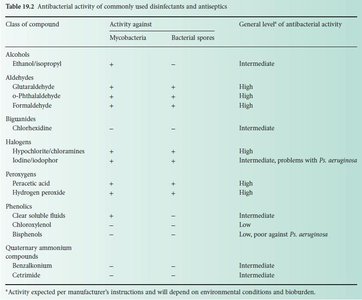
High-level disinfectants (Sterilants): Kill all organisms except high levels of bacterial spores. Examples: Ethylene oxide, glutaraldehyde, hydrogen peroxide gas, peracetic acid.
Intermediate-level disinfectants: Kill vegetative bacteria (including Mycobacterium tuberculosis), most fungi and viruses, but not spores. Examples: Alcohol-based phenolics, iodophors, sodium hypochlorites.
Low-level disinfectants: Destroy most vegetative bacteria, fungi, and some viruses, but not spores or resistant organisms.
Categories of Medical Devices (Spaulding Classification)
Critical items: Enter sterile tissue or vascular system; require sterilization (e.g., surgical instruments).
Non-critical items: Contact only intact skin; require low-level disinfection (e.g., bed linen).
Factors Affecting the Choice and Efficacy of DAP Agents
Key Factors
Properties of the agent: Concentration, temperature, pH, formulation.
Microbial challenge: Type and quantity of microorganisms (bioburden).
Intended application: Compatibility with materials and surfaces.
Environmental factors: Presence of organic matter, ions, and other interfering substances.
Toxicity: Safety for humans, animals, and the environment.
Groups and Types of DAP Agents
Major Chemical Groups
Acids and esters
Alcohols
Aldehydes
Biguanides
Halogens
Heavy metals
Hydrogen peroxide and peroxygen compounds
Phenols
Surface active agents (QACs)
Others: Diamidines, dyes, quinolone derivatives
Use-Based Groupings
Air disinfectants: Alcohols, halogens (e.g., dilute bleach in burn units).
Surface disinfectants: Acids, alkalis, halogens, phenols, alcohols, aldehydes, dyes, metals, surface active agents.
Mechanisms of Action of Disinfectants
How Disinfectants Work
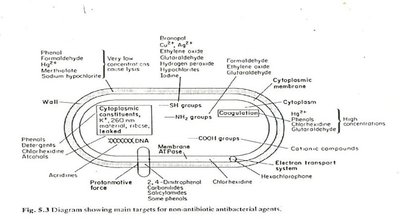
Disinfectants act by damaging essential microbial structures or functions:
Protein denaturation
Membrane disruption
Nucleic acid damage
Inhibition of metabolism
Steps in Microbial Inactivation
Adsorption to microbial surface
Diffusion through surface
Binding to vulnerable sites (membrane, proteins, nucleic acids)
Disruption and injury leading to cell death
Properties of an Ideal Disinfectant
Desirable Characteristics
Fast-acting, even in the presence of organic matter
Broad-spectrum efficacy
Non-toxic, non-corrosive, and inexpensive
Stable under various conditions
No unpleasant odor
Easy to prepare and use
Note: No disinfectant is ideal; combinations are often used to enhance efficacy and reduce limitations.
Antimicrobial Combinations
Rationale and Examples
Combinations overcome limitations such as resistance, instability, or toxicity.
Examples: Ethanol + chlorhexidine + iodine; QACs + glutaraldehyde; hydrogen peroxide + peroxygen compounds.
Disinfection Policies and Committees
Policy Development
Institutions should have clear disinfection policies to guide chemical use.
Committees typically include pharmacists, microbiologists, and infection control personnel.
Risk categories are assigned to equipment to determine required decontamination levels.
Dynamics of Disinfection
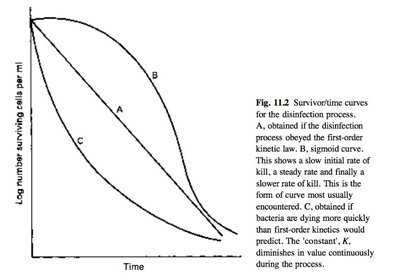
Bacterial Death Curves
The effectiveness of disinfection is often measured by plotting the number of surviving bacteria over time, resulting in a mortality curve. The rate of kill can be influenced by agent concentration, temperature, and microbial load.
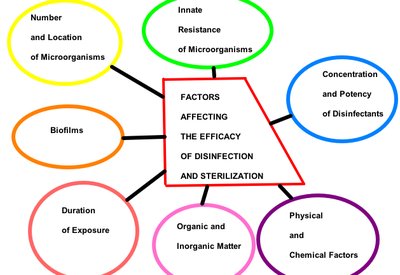
Factors Affecting Disinfection
Major Influences
Temperature: Higher temperatures generally increase the rate of disinfection.
Concentration: Higher concentrations of disinfectant increase potency and reduce required time.
pH: The ionization state of the agent and the microorganism's growth rate are pH-dependent.
Surface activity: Surfactants can enhance penetration and efficacy.
Other factors: Age of disinfectant, microbial load, type of microorganism, presence of organic matter, toxicity, and cost.
Resistance to Non-Antibiotic Antibacterial Agents
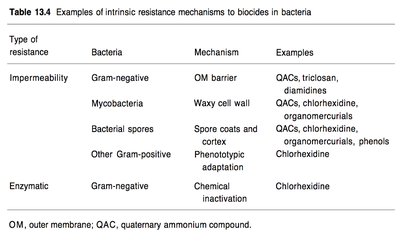
Intrinsic Resistance
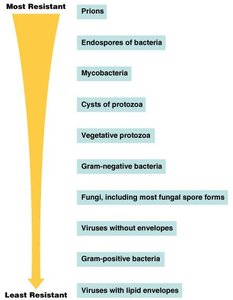
Due to structural or physiological traits (e.g., Gram-negative outer membrane, mycobacterial waxy cell wall, spore coats).
Biofilm formation and chromosomal control are common mechanisms.
Acquired Resistance
Results from chromosomal mutations or acquisition of genetic elements (plasmids, transposons).
Can involve enzymatic inactivation, impaired uptake, or efflux mechanisms.

Evaluation of Disinfectants
Testing Methods
Suspension tests: Assess bactericidal activity in liquid suspension.
Phenol coefficient tests: Compare efficacy to phenol (Rideal-Walker, Chick-Martin methods).
Capacity use-dilution test: Successive addition of bacteria to test disinfectant.
Membrane filtration: Retains treated cells on a filter for colony counting.
In vivo tests: Assess activity on living tissue (e.g., skin tests, hand disinfection).
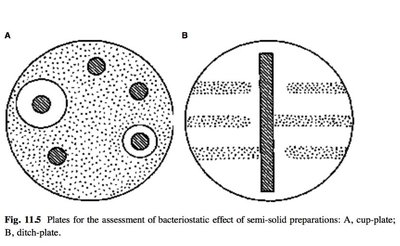
Ditch-plate and cup-plate techniques: Assess bacteriostatic effect of semi-solid preparations.
Antimicrobial Preservatives
Role and Properties
Prevent microbial spoilage and maintain product safety.
Used in pharmaceuticals, foods, cosmetics, and biological samples.
Should be non-toxic, broad-spectrum, stable, and compatible with product ingredients.
Examples of Preservatives
Preservative | Typical Concentration |
|---|---|
Benzoic acid/solution | 0.1% |
Salicylic acid | 4.0% |
Sorbic acid | 0.2% |
Sodium benzoate | 0.1% – 0.2% |
Benzyl alcohol | 0.9% |
Chlorbutol | 0.5% |
Ethyl alcohol | 15.0% |
Glycerol | 50.0% |
Cresol | 0.3% – 0.5% |
Phenol | 0.5% |
Chloroform | 0.02% |
Sucrose | 6.5% |
Factors Affecting Preservative Activity
Species and strain of microorganism
Morphological state (spores, capsules)
Cultural state (growth phase)
Nature of medium (aqueous vs. oily)
Inoculum size
Concentration of bactericide
Temperature (15–45°C)
pH and oxidation-reduction potential
Nature of medicament (dosage form)

Summary Table: Resistance Mechanisms
Type of Resistance | Bacteria | Mechanism | Examples |
|---|---|---|---|
Impermeability | Gram-negative | OM barrier | QACs, triclosan, diamidines |
Impermeability | Mycobacteria | Waxy cell wall | QACs, chlorhexidine |
Impermeability | Bacterial spores | Spore coats/cortex | QACs, organomercurials |
Impermeability | Other Gram-positive | Phenotypic adaptation | Chlorhexidine |
Enzymatic | Gram-negative | Chemical inactivation | Chlorhexidine |
Type of Resistance | Bacteria | Mechanism | Examples |
|---|---|---|---|
Enzymatic | Gram-positive/Gram-negative | Plasmid/Tn-encoded inactivation | Mercury compounds, formaldehyde |
Impaired uptake | Gram-negative | Plasmid-encoded porin modification | QACs |
Efflux | Gram-positive | Plasmid-encoded expulsion | QACs, chlorhexidine? |
Conclusion
Chemical disinfection, antisepsis, and preservation are foundational to infection control and product safety in microbiology. Understanding the mechanisms, factors affecting efficacy, and resistance patterns is essential for effective application and policy development in clinical and industrial environments.
