 Back
Chemical Principles and Important Biological Molecules in Microbiology
Study Guide - Smart Notes
 Tailored notes based on your materials, expanded with key definitions, examples, and context.
Chapter 2: Chemical Principles
Introduction
This chapter explores the foundational chemical principles relevant to microbiology, focusing on the types, properties, and functions of inorganic and organic molecules essential for life. Understanding these molecules is crucial for comprehending cellular structure, metabolism, and genetic information in microorganisms.
Inorganic Compounds
Properties of Water
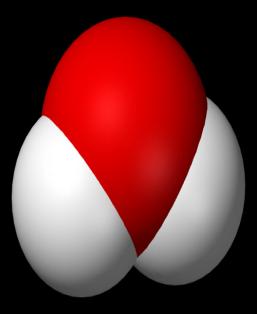
Water is the most important inorganic compound in biological systems, composing 65-75% of a cell. Its polarity allows it to form hydrogen bonds, resulting in high boiling temperature and effective temperature regulation. Water acts as a solvent, dissolving nutrients and facilitating their movement into and out of cells, and serves as a medium for chemical reactions.
Hydrogen Bonds: Water molecules form hydrogen bonds, contributing to its unique properties.
Solvent Function: Water dissolves salts and other solutes, which often dissociate in solution.
Source of Elements: Water provides oxygen and hydrogen for biological reactions.
Acids, Bases, and Salts
Acids, bases, and salts are inorganic compounds that play vital roles in cellular processes. Acids release hydrogen ions (H+), bases release hydroxide ions (OH-), and salts result from the reaction between acids and bases.
Acids: Substances that dissociate to release H+ ions.
Bases: Substances that dissociate to release OH- ions.
Salts: Ionic compounds formed from acid-base reactions.

pH and Buffers
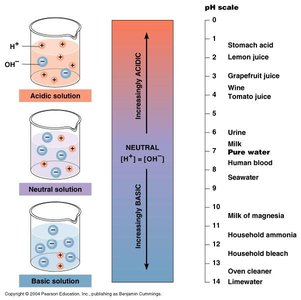
The pH scale measures the concentration of H+ ions in a solution, ranging from 0 (acidic) to 14 (basic). Biological systems require a narrow pH range for optimal function, maintained by buffers that stabilize pH.
Acidic Solutions: More H+ than OH-.
Basic Solutions: More OH- than H+.
Neutral Solutions: Equal H+ and OH-.
Buffer Systems: Maintain pH balance in organisms.
Organic Compounds
Characteristics of Organic Molecules
Organic compounds make up 98-99% of the material in living cells and always contain carbon and hydrogen. They often include other elements such as oxygen, nitrogen, sulfur, and phosphorus. Organic molecules are characterized by carbon skeletons and functional groups, which determine their chemical properties.
Carbon Chains: Provide structural backbone.
Functional Groups: Responsible for specific chemical properties.
Dehydration Synthesis and Hydrolysis
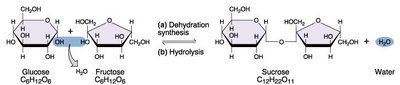
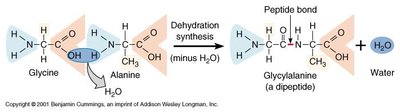
Biological macromolecules are formed and broken down by dehydration synthesis and hydrolysis. Dehydration synthesis joins monomers by removing water, forming polymers. Hydrolysis breaks polymers into monomers by adding water.
Monomers: Small building blocks (e.g., glucose, amino acids).
Polymers: Large molecules made of repeating monomers (e.g., starch, proteins).
Macromolecules: Very large polymers essential for life.
Important Biological Molecules
Carbohydrates
Carbohydrates include sugars and starches, composed of carbon, hydrogen, and oxygen (CH2O)n. They are classified as monosaccharides, disaccharides, and polysaccharides.
Monosaccharides: Single sugar units (e.g., glucose).
Disaccharides: Two sugar units (e.g., sucrose).
Polysaccharides: Many sugar units (e.g., glycogen, cellulose, starch).
Functions: Energy source, structural components, building blocks for nucleotides.
Polysaccharide | Source | Function |
|---|---|---|
Glycogen | Animals, some bacteria | Energy storage |
Cellulose | Plants | Structural component (cell wall) |
Starch | Plants | Energy storage |
Lipids
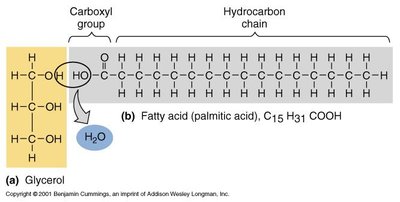
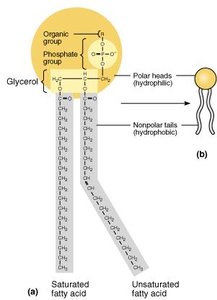
Lipids are hydrophobic molecules containing carbon, hydrogen, and oxygen. They are insoluble in water but dissolve in organic solvents. Lipids serve as energy storage and are key components of cell membranes.
Simple Lipids: Fats or triglycerides, composed of glycerol and fatty acids.
Complex Lipids: Phospholipids with polar heads and nonpolar tails, forming cell membranes.
Functions: Energy storage, membrane structure, selective permeability.
Amino Acids and Proteins
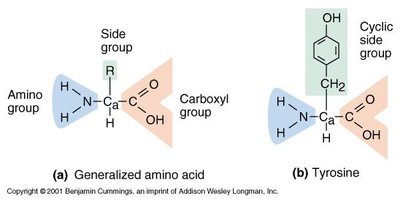
Amino acids are organic molecules containing an amino group (–NH2) and a carboxy group (–COOH). There are 20 standard amino acids, which join via peptide bonds to form polypeptides and proteins.
Peptide Bonds: Formed by dehydration synthesis between amino and carboxy groups.
Proteins: Polymers of amino acids, essential for cell structure and function.
Functions: Enzymes, transport, movement, cell structure, toxins, hormones, antibodies.
Nucleic Acids
Nucleic acids are polymers of nucleotides, which consist of a base, sugar, and phosphate group. DNA and RNA are the two main types, responsible for genetic information and protein synthesis.
DNA: Double-stranded, contains bases A, T, C, G; deoxyribose sugar.
RNA: Single-stranded, contains bases A, U, C, G; ribose sugar.
Nucleotides: Building blocks of nucleic acids.
Types of RNA: mRNA, rRNA, tRNA (involved in protein synthesis).

Adenosine Triphosphate (ATP)
ATP is the principal energy-carrying molecule in cells, structurally similar to a nucleotide. It consists of adenine, ribose, and three phosphate groups. Energy is released by breaking high-energy phosphate bonds.
Structure: Adenine base + ribose sugar + 3 phosphate groups.
Energy Release: ATP + H2O → ADP + P + Energy
Function: Immediate or stored energy for cellular activities.
Recap
Defined inorganic and organic molecules.
Discussed properties of water, acids, bases, and salts.
Explained dehydration synthesis and hydrolysis in biological molecule formation.
Described important biological molecules: carbohydrates, lipids, amino acids, proteins, nucleic acids, and ATP.
