Back
BackChemical Principles and Macromolecules in Microbiology
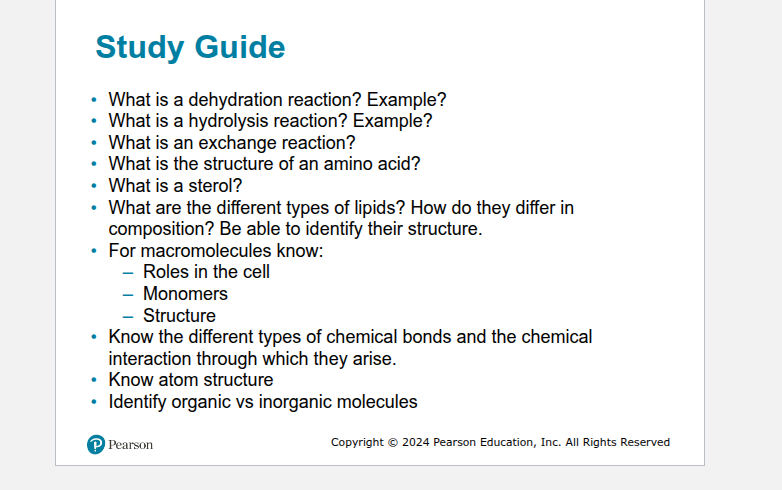
Study Guide - Smart Notes
 Tailored notes based on your materials, expanded with key definitions, examples, and context.
Chemical Principles in Microbiology
Dehydration Reactions
Dehydration reactions are fundamental chemical processes in biological systems, where two molecules are joined together with the removal of a water molecule. This type of reaction is essential for the synthesis of macromolecules such as proteins, carbohydrates, and nucleic acids.
Definition: A dehydration reaction (also called condensation reaction) is a process in which two molecules combine to form a larger molecule, releasing water (H2O) as a byproduct.
Example: Formation of a peptide bond between two amino acids.
Equation:
Hydrolysis Reactions
Hydrolysis reactions are the reverse of dehydration reactions and are crucial for breaking down macromolecules into their monomeric units.
Definition: A hydrolysis reaction is a process in which a molecule is split into two smaller molecules by the addition of water.
Example: Breakdown of a disaccharide (such as sucrose) into monosaccharides.
Equation:
Exchange Reactions
Exchange reactions involve the transfer of atoms or groups between molecules, combining aspects of both synthesis and decomposition.
Definition: An exchange reaction occurs when parts of two molecules are exchanged to form two new molecules.
Example:
Macromolecules: Structure and Function
Amino Acids and Proteins
Amino acids are the building blocks of proteins, which perform a wide range of functions in cells.
Structure of an Amino Acid: Each amino acid contains a central carbon atom (alpha carbon), an amino group (NH2), a carboxyl group (COOH), a hydrogen atom, and a variable R group.
General Formula:
Roles in the Cell: Enzymes, structural proteins, transport, signaling.
Monomers: Amino acids.
Structure: Primary, secondary, tertiary, and quaternary levels.
Sterols
Sterols are a subgroup of steroids, important components of cell membranes, especially in eukaryotes.
Definition: Sterols are lipids characterized by a four-ring structure.
Example: Cholesterol in animal cell membranes.
Types of Lipids
Lipids are diverse molecules with key roles in energy storage, membrane structure, and signaling.
Types:
Triglycerides: Composed of glycerol and three fatty acids.
Phospholipids: Composed of glycerol, two fatty acids, and a phosphate group; major component of cell membranes.
Sterols: Four-ring structure; e.g., cholesterol.
Differences in Composition: Triglycerides are neutral fats, phospholipids have a hydrophilic head and hydrophobic tails, sterols have a rigid ring structure.
Macromolecules Overview
Macromolecules are large, complex molecules essential for life. They include carbohydrates, proteins, lipids, and nucleic acids.
Roles in the Cell: Structure, energy storage, catalysis, information storage.
Monomers:
Carbohydrates: Monosaccharides
Proteins: Amino acids
Lipids: Fatty acids and glycerol
Nucleic acids: Nucleotides
Structure: Polymers formed by dehydration reactions; specific structures determine function.
Chemical Bonds and Atomic Structure
Types of Chemical Bonds
Chemical bonds are forces that hold atoms together in molecules. Their nature determines the properties of compounds.
Ionic Bonds: Formed by the transfer of electrons from one atom to another, resulting in charged ions.
Covalent Bonds: Formed by the sharing of electrons between atoms.
Hydrogen Bonds: Weak attractions between a hydrogen atom and an electronegative atom (e.g., oxygen or nitrogen).
Atomic Structure
Atoms are the basic units of matter, consisting of a nucleus (protons and neutrons) and electrons orbiting the nucleus.
Components:
Protons: Positively charged, found in the nucleus.
Neutrons: Neutral, found in the nucleus.
Electrons: Negatively charged, orbit the nucleus.
Atomic Number: Number of protons in the nucleus.
Mass Number: Sum of protons and neutrons.
Organic vs Inorganic Molecules
Classification of Molecules
Molecules are classified as organic or inorganic based on their composition and origin.
Organic Molecules: Contain carbon and hydrogen, often found in living organisms (e.g., proteins, lipids, carbohydrates, nucleic acids).
Inorganic Molecules: Do not contain both carbon and hydrogen; include water, salts, acids, and bases.
Example Table:
Type | Contains C-H Bonds? | Examples |
|---|---|---|
Organic | Yes | Glucose, DNA, Proteins |
Inorganic | No | Water, NaCl, CO2 |