 Back
Chemical Principles in Microbiology: Structure and Function of Biological Molecules
Study Guide - Smart Notes
 Tailored notes based on your materials, expanded with key definitions, examples, and context.
Important Biological Molecules
Organic and Inorganic Compounds
Biological systems are composed of both organic and inorganic compounds, each playing essential roles in cellular structure and function.
Organic compounds always contain carbon and hydrogen. They form the backbone of macromolecules essential for life.
Inorganic compounds typically lack carbon and include water, salts, acids, and bases.
Macromolecules of life include proteins, lipids, carbohydrates, and nucleic acids.
Inorganic Compounds: Water
Structure and Properties of Water
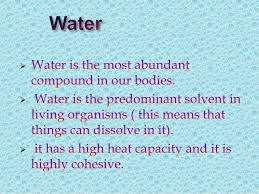
Water is the most abundant compound in living organisms and is critical for life due to its unique chemical properties.
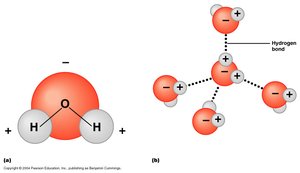
Polar covalent bonds within water molecules create a polar molecule, with partial positive charges on hydrogen atoms and a partial negative charge on oxygen.
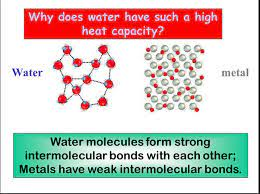
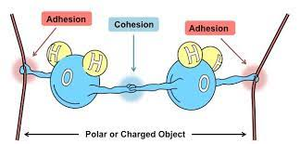
Hydrogen bonding between water molecules leads to high cohesion, surface tension, and a high heat capacity, making water an excellent temperature buffer.
Water acts as a solvent, dissolving polar substances and facilitating chemical reactions in cells.
Water as a Solvent
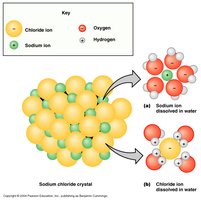
Water's polarity allows it to dissociate ionic compounds, forming solutions essential for biological processes.
Polar substances dissociate in water, forming solutes.
Hydrogen bonding contributes to water's role as a temperature buffer and solvent.
Acids, Bases, and Salts
Acids, bases, and salts are important inorganic compounds that participate in cellular chemical reactions and help maintain pH balance.
Acids dissociate into one or more H+ ions (e.g., ).
Bases dissociate into one or more OH− ions (e.g., ).
Salts dissociate into cations and anions, neither of which is H+ or OH− (e.g., ).
The pH of a solution is defined as .
Most organisms grow best between pH 6.5 and 8.5.
Organic Compounds
Structure and Functional Groups
Organic molecules are based on chains of carbon atoms, known as the carbon skeleton. Functional groups attached to these skeletons determine the chemical properties of the molecules.
Common prefixes for carbon chains: meth-, eth-, prop-, but-, pent-.
Important functional groups include hydroxyl (-OH) and carboxyl (-COOH).
Macromolecules: Polymers and Monomers
Macromolecules are large molecules formed by joining smaller organic molecules called monomers through dehydration synthesis (condensation reactions).
Polymers are chains of repeating monomer units.
Dehydration synthesis joins monomers by removing water; hydrolysis breaks polymers into monomers by adding water.
Carbohydrates
Structure and Function
Carbohydrates are essential for energy storage and structural components in cells. They consist of carbon, hydrogen, and oxygen, typically with the formula .
Monosaccharides: Simple sugars with 3 to 7 carbon atoms (e.g., glucose).
Disaccharides: Formed by joining two monosaccharides via dehydration synthesis; can be broken down by hydrolysis.
Polysaccharides: Long chains of monosaccharides (e.g., starch, glycogen, cellulose, chitin).
Lipids
Structure and Types
Lipids are nonpolar, hydrophobic molecules that serve as energy storage, membrane structure, and hormones.
Simple lipids (triglycerides): Composed of glycerol and fatty acids; formed by dehydration synthesis. Unsaturated fats contain one or more double bonds.
Phospholipids: Contain C, H, O, and additional elements like P, N, or S; major components of cell membranes.
Steroids: Consist of four carbon rings with an –OH group; important in membrane structure.
Proteins
Structure and Function
Proteins are polymers of amino acids and are essential for cell structure, function, and regulation.
Enzymes: Proteins that catalyze biochemical reactions.
Transporter proteins: Move chemicals across membranes.
Structural proteins: Provide support (e.g., flagella, cell walls).
Toxins: Some bacterial toxins are proteins.
Levels of Protein Structure
Primary structure: Linear sequence of amino acids in a polypeptide chain.
Secondary structure: Regular folding into alpha-helices or beta-pleated sheets.
Tertiary structure: Irregular folding due to interactions among side chains (disulfide, hydrogen, ionic bonds).
Quaternary structure: Association of two or more polypeptide chains.
Conjugated proteins: Contain amino acids and other organic molecules (e.g., glycoproteins, nucleoproteins, lipoproteins).
Nucleic Acids
Structure and Types
Nucleic acids store and transmit genetic information. They are polymers of nucleotides, each consisting of a pentose sugar, phosphate group, and nitrogenous base.
DNA (deoxyribonucleic acid): Double helix with deoxyribose sugar; base pairing: A-T, C-G.
RNA (ribonucleic acid): Single-stranded with ribose sugar; base pairing: A-U, C-G.
ATP (Adenosine Triphosphate)
Structure and Function
ATP is the primary energy carrier in cells, consisting of ribose, adenine, and three phosphate groups.
ATP is synthesized by dehydration synthesis and broken down by hydrolysis to release energy for cellular processes.
Additional info: This summary covers the chemical principles foundational to microbiology, focusing on the structure and function of water, acids, bases, salts, and the four major classes of biological macromolecules. Understanding these principles is essential for grasping microbial metabolism, genetics, and physiology.
