 Back
BackChemistry of Life: Foundations for Microbiology
Study Guide - Smart Notes
 Tailored notes based on your materials, expanded with key definitions, examples, and context.
Chemical Principles of Microbiology
Introduction to Matter, Elements, Atoms, and Ions
Understanding the chemical basis of life is essential for microbiology. All living organisms are composed of matter, which is made up of elements and atoms. The behavior of atoms and their interactions form the foundation for biological molecules and cellular processes.
Matter: Anything that occupies space and has mass.
Element: A pure substance consisting of one type of atom, distinguished by its atomic number (number of protons).
Atom: The smallest unit of an element that retains its chemical properties; composed of protons, neutrons, and electrons.
Ion: An atom or molecule that has gained or lost electrons, resulting in a net electrical charge. Cations are positively charged, and anions are negatively charged. WHAT WE SEE + or -
Atomic Structure and Related Terms
Atoms consist of a central nucleus containing protons and neutrons, surrounded by electrons in orbitals. The arrangement and number of these subatomic particles determine the atom's properties and behavior in chemical reactions.
Proton: Positively charged particle in the nucleus.
Neutron: Electrically neutral particle in the nucleus.
Electron: Negatively charged particle orbiting the nucleus in energy levels (shells).
Atomic Weight (Atomic Mass): The sum of protons and neutrons in the nucleus.
Valence: The number of electrons in the outermost shell, determining an atom's chemical bonding capacity.
Isotope: Atoms of the same element with different numbers of neutrons. Some isotopes are radioactive, releasing energy as they decay.
Chemical Bonds and Chemical Reactions
Types of Chemical Bonds
Chemical bonds are forces that hold atoms together in molecules and compounds. The type and strength of these bonds influence the structure and function of biological molecules.
Covalent Bonds: Atoms share electrons. Nonpolar covalent bonds involve equal sharing (e.g., carbon backbones), while polar covalent bonds involve unequal sharing (e.g., water).
Ionic Bonds: Electrons are transferred from one atom to another, creating charged ions that attract each other (e.g., salts).
Hydrogen Bonds: Weak attractions between a slightly positive hydrogen atom and a slightly negative atom (often oxygen or nitrogen). Important in stabilizing biological molecules like DNA and proteins.
Van der Waals Forces: Weak, non-specific interactions due to transient charges. Significant when many are present, contributing to molecular shape and specificity.
Bond Strength Ranking: Covalent > Ionic > Hydrogen > Van der Waals
Types of Chemical Reactions
Chemical reactions rearrange atoms to form new substances. In biological systems, these reactions are essential for metabolism, growth, and cellular function.
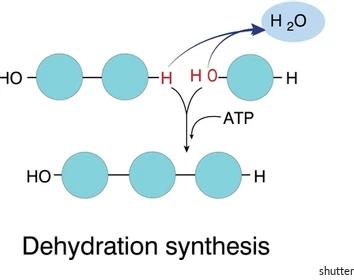
Dehydration Synthesis: Two molecules are joined by removing a water molecule. This process is endergonic (requires energy) and is used to build polymers like proteins and polysaccharides.
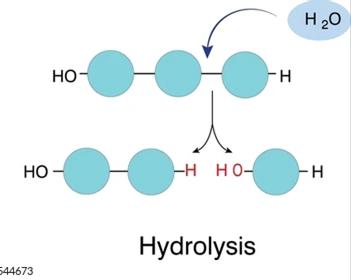
Hydrolysis: A molecule is split into two by the addition of water. This process is exergonic (releases energy) and is used to break down polymers into monomers.
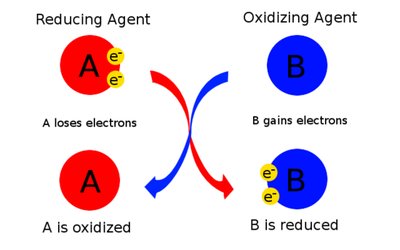
Redox (Oxidation-Reduction) Reactions: Involve the transfer of electrons. Oxidation is the loss of electrons, and reduction is the gain of electrons. These reactions are coupled and essential for energy production in cells.
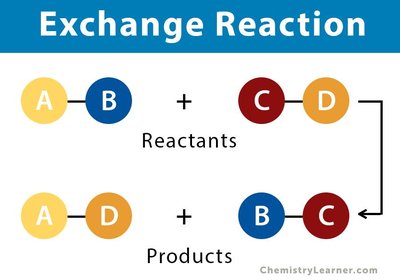
Exchange Reactions: Atoms or groups of atoms are exchanged between molecules, forming new products. These reactions are common in metabolism.
Chemical Notation and the Periodic Table
Rules of Chemical Notation
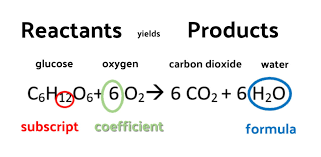
Chemical notation provides a standardized way to represent elements, compounds, and reactions.
Reactants are substances that enter a reaction; products are substances formed.
Arrows indicate the direction of the reaction; double arrows indicate reversibility.
Subscripts show the number of atoms in a molecule; coefficients show the number of molecules.
Superscripts (+ or -) indicate ionic charge.
Atoms are rearranged, not created or destroyed, in chemical reactions (Law of Conservation of Mass).
Acid-Base Balance and the pH Scale
Acids, Bases, and pH
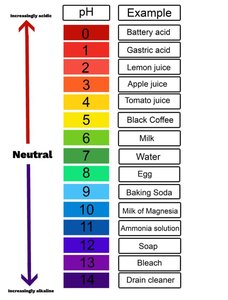
The balance of acids and bases is crucial for cellular processes. The pH scale measures the concentration of hydrogen ions in a solution.
Acids: Substances that release hydrogen ions (H+) in water.
Bases: Substances that release hydroxyl ions (OH-) in water.
pH Scale: Ranges from 0 (most acidic) to 14 (most basic); pH 7 is neutral. Each unit change represents a tenfold change in H+ concentration.
Properties of Water and Solutions
Unique Properties of Water
Water is essential for life due to its unique physical and chemical properties, which support cellular structure and function.
Exists in three states: liquid, solid, gas.
High heat capacity and cohesive properties (surface tension, capillary action).
Universal solvent, enabling chemical reactions and transport of substances.
Solutions and Concentrations
Solvent: The liquid in which substances dissolve (water is the most common biological solvent).
Solute: The substance dissolved in the solvent.
Solution: A homogeneous mixture of solvent and solute.
Hypertonic: Higher solute concentration outside the cell; water leaves the cell, causing shrinkage.
Hypotonic: Lower solute concentration outside the cell; water enters the cell, causing swelling or bursting.
Isotonic: Equal solute concentration inside and outside the cell; no net water movement.
Hydrophilic: Water-loving, soluble in water.
Hydrophobic: Water-repelling, insoluble in water.
Organic Molecules: Structure and Function
Common Properties of Organic Molecules
Organic molecules are the building blocks of life, containing carbon and hydrogen backbones. They include carbohydrates, proteins, lipids, and nucleic acids.
All contain carbon and hydrogen; often form rings or chains.
May include oxygen, nitrogen, sulfur, and phosphorus.
Major types: proteins, carbohydrates, lipids, nucleic acids.
Carbohydrates
Structure and Function
Carbohydrates are essential for energy storage and structural components in cells.
Monomers: Monosaccharides (e.g., glucose, fructose, ribose).
Disaccharides: Two monosaccharides joined (e.g., sucrose, lactose, maltose).
Polysaccharides: Long chains of monosaccharides (e.g., cellulose in cell walls).
General formula:
Functions: Energy source, structural support.
Proteins and Amino Acids
Structure and Function
Proteins are polymers of amino acids, performing diverse roles in cells including catalysis, structure, and signaling.
Amino Acids: 20 types, each with an amine group, carboxyl group, and variable R group.
Peptides: Short chains of amino acids (dipeptide, tripeptide, polypeptide).
Protein Structure:
Primary: Sequence of amino acids.
Secondary: Alpha-helix or beta-sheet folding.
Tertiary: 3D globular structure.
Quaternary: Multiple polypeptides forming a functional unit (e.g., hemoglobin).
Functions: Enzymes, structural support, transport, signaling, immune response.
Lipids
Structure and Function
Lipids are hydrophobic molecules important for energy storage, membrane structure, and signaling.
Triglycerides: Glycerol + 3 fatty acids; energy storage.
Phospholipids: Glycerol + 2 fatty acids + phosphate; form cell membranes (hydrophilic head, hydrophobic tail).
Steroids: Four fused carbon rings; hormones and membrane components.
Prostaglandins: Signaling molecules derived from fatty acids.
Cholesterol: Precursor for steroid hormones, vitamin D, and membrane structure.
Nucleic Acids and Nucleotides
Structure and Function
Nucleic acids store and transmit genetic information and direct protein synthesis. Nucleotides are the monomers of nucleic acids.
Nucleotide Structure: Pentose sugar, phosphate group, nitrogenous base (purine or pyrimidine).
Purines: Adenine (A), Guanine (G).
Pyrimidines: Cytosine (C), Thymine (T, in DNA), Uracil (U, in RNA).
DNA: Double helix, deoxyribose sugar, A-T and G-C base pairing; stores genetic information.
RNA: Single-stranded, ribose sugar, A-U and G-C base pairing; involved in protein synthesis (mRNA, tRNA, rRNA).
ATP (Adenosine Triphosphate): The primary energy carrier in cells; energy is released when phosphate bonds are broken.
