 Back
BackChemotherapeutic Agents and Antimicrobial Drugs: Mechanisms, Spectrum, and Applications
Study Guide - Smart Notes
 Tailored notes based on your materials, expanded with key definitions, examples, and context.
Chemotherapeutic Agents and Antimicrobial Drugs
Introduction to Chemotherapeutic Agents
Chemotherapeutic agents are substances used to treat infectious diseases by inhibiting or killing pathogenic microorganisms. The central principle guiding their use is selective toxicity, which ensures that the drug targets microbial cells while minimizing harm to host tissues.
Selective toxicity: The ability of a drug to target microbial processes or structures not found in the host.
Antibiotics: Naturally occurring or synthetic compounds that inhibit or kill bacteria.
Semi-synthetic drugs: Modified antibiotics to enhance efficacy or reduce toxicity.
Interactions Between Drugs and Microbes
The effectiveness of antimicrobial drugs depends on their ability to exploit differences between microbial and host cells.
Penicillin and derivatives: Exhibit excellent selective toxicity by targeting bacterial cell wall synthesis.
Drugs with lower selective toxicity: Target features common to both microbes and host cells, increasing risk of toxicity.
As pathogens become more similar to host cells (e.g., fungi, protozoa), achieving selective toxicity becomes more challenging.
Mechanisms of Drug Action
Overview of Mechanisms
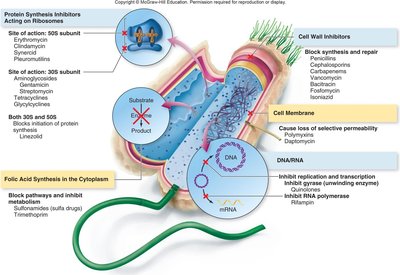
Antimicrobial drugs act through several distinct mechanisms:
Inhibition of cell wall synthesis
Inhibition of nucleic acid (DNA and RNA) structure and function
Inhibition of protein synthesis
Interference with cell membrane structure or function
Inhibition of folic acid synthesis
Spectrum of Antibiotic Activity
Broad vs. Narrow Spectrum
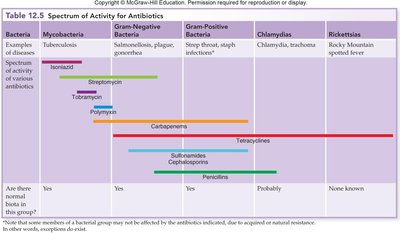
The spectrum of activity describes the range of bacteria affected by an antibiotic.
Broad spectrum: Effective against multiple types of bacteria, including both Gram-positive and Gram-negative species (e.g., tetracyclines).
Narrow spectrum: Targets specific bacteria or groups (e.g., penicillin for Gram-positive bacteria, polymyxin for Gram-negative bacteria).
Drugs That Target the Cell Wall
Penicillin and Its Derivatives
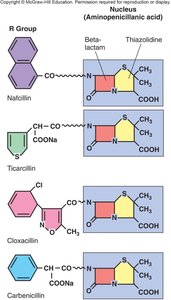
Penicillin is a classic antibiotic that disrupts bacterial cell wall synthesis by interfering with peptidoglycan formation.
Contains a thiazolidine ring, beta-lactam ring (active portion), and a variable side chain.
Beta-lactam ring is essential for antimicrobial activity.
Penicillin allergies are common.
Cephalosporin
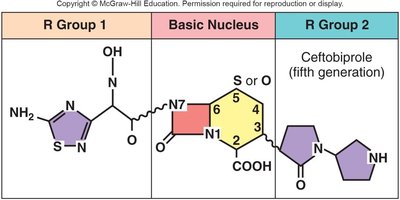
Cephalosporins are structurally similar to penicillin and also disrupt peptidoglycan synthesis.
Isolated from Cephalosporium acremonium.
Beta-lactam ring can be chemically altered.
Less allergenic than penicillin derivatives.
Other Cell Wall Targeting Antibiotics
Bacitracin: Narrow-spectrum, used for skin infections (main ingredient in Neosporin).
Isoniazid: Treats Mycobacterium tuberculosis, disrupts mycolic acid formation.
Vancomycin: Used against MRSA and penicillin-resistant staphylococci.
Drugs That Target Protein Synthesis
Mechanism of Action
Protein synthesis inhibitors target bacterial ribosomes (70S), affecting both large (50S) and small (30S) subunits.
Broad spectrum activity against all bacteria.
Disrupts translation, preventing protein formation.
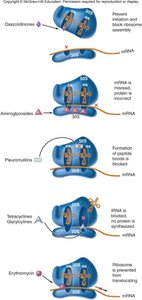
Tetracycline
Derived from Streptomyces.
Effective against a wide range of bacteria, mycoplasmas, rickettsias, and spirochetes.
Side effects: gastrointestinal disruption, bone development issues, antagonism with birth control.
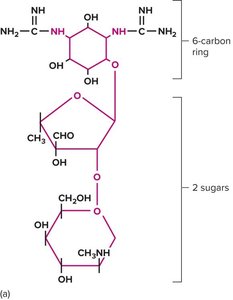
Streptomycin
Aminoglycoside antibiotic from Streptomyces.
Treats bubonic plague, tularemia, and tuberculosis.
Lower toxicity than tetracyclines.
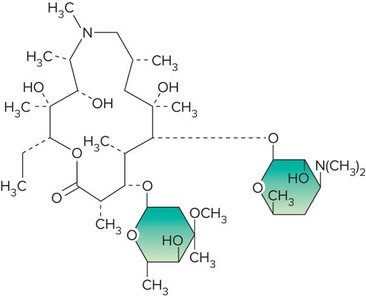
Erythromycin
Macrolide antibiotic from Streptomyces.
Treats ear, respiratory, and skin infections; also used for Mycobacterium infections in AIDS patients.
Lowest toxicity among protein synthesis inhibitors.
Drugs That Target Folic Acid Synthesis
Sulfonamides (Sulfa Drugs) and Trimethoprim
First modern class of synthetic antimicrobial drugs.
Block pathways and inhibit folic acid synthesis, which is essential for bacterial growth.
Humans do not synthesize folic acid, making these drugs selectively toxic.
Trimethoprim and sulfamethoxazole are often combined for synergistic effects.
Drugs That Target DNA or RNA
Fluoroquinolones
Inhibit bacterial gyrases and topoisomerases, preventing DNA replication.
Example: Ciprofloxacin.
Broad spectrum, but can cause neurological side effects.
Drugs That Target Cell Membranes
Polymyxins
Derived from Bacillus polymyxa.
Narrow-spectrum peptide antibiotics with detergent activity.
Disrupts LPS in Gram-negative bacteria.
Used for drug-resistant Pseudomonas aeruginosa and severe urinary tract infections.
Toxic to kidneys with long-term use.
Additional Chemotherapeutic Agents
Antifungal Drugs
Amphoteracin B: Binds to fungal membranes, disrupting integrity; used topically or systemically.
Antiprotozoan and Antihelminth Drugs
Antimalarial: Quinine, chloroquine, primaquine.
Antiamoebic: Metronidazole.
Antihelminthic: Mebendazole, albendazole.
Antiviral Agents
Prevent viral penetration (e.g., Tamiflu).
Block transcription/translation (e.g., Acyclovir, AZT).
Inhibit maturation of viral particles.
Biofilms and Antibiotic Efficacy
Impact of Biofilms
Biofilms are complex microbial communities that are significantly less sensitive to antimicrobial agents compared to individual colonies.
Biofilms are up to 1,000 times less sensitive to antibiotics.
Treatment strategies include interrupting quorum sensing, adding DNase, and pretreatment to reduce biofilm thickness.
Summary Table: Spectrum of Activity for Antibiotics
Bacteria | Examples of diseases | Spectrum of activity of various antibiotics |
|---|---|---|
Mycobacteria | Tuberculosis | Isoniazid, Streptomycin |
Gram-Negative Bacteria | Salmonellosis, plague, gonorrhea | Streptomycin, Polymyxin, Carbapenems |
Gram-Positive Bacteria | Strep throat, staph infections | Penicillin, Cephalosporins, Sulfonamides |
Chlamydias | Chlamydia, trachoma | Tetracyclines |
Rickettsias | Rocky Mountain spotted fever | Tetracyclines |
Conclusion
Chemotherapeutic agents are essential tools in the treatment of infectious diseases. Their effectiveness depends on selective toxicity, mechanism of action, and spectrum of activity. Understanding these principles is crucial for microbiology students preparing for exams and clinical practice. Key concepts: selective toxicity, mechanisms of drug action, spectrum of activity, and resistance management. Additional info: The notes expand on brief points from the original slides to provide a comprehensive, self-contained study guide suitable for exam preparation.
