 Back
BackClassification of Microorganisms & Prokaryotic Diversity: Study Notes
Study Guide - Smart Notes
 Tailored notes based on your materials, expanded with key definitions, examples, and context.
Ch. 10: Classification of Microorganisms
Taxonomy: Organizing Life
Taxonomy is the science of classifying organisms into hierarchical categories called taxa. This process helps scientists understand evolutionary relationships and organize biological diversity.
Systematics/Phylogeny: The study of evolutionary relationships among organisms.
Taxonomic Hierarchy: Domain, Kingdom, Phylum, Class, Order, Family, Genus, Species. Mnemonic: "Dear King Philip Come Over For Good Spaghetti".
Subspecies, Strains, Serovars: Additional subdivisions used for finer classification, especially in microbiology.
Three Domains of Life
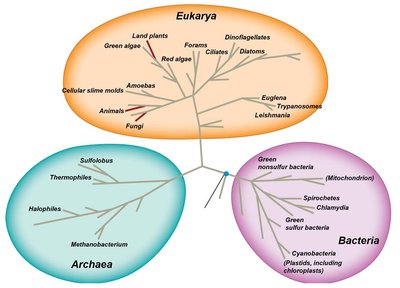
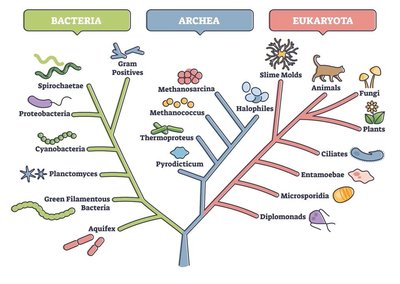
All organisms are classified into three domains: Bacteria, Archaea, and Eukarya. Each domain is characterized by unique cellular and molecular features.
Bacteria: Prokaryotic, cell walls contain peptidoglycan.
Archaea: Prokaryotic, cell walls lack peptidoglycan, often extremophiles.
Eukarya: Eukaryotic, includes animals, plants, fungi, and protists.
Methods of Classification
Microorganisms are classified using a variety of methods, each providing different information about their identity and relationships.
Conventional Classification: Based on morphology (shape, size, color, interactions, external & internal features).
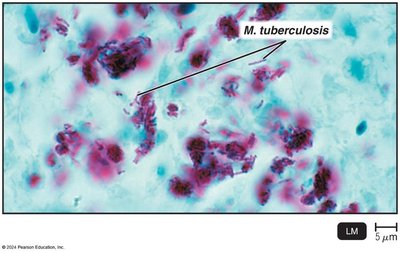
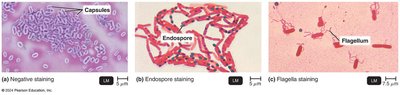
Differential Staining: Includes Gram stain, acid-fast stain (for Mycobacterium tuberculosis), and endospore stain.
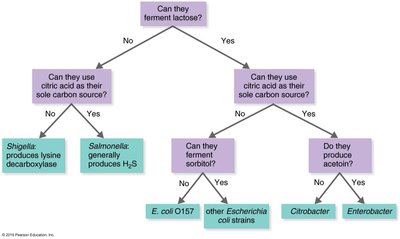
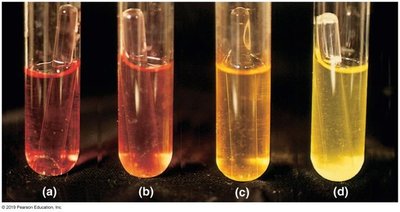
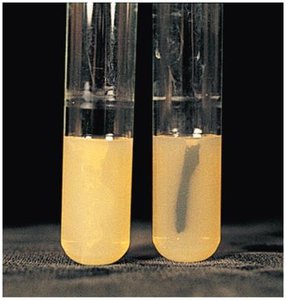
Biochemical Tests: Assess metabolic capabilities, enzyme presence, and waste products.
Serology: Uses antigen-antibody interactions to identify microbes.
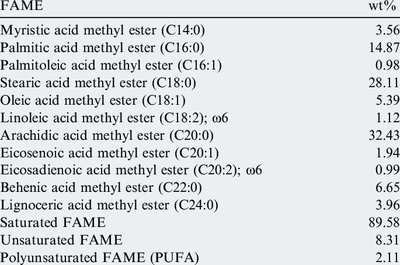
Fatty Acid Profiles (FAME): Unique fatty acid composition of bacteria.
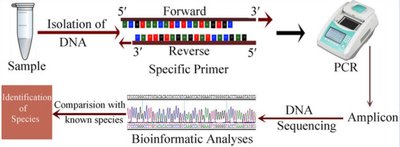
DNA & RNA Sequencing: Determines genetic relationships and identifies unique sequences.
Conventional Classification: Morphology & Staining
Microbial morphology and staining techniques are fundamental for initial identification.
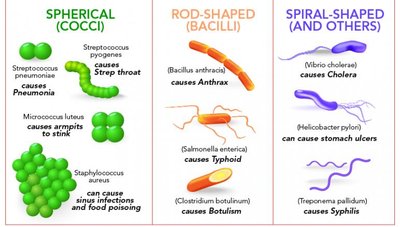
Shape: Cocci (spherical), Bacilli (rod-shaped), Spirilla (spiral-shaped).
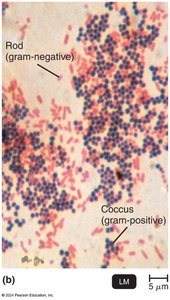
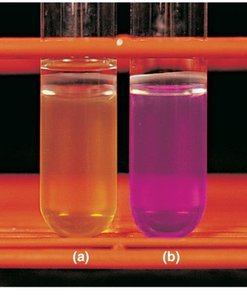
Gram Stain: Differentiates bacteria into Gram-positive (purple) and Gram-negative (pink).
Acid-fast Stain: Used for bacteria with waxy cell walls, such as Mycobacterium tuberculosis.
Endospore Stain: Identifies spore-forming bacteria.
Biochemical Tests
Biochemical tests are performed on bacterial cultures to determine their metabolic properties.
Oxygen Use: Aerobic vs. anaerobic metabolism.
Metabolic Fuel Use: Utilization of sugars, amino acids, etc.
Enzyme Presence: Detection of specific enzymes (e.g., catalase, oxidase).
Waste Products: Identification of metabolic byproducts.
Rapid Identification Systems
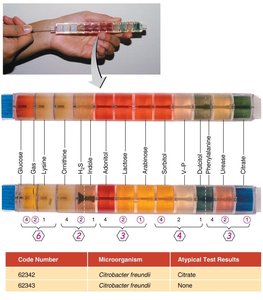
Systems like EnteroPluri allow rapid identification of enteric bacteria by testing multiple biochemical reactions simultaneously.
Serology
Serological methods use antigen-antibody interactions to identify microorganisms and their strains.
Antiserum: Contains antibodies against specific antigens.
Serovar/Serotype: Variants within a species distinguished by antigenic properties.
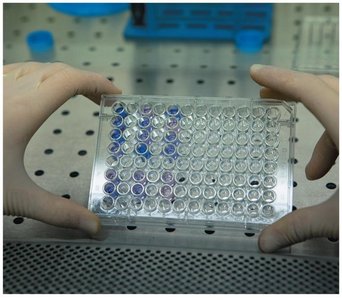
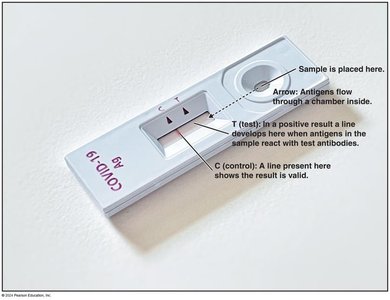
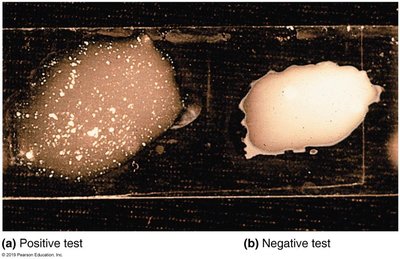
COVID Test: Detects antibodies or antigens using lateral flow immunoassay.
Phage Typing
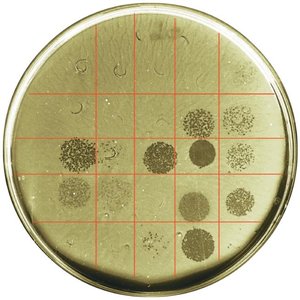
Phage typing uses bacteriophages to identify bacterial strains based on susceptibility to specific viruses. Useful for tracing outbreaks.
Applications: Mycobacterium tuberculosis, Yersinia pestis, Bacillus anthracis, Staphylococcus aureus.
Fatty Acid Profiles (FAME)
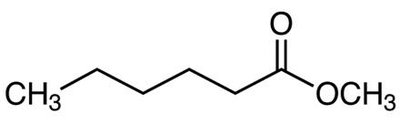
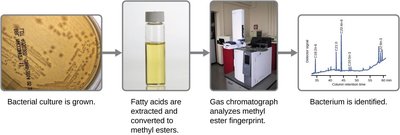
Each bacterial species has a unique profile of fatty acids, which can be analyzed by gas chromatography after conversion to methyl esters.
FAME Analysis: Fatty Acid Methyl Ester analysis is used for bacterial identification.
DNA & RNA Sequencing
Genetic methods provide precise identification and classification of microorganisms.
Whole Genome Sequencing: Comprehensive but resource-intensive.
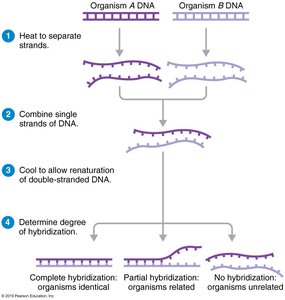
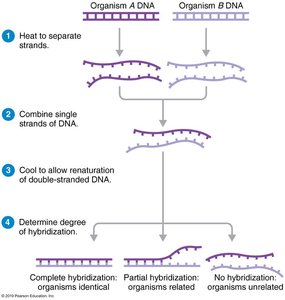
DNA-DNA Hybridization: Measures genetic similarity between organisms.
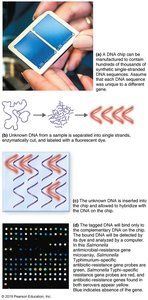
DNA Microarray: Detects specific DNA sequences or genes.
DNA Fingerprinting: Identifies unique genetic patterns.
Fluorescent In Situ Hybridization (FISH): Stains specific DNA or RNA sequences in cells.
Ch. 11: The Prokaryotes: Domains Bacteria and Archaea
Domain Archaea
Archaea are prokaryotes distinct from bacteria, often found in extreme environments. They lack peptidoglycan in their cell walls and have unique membrane lipids and DNA sequences.
Extremophiles: Thrive in extreme conditions (e.g., high temperature, salinity).
No Known Human Pathogens: Archaea are not associated with human disease.
Domain Bacteria
Bacteria are prokaryotes with diverse metabolic and ecological roles. They are classified based on cell wall structure, metabolism, and genetic characteristics.
Gram Negative Bacteria: Phylum Pseudomonadota (Proteobacteria) is the largest group, mostly chemoheterotrophs.
Classes: Alphaproteobacteria, Betaproteobacteria, Gammaproteobacteria.
Alphaproteobacteria
Rhizobium: Nitrogen-fixing bacteria important for legumes (beans, peas, clover).
Rickettsia: Transmitted by insects and ticks; causes Rocky Mountain Spotted Fever and Typhus.
Wolbachia: Inhibits insect reproduction; used for mosquito control to prevent Zika & Dengue.
Betaproteobacteria
Bordetella: Causes pertussis (whooping cough).
Neisseria: Cocci inhabiting mucous membranes; causes gonorrhea.
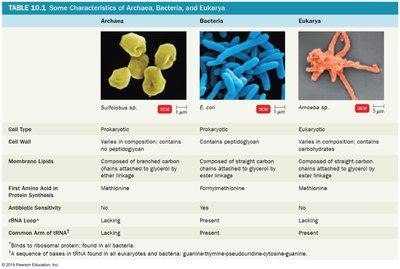
Summary Table: Characteristics of Archaea, Bacteria, and Eukarya
Feature | Archaea | Bacteria | Eukarya |
|---|---|---|---|
Cell Type | Prokaryotic | Prokaryotic | Eukaryotic |
Cell Wall | Varies, no peptidoglycan | Contains peptidoglycan | Varies, no peptidoglycan |
Membrane Lipids | Branched carbon chains | Straight carbon chains | Straight carbon chains |
First Amino Acid in Protein Synthesis | Methionine | Formylmethionine | Methionine |
Antibiotic Sensitivity | No | Yes | No |
RNA Polymerase | Several types | One type | Several types |
Common tRNA for Met | Lacking | Present | Present |
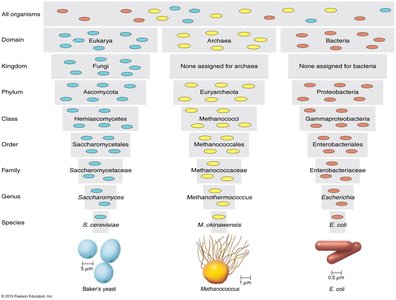
Taxonomic Hierarchy Example
Domain | Kingdom | Phylum | Class | Order | Family | Genus | Species |
|---|---|---|---|---|---|---|---|
Eukarya | Fungi | Ascomycota | Hemiascomycetes | Saccharomycetales | Saccharomycetaceae | Saccharomyces | S. cerevisiae |
Archaea | None assigned | Euryarchaeota | Methanococci | Methanococcales | Methanococcaceae | Methanococcus | M. okinawensis |
Bacteria | None assigned | Proteobacteria | Gammaproteobacteria | Enterobacteriales | Enterobacteriaceae | Escherichia | E. coli |
