 Back
Comprehensive Study Guide: Viruses, Disease, and Pathogenicity (Chapters 13–15)
Study Guide - Smart Notes
 Tailored notes based on your materials, expanded with key definitions, examples, and context.
Viruses, Virions, and Prions
General Characteristics of Viruses and Virions
Viruses are acellular infectious agents that require living host cells to multiply. They contain either DNA or RNA (never both), are surrounded by a protein coat, and may possess a lipid envelope. Virions are complete virus particles outside the host cell, consisting of nucleic acid, a capsid made of capsomeres, an envelope (in some viruses), and spikes for attachment.
Viruses: Obligate intracellular parasites, lack metabolic enzymes, multiply using host machinery.
Virions: Nucleic acid (DNA or RNA, single/double-stranded, linear/circular), capsid, envelope (lipids, proteins, carbohydrates), spikes (protein-carbohydrate complexes for attachment).
Host Range
The host range is the spectrum of host cells a virus can infect, determined by specific attachment sites and cellular factors.
Attachment: Virus must bind to specific receptors on host cells.
Cellular Factors: Host cell must provide factors necessary for viral replication.
Viral One-Step Growth Curve
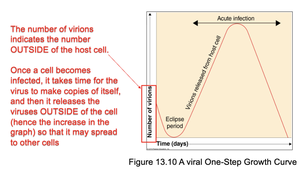
The one-step growth curve illustrates the replication of viruses in a host cell. After infection, there is an eclipse period where no virions are detected outside the cell, followed by a rise as new virions are released.
Lytic vs. Lysogenic Cycle of Bacteriophages
Lytic Cycle: Virus immediately replicates using host machinery, leading to host cell lysis and release of new viruses.
Lysogenic Cycle: Viral DNA integrates into host genome, replicates with host DNA, and can later excise to enter the lytic cycle.
Steps of Virus Infection and Multiplication
Bacteriophage: Attachment, penetration, biosynthesis, maturation, release.
Animal Viruses: Attachment, entry (endocytosis/fusion), uncoating, biosynthesis, maturation, release (budding/rupture).
DNA and RNA Virus Replication
DNA Viruses: Replicate in the nucleus using host enzymes.
RNA Viruses: (+) sense RNA acts as mRNA; (–) sense RNA must be transcribed to (+) sense; retroviruses use reverse transcriptase.
Latent, Persistent, and Acute Infections
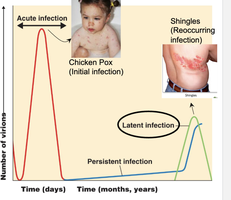
Acute infections occur rapidly and resolve; latent infections remain dormant and can reactivate; persistent infections progress slowly and are often fatal.
Prions and Prion Diseases
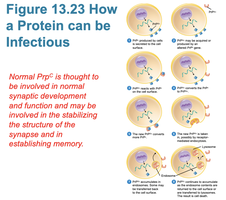
Prions are infectious proteins that cause neurodegenerative diseases by inducing misfolding of normal proteins. Diseases include Creutzfeldt-Jakob disease, Kuru, and mad cow disease.
Principles of Disease and Epidemiology
Normal vs. Transient Microbiota
Normal Microbiota: Permanently colonize the host, usually non-pathogenic.
Transient Microbiota: Present temporarily.
Protection: Compete with pathogens, produce acids, and bacteriocins.
Classification of Infectious Diseases
Communicable: Spread from host to host.
Contagious: Easily spread.
Non-communicable: Not spread between hosts.
Incidence vs. Prevalence
Incidence: Number of new cases in a time period.
Prevalence: Total number of cases at a given time.
Occurrence of Disease
Sporadic: Occasional cases (e.g., Typhoid fever).
Endemic: Constantly present (e.g., common cold).
Epidemic: Many cases in a short time (e.g., mumps).
Pandemic: Worldwide epidemic (e.g., COVID-19).
Herd Immunity
Immunity in most of a population, established by vaccination, protects vulnerable individuals.
Severity and Duration of Disease
Acute: Rapid onset, short duration (e.g., influenza).
Chronic: Slow development, long duration (e.g., hepatitis B).
Subacute: Intermediate.
Latent: Inactive for a time, then reactivates (e.g., shingles).
Extent of Host Involvement
Local: Limited to a small area.
Systemic: Spread throughout the body.
Focal: Local infection spreads to other areas.
Sepsis: Toxic inflammatory condition from spread of microbes/toxins.
Septicemia: Bacterial growth in blood.
Bacteremia: Bacteria in blood.
Toxemia: Toxins in blood.
Viremia: Viruses in blood.
Stages of Disease
Incubation period
Prodromal period
Period of illness
Period of decline
Period of convalescence
Transmission of Disease
Contact: Direct, indirect (fomites), droplet.
Vehicle: Airborne, waterborne, foodborne.
Vector: Mechanical (on feet), biological (bites, reproduction in vector).
Healthcare-Associated Infections (HAIs)
Microorganisms in hospital environment
Compromised host
Chain of transmission
Control: Universal precautions, reducing pathogens, infection control committees
Epidemiology: Factors and Case Reporting
Genetic recombination, new strains, antibiotics/pesticides, weather, transportation, vectors, disasters, animal control
Case reporting provides early warning and helps track disease spread
Microbial Mechanisms of Pathogenicity
Portals of Entry
Mucous membranes (respiratory, GI, GU, conjunctiva)
Skin (cuts, wounds)
Parenteral route (bites, punctures, surgery)
ID50 and LD50
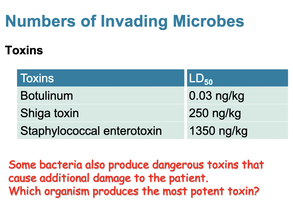
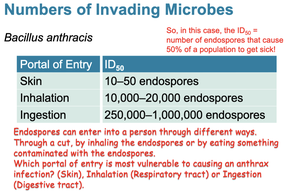
ID50 is the infectious dose for 50% of a population; LD50 is the lethal dose for 50%. Lower values indicate higher virulence or toxicity.
Adherence of Microbes
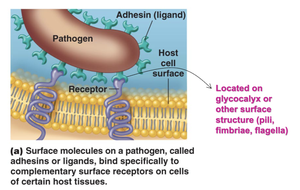
Pathogens use adhesins (ligands) to bind to host cell receptors, a critical step for colonization and infection. Structures involved include glycocalyx, pili, fimbriae, and flagella.
Biofilms
Biofilms are communities of microbes encased in extracellular polymeric substances, providing resistance to disinfectants, antibiotics, and phagocytosis. Common in hospital settings (catheters, water systems).
Factors Contributing to Virulence
Capsules: Prevent phagocytosis (e.g., Bacillus anthracis).
Cell Wall Components: M protein, fimbriae, mycolic acid aid in attachment and resistance.
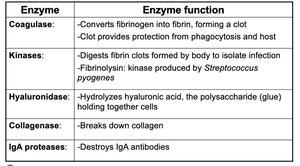
Enzymes: Coagulase, kinases, hyaluronidase, collagenase, IgA proteases facilitate invasion and immune evasion.
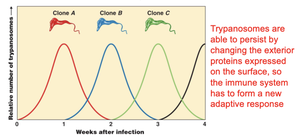
Antigenic Variation: Pathogens alter surface antigens to evade immune response (e.g., trypanosomes).
Penetration into Host Cells: Invasins rearrange actin, allowing entry and movement between cells (e.g., Shigella, Listeria).
How Microorganisms Damage the Host
Using host nutrients (e.g., siderophores for iron acquisition)
Causing direct damage at the site of infection
Producing toxins (exotoxins and endotoxins)
Inducing hypersensitivity reactions
Exotoxins vs. Endotoxins
Exotoxins: Proteins secreted by bacteria, highly specific, can be inactivated by antitoxins/toxoids.
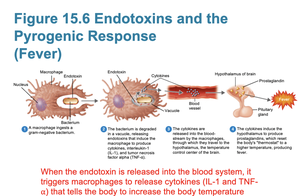
Endotoxins: Lipid A of LPS in Gram-negative bacteria, released upon cell death, cause fever and shock.
Types of Exotoxins
A-B Toxins: Two-part toxins with enzymatic (A) and binding (B) components.
Membrane-Disrupting Toxins: Form pores or disrupt membranes (e.g., hemolysins).
Superantigens: Trigger excessive immune response (e.g., toxic shock syndrome).
Portals of Exit
Respiratory tract (coughing, sneezing)
Gastrointestinal tract (feces, saliva)
Genitourinary tract (urine, secretions)
Skin
Blood (bites, needles)
Selected Viral Diseases
Smallpox (Variola)
Double-stranded DNA virus, transmitted via respiratory route, eradicated by vaccination.
Chickenpox/Shingles (Varicella-Zoster Virus)
Initial infection causes chickenpox; virus remains latent and can reactivate as shingles.
Prevention: live attenuated vaccine (varicella), zoster vaccine for shingles.
Herpes Simplex Virus (HSV-1, HSV-2)
HSV-1: oral/respiratory transmission, latent in trigeminal ganglia.
HSV-2: sexual transmission, latent in sacral ganglia.
Poliovirus and Rabies (Lyssavirus)
Poliovirus: fecal-oral transmission, can cause paralysis, vaccines available (IPV, OPV).
Rabies: transmitted by animal bites, long incubation, post-exposure prophylaxis effective.
Influenza Virus
Single-stranded, negative-sense RNA virus, envelope with spikes, pandemics caused by antigenic shifts.
Lentivirus (HIV)
Retrovirus, two identical +RNA genomes, reverse transcriptase, integrase, protease, treated with antiretroviral therapy.
Coronavirus (SARS-CoV-2)
Positive-sense single-stranded RNA virus, causes COVID-19, enters cells via ACE2 receptor, mRNA and DNA vaccines available.
