 Back
BackControl of Microbial Growth and Food Microbiology: Study Notes
Study Guide - Smart Notes
 Tailored notes based on your materials, expanded with key definitions, examples, and context.
Control of Microbial Growth
Definitions and Key Concepts
The control of microbial growth is essential in clinical, laboratory, and food settings to prevent infection, contamination, and spoilage. Several terms are fundamental to understanding microbial control:
Sterilization: The complete destruction or removal of all forms of microbial life, including bacterial endospores. Typically achieved by physical methods such as heat or radiation.
Disinfection: The reduction of microbial populations on inanimate surfaces to safe levels, usually by chemical agents called disinfectants.
Antisepsis: The reduction of microbial populations on living tissue to safe levels, using chemical agents known as antiseptics.
“-cidal” agents: Substances that kill microorganisms (e.g., bactericidal, fungicidal).
“-static” agents: Substances that inhibit microbial growth without killing (e.g., bacteriostatic).
Physical Methods of Microbial Control
Physical methods are commonly used to control microbial growth, especially for sterilization and disinfection.
Heat:
Dry Heat: Kills by oxidation of cell components. Requires high temperatures and long exposure (e.g., 2 hours at 160°C or 1 hour at 170°C). Used for glassware and metal instruments.
Moist Heat (Autoclaving): Kills by denaturing proteins and disrupting membranes. Uses steam under pressure (121°C, 15 psi, 15 min). Suitable for glass, metal, some plastics, and liquids.
Pasteurization: Gentle heating to reduce microbial load in food (e.g., 62.9°C for 30 min or 71.6°C for 15 sec). Preserves taste and quality of food products.
Radiation:
Non-ionizing (UV) Radiation: Causes thymidine dimers in DNA, leading to mutations. Effective for surface disinfection (optimal at 260 nm).
Ionizing Radiation: (X-rays, gamma rays) Induces double-stranded DNA breaks. Used for sterilizing medical supplies and food packaging. Effectiveness increases with DNA content (viruses < fungi < spores < Gram-positive < Gram-negative bacteria).
Filtration: Physically removes microorganisms from liquids using filters with pore sizes of 0.45 or 0.22 μm. Used for heat-sensitive solutions.
Chemical Methods of Microbial Control
Chemical agents can act as disinfectants, antiseptics, or sterilants depending on their concentration and exposure time. Common chemicals include alcohols, phenolics, halogens, and aldehydes. Their effectiveness varies with the type of microorganism and environmental conditions.
Chemotherapeutic Agents
Chemotherapeutic agents are chemicals that inhibit or kill microorganisms at concentrations tolerated by the host (selective toxicity).
Antibiotics: Naturally occurring or synthetic compounds that inhibit or kill bacteria. Many are produced by sporulating organisms and can be chemically modified for improved efficacy.
Antimycotics: Agents that target fungi (yeasts and molds).
Antivirals: Agents that inhibit viral replication within host cells.
Antimicrobial Susceptibility Testing
Purpose and Overview
Antimicrobial susceptibility testing determines the effectiveness of antimicrobial agents (disinfectants, antiseptics, antibiotics) against specific microorganisms. This guides clinical therapy and infection control.
Use-Dilution Test
This test evaluates the effectiveness of disinfectants by exposing standardized bacterial cultures to different concentrations of the chemical agent and assessing survival.
Kirby-Bauer Disk Diffusion Method
The Kirby-Bauer method is a standardized assay to assess the susceptibility of bacteria to antibiotics and other antimicrobial agents.
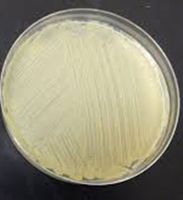
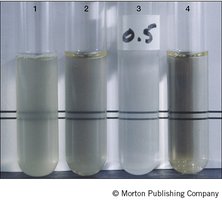
A standardized inoculum (0.5 McFarland standard, ~1.5 x 10⁸ CFU/mL) is spread to create a bacterial lawn on Mueller-Hinton agar.
Paper discs impregnated with known concentrations of antimicrobial agents are placed on the agar surface.
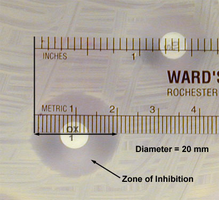
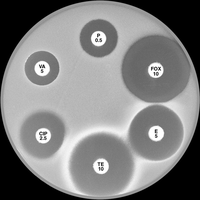
After incubation, zones of inhibition (clear areas around discs) are measured to determine effectiveness.
Interpreting Results
The diameter of the zone of inhibition is directly proportional to the effectiveness of the antimicrobial agent. Larger zones indicate higher effectiveness. Results are compared to standardized charts to classify bacteria as susceptible, intermediate, or resistant.
Factors Affecting Kirby-Bauer Results
Inoculum size: Must match the 0.5 McFarland standard for consistency.
Agar depth: Should be 4 mm; deviations affect diffusion and zone size.
Disc placement: Discs must be in full contact with agar for accurate diffusion.
Example Table: Antibiotic Effectiveness (Inferred)
Antibiotic | Zone of Inhibition (mm) | Effectiveness |
|---|---|---|
Penicillin (P) | Small | Low |
Cefoxitin (FOX) | Large | High |
Erythromycin (E) | Medium | Moderate |
Tetracycline (TE) | Medium | Moderate |
Ciprofloxacin (CIP) | Large | High |
Vancomycin (VA) | Small | Low |
Additional info: Actual zone diameters should be measured for precise interpretation.
Food Microbiology I: Quantitative Analysis
Purpose and Public Health Context
Food microbiology involves the detection and quantification of microorganisms in food products to ensure safety and compliance with public health standards. Foodborne illnesses affect millions annually, making microbial testing essential.
Viable Plate Count Method
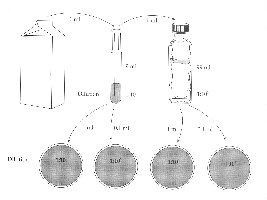
This method estimates the number of viable bacteria in a food sample by serial dilution and plating.
Milk samples are serially diluted (e.g., 1:10, 1:100, 1:1000, 1:10,000).
Aliquots from each dilution are plated on nutrient agar and incubated.
Colonies are counted on plates with 30–300 colonies (countable range).
Original Cell Density (OCD) is calculated using the formula:
Food Microbiology II: Microbial Food Production
Beneficial Microorganisms in Food
Not all microorganisms in food are harmful; some are essential for food production and human health. Examples include:
Lactobacillus spp. in yogurt
Mushrooms (macroscopic fungi) consumed directly
Microbes used in cheese, yogurt, and alcoholic beverage production
Fermentation Pathways in Food Production
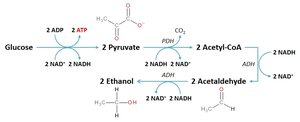
Homolactic Acid Fermentation: Pyruvate is reduced to lactic acid by lactate dehydrogenase (LDH). Main pathway in yogurt and cheese production.
Alcoholic Fermentation: Acetaldehyde is reduced to ethanol by acetaldehyde dehydrogenase (ADH), producing ethanol and CO2. Used in bread and alcoholic beverage production.
Yogurt Production
Yogurt is produced by fermenting milk with Lactobacillus bulgaricus and Streptococcus thermophilus. The process involves:
Lactase enzyme hydrolyzes lactose into glucose and galactose.
Glucose is fermented to lactic acid, which imparts tartness and causes casein to curdle (forming curd and whey).
Yogurt can be prepared in the laboratory or at home using a starter culture and controlled incubation.
Summary Table: Methods of Microbial Control (Inferred)
Method | Mechanism | Application |
|---|---|---|
Dry Heat | Oxidation of proteins/lipids | Glassware, metal tools |
Moist Heat (Autoclave) | Protein denaturation | Media, liquids, some plastics |
Filtration | Physical removal | Heat-sensitive liquids |
UV Radiation | DNA damage (thymidine dimers) | Surface disinfection |
Ionizing Radiation | DNA double-strand breaks | Medical supplies, food packaging |
Chemical Agents | Varied (protein denaturation, membrane disruption) | Surfaces, skin, instruments |
