 Back
BackControl of Microbial Growth: Principles and Methods
Study Guide - Smart Notes
 Tailored notes based on your materials, expanded with key definitions, examples, and context.
Control of Microbial Growth
Key Terms and Definitions
Understanding the terminology related to microbial control is essential for effective application in laboratory and clinical settings.
Sterilization: Removal or destruction of all forms of microbial life, including endospores and prions.
Disinfection: Control directed at destroying harmful microorganisms, specifically vegetative pathogens on inert surfaces.
Antisepsis: Destruction of vegetative pathogens on living tissue.
Degerming: Mechanical removal of most microbes in a limited area (e.g., skin preparation before injection).
Bacteriostasis: Inhibition of microbial growth without killing the organisms.
Biocide/Germicide: Agents that kill microbes.
Microbial resistance to control methods varies by organism type, with prions and bacterial endospores being the most resistant, and enveloped viruses being the least resistant.
Microbial Characteristics Affecting Control
Prions (most resistant)
Endospores of bacteria
Mycobacteria
Cysts of protozoa
Vegetative protozoa
Gram-negative bacteria
Fungi
Nonenveloped viruses
Gram-positive bacteria
Enveloped viruses (least resistant)
The Rate of Microbial Death
Exponential Death Rate
Microbial populations die at a constant rate when exposed to microbial control agents or adverse conditions. This is known as the exponential death rate.
The effectiveness of a treatment is measured by the decrease in the number of surviving microbes over time.
Death rate is often logarithmic, meaning a fixed percentage of the population dies per unit time.
Time (min) | Deaths per Minute | Number of Survivors |
|---|---|---|
0 | 0 | 1,000,000 |
1 | 900,000 | 100,000 |
2 | 90,000 | 10,000 |
3 | 9,000 | 1,000 |
4 | 900 | 100 |
5 | 90 | 10 |
6 | 9 | 1 |
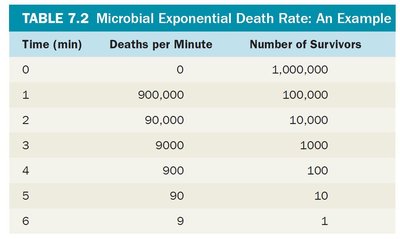
Example: If a disinfectant kills 90% of a bacterial population per minute, the number of survivors decreases by a factor of ten each minute.
Physical Methods of Microbial Control
Moist Heat Methods
Moist heat denatures proteins, leading to microbial death. It is more effective than dry heat at lower temperatures and shorter exposure times.
Boiling: Kills most vegetative cells and viruses within 10 minutes but does not reliably kill endospores.
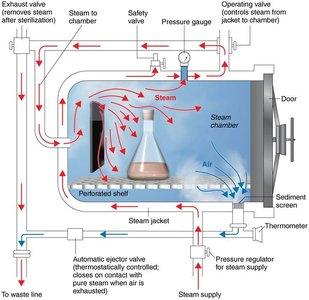
Autoclaving: Uses steam under pressure (typically 121°C at 15 psi for 15 minutes) to achieve sterilization, effective against endospores.
Pasteurization: Reduces spoilage organisms and pathogens by heating materials for a short time without damaging the product.
Pasteurization Equivalent Treatments:
63°C for 30 min (classic method)
High-temperature short-time (HTST): 72°C for 15 sec
Ultra-high-temperature (UHT): 140°C for 4 sec
Dry Heat Methods
Dry heat kills by oxidation and requires higher temperatures and longer exposure times than moist heat.
Hot-air sterilization: Typically 170°C for 2 hours.
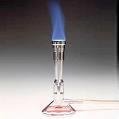
Direct flaming: Used for sterilizing inoculating loops and needles.
Filtration
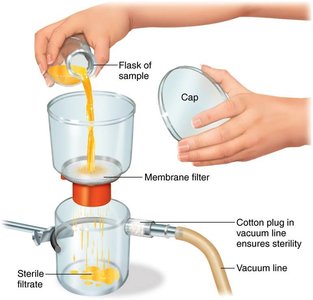
Filtration physically removes microbes from liquids or air, useful for heat-sensitive materials.
HEPA filters: Remove microbes >0.3 µm from air.
Membrane filtration: Removes microbes >0.22 µm from liquids.
Radiation
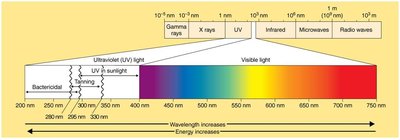
Radiation damages microbial DNA, leading to cell death.
Ionizing radiation (X-rays, gamma rays): Produces reactive molecules that damage DNA.
Nonionizing radiation (ultraviolet): Damages DNA by creating thymine dimers, inhibiting replication.
Other Physical Methods
Low temperature: Refrigeration and freezing slow microbial growth but do not kill most microbes.
Desiccation: Drying inhibits microbial growth by removing water.
Osmotic pressure: High concentrations of salt or sugar create hypertonic environments, causing plasmolysis in microbes.
Chemical Methods of Microbial Control
Phenol and Phenol Derivatives
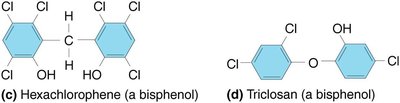
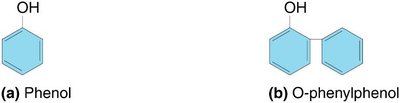
Phenolics disrupt cell walls and membranes and precipitate proteins. They are bactericidal, fungicidal, and virucidal but not sporicidal.
Common examples: Lysol, triclosan
Alcohols
Alcohols such as ethanol and isopropanol denature proteins and dissolve lipids, effectively killing bacteria and fungi but not endospores or nonenveloped viruses.
Concentration of Ethanol (%) | 10 sec | 20 sec | 30 sec | 40 sec | 50 sec |
|---|---|---|---|---|---|
100 | G | G | G | G | G |
95 | NG | NG | NG | NG | NG |
90 | NG | NG | NG | NG | NG |
80 | NG | NG | NG | NG | NG |
70 | NG | NG | NG | NG | NG |
60 | NG | NG | NG | NG | NG |
50 | G | G | G | G | G |
40 | G | G | G | G | G |
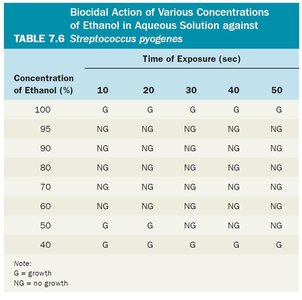
Example: 70% ethanol is more effective than 100% ethanol for microbial control because water is required for protein denaturation.
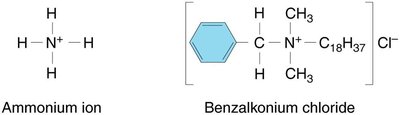
Quaternary Ammonium Compounds (Quats)
Quats are cationic detergents that disrupt plasma membranes and denature proteins. They are effective against a broad range of microbes but do not kill endospores, Mycobacterium, or Pseudomonas.
Hydrogen Peroxide
Hydrogen peroxide (H2O2) acts as an oxidizing agent, producing highly reactive hydroxyl-free radicals that damage proteins and DNA. Concentrations range from weak (3%) to strong (25%).
Summary Table: Methods of Microbial Control
Method | Mechanism | Applications | Limitations |
|---|---|---|---|
Moist Heat (Autoclave) | Protein denaturation | Media, glassware, instruments | Not suitable for heat-sensitive items |
Dry Heat | Oxidation | Glassware, metal instruments | Longer time, higher temp needed |
Filtration | Physical removal | Heat-sensitive liquids | Does not remove viruses or toxins |
Radiation | DNA damage | Medical supplies, food | Penetration varies by type |
Phenolics | Disrupt membranes, denature proteins | Surfaces, skin (some types) | Toxicity, not sporicidal |
Alcohols | Denature proteins, dissolve lipids | Skin, surfaces | Not sporicidal |
Quats | Disrupt membranes, denature proteins | Surfaces, instruments | Ineffective against spores, some bacteria |
Hydrogen Peroxide | Oxidation | Surfaces, wounds | Decomposes in light, catalase breaks down |
Additional info: The effectiveness of each method depends on the type of microorganism, the environment, and the presence of organic matter. Selection of a control method should consider the specific application and desired level of microbial reduction.
