 Back
BackControl of Microorganisms: Antimicrobial Drugs and Resistance
Study Guide - Smart Notes
 Tailored notes based on your materials, expanded with key definitions, examples, and context.
Control of Microorganisms
Key Terms and Concepts
Understanding the control of microorganisms is essential in microbiology, especially regarding the use of antimicrobial agents. Below are important terms and foundational concepts:
Prophylaxis: The use of a drug to prevent infection or disease in individuals at risk.
Antibiotic: Substances produced by certain microorganisms that inhibit or destroy other microbes. Commonly produced by aerobic bacteria or fungi.
Desirable Characteristics of Antimicrobials:
Selectively toxic to the pathogen but not the host or normal flora (narrow spectrum preferred).
Soluble in water and remains active in tissues and body fluids.
Can reach the site of infection and is not rapidly broken down or excreted.
Does not promote resistance, cause allergies, or predispose to other infections.
Reasonably priced.
Antibacterial Drugs: Mechanisms of Action
Sites of Antibiotic Activity
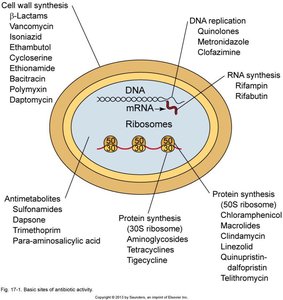
Antibacterial drugs target specific structures or processes in bacteria. The main sites of action include the cell wall, cytoplasmic membrane, protein synthesis machinery, DNA/RNA synthesis, and metabolic pathways.
Cell Wall Synthesis Inhibitors
These drugs prevent bacteria from forming a functional cell wall, leading to cell lysis and death.
β-lactam antibiotics: (e.g., penicillins, cephalosporins, carbapenems, monobactams) block peptidoglycan synthesis by binding to penicillin-binding proteins (PBPs). They are most effective against Gram-positive bacteria but some can cross the outer membrane of Gram-negatives (broad spectrum).
Non-β-lactam inhibitors:
Vancomycin: Inhibits peptide cross-linking; used for resistant Gram-positive infections.
Bacitracin: Interferes with transport of cell wall precursors; used topically.
Cycloserine: Inhibits early steps in peptidoglycan synthesis.
Isoniazid, Ethionamide, Ethambutol: Inhibit mycolic acid synthesis, targeting acid-fast bacteria (e.g., Mycobacterium).
Disruption of Cytoplasmic Membrane Function
Polymyxins: Disrupt phospholipids in the outer and cytoplasmic membranes of Gram-negative bacteria; can cause neuro- and nephrotoxicity.
Daptomycin: Binds to the cytoplasmic membrane, disrupting ion gradients (mainly for Gram-positive bacteria).
Clofazimine: Acts as an electron acceptor, generating toxic oxygen species and breaking down phospholipids.
Inhibition of Protein Synthesis
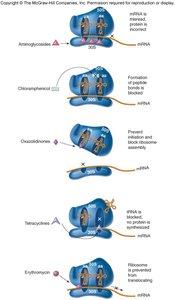
These drugs exploit differences between prokaryotic and eukaryotic ribosomes to selectively inhibit bacterial protein synthesis.
Aminoglycosides: Bind to the 30S subunit, causing misreading of mRNA and premature release of the growing peptide (bactericidal).
Tetracyclines: Bind to the 30S subunit, blocking tRNA binding (bacteriostatic).
Chloramphenicol, Clindamycin: Bind to the 50S subunit, inhibiting peptidyl transferase (bacteriostatic).
Macrolides, Ketolides: Bind reversibly to the 50S subunit, blocking elongation (bacteriostatic).
Streptogramins: Combination drugs that bind to the 50S subunit, blocking elongation and promoting peptide release.
Inhibition of Nucleic Acid Synthesis
DNA Synthesis Inhibitors:
Fluoroquinolones: Bind to topoisomerases or gyrases, enzymes that control DNA supercoiling and chromosome separation (broad spectrum).
Metronidazole: Activated by anaerobic microbes to cause DNA breaks.
Clofazimine: Binds high G/C DNA and competes with NADH acceptor.
RNA Synthesis Inhibitors:
Rifampin, Rifabutin: Bind to DNA-dependent RNA polymerase, inhibiting transcription initiation (more selective for prokaryotes).
Antimetabolites
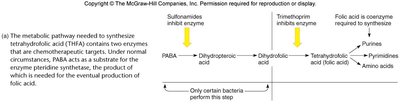
These drugs inhibit enzymes in metabolic pathways unique to bacteria, such as folic acid synthesis.
Sulfonamides: Competitive inhibitors of dihydropteroate synthase, blocking folic acid synthesis.
Trimethoprim: Inhibits dihydrofolate reductase, another enzyme in the folic acid pathway.
Dapsone: Similar mechanism to sulfonamides.
Antimicrobial Resistance
Mechanisms of Resistance
Microorganisms can develop resistance to antimicrobials through various mechanisms:
Enzymatic breakdown or modification of the drug (e.g., β-lactamases).
Reduced drug entry (e.g., mutations in porins).
Active export of the drug (drug pumps).
Alteration of the drug's target site.
Use of alternative metabolic pathways.
Resistance can be intrinsic or acquired (via mutation or gene transfer). Overuse and misuse of antimicrobials accelerate the spread of resistance.
Testing for Drug Susceptibility
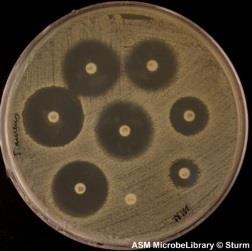
Kirby-Bauer Disk Diffusion Test
This method assesses the susceptibility of bacteria to antibiotics by measuring zones of inhibition around antibiotic-impregnated disks on an agar plate.
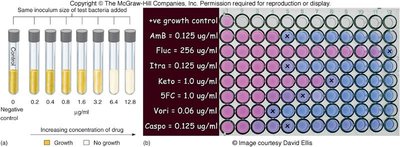
Dilution Tests and Minimum Inhibitory Concentration (MIC)
Dilution tests determine the lowest concentration of a drug that visibly inhibits bacterial growth (MIC). This is a quantitative measure of drug efficacy.
Therapeutic Index (TI)
The therapeutic index is the ratio of the toxic dose to the minimum inhibitory concentration (MIC):
TI = Toxic Dose / MIC
A higher TI indicates a greater margin of safety for the patient.
For example:
TI =
TI =
Antiviral Agents
Challenges and Mechanisms
Viruses are obligate intracellular parasites, making selective toxicity difficult. Antiviral drugs are usually virus-specific and may:
Block viral entry into host cells.
Inhibit replication or transcription of viral genetic material.
Prevent maturation or release of viral particles.
Type I Interferons (INF)
Proteins produced by host cells in response to viral infection.
Activate genes with antiviral activity, reduce symptoms, and slow some cancers.
Side effects include flu-like symptoms and low blood counts.
Nucleoside/Nucleotide Analogs
Mimic natural nucleosides/nucleotides, inhibiting viral polymerases.
Examples: acyclovir, ganciclovir (herpes); zidovudine (HIV); sofosbuvir (hepatitis C); remdesivir (SARS-CoV-2, Ebola).
May cause toxicities such as anemia and birth defects.
Protease Inhibitors
Block viral proteases required for processing viral proteins.
Used in HIV and hepatitis C therapy (often in combination with other drugs).
Drugs for Treating HIV Infections
Combination therapy is standard; drugs target reverse transcriptase, integrase, protease, and viral binding/entry.
Examples: AZT (reverse transcriptase inhibitor), integrase inhibitors, protease inhibitors, entry inhibitors (Fuzeon, Maravoc).
Drugs for Treating Influenza
Block viral ion channels (amantadine, rimantidine) or neuraminidase (oseltamivir, zanamivir).
Baloxavir inhibits viral RNA polymerase cap-stealing.
Most effective early in infection; can be used as prophylaxis.
Additional info: The above notes integrate and expand upon the provided material, ensuring a comprehensive, self-contained study guide suitable for college-level microbiology students.
