 Back
Control of Microorganisms: Mechanisms, Effectiveness, and Methods
Study Guide - Smart Notes
 Tailored notes based on your materials, expanded with key definitions, examples, and context.
Control of Microorganisms
Key Definitions and Terminology
Understanding the terminology of microbial control is essential for distinguishing between different methods and their applications. The terms describe the reduction, removal, or destruction of microorganisms in various environments.
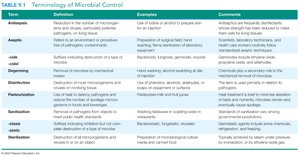
Antisepsis: Reduction of microbial load on living tissue using chemical agents.
Aseptic: Procedures that prevent contamination by pathogens.
Degerming: Removal of microbes from a surface, typically skin, by mechanical means.
Disinfection: Destruction of most microorganisms on non-living surfaces.
Pasteurization: Use of heat to kill pathogens and reduce spoilage organisms in foods and beverages.
Sterilization: Elimination of all microorganisms, including spores, from an object or area.
Sanitization: Reduction of microbial population to safe levels as determined by public health standards.
Decontamination: Removal of hazardous substances, including microorganisms, from an object or area.
Microbial Resistance
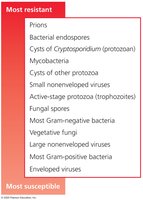
Microorganisms vary in their resistance to control methods. Understanding this hierarchy is crucial for selecting appropriate control strategies.
Most resistant: Prions, bacterial endospores, cysts of protozoa, mycobacteria.
Moderately resistant: Small nonenveloped viruses, active-stage protozoa, fungal spores, most Gram-negative bacteria.
Least resistant: Vegetative fungi, large nonenveloped viruses, most Gram-positive bacteria, enveloped viruses.
Mechanisms of Microbial Control
Microbial control mechanisms are based on physical, chemical, or biological methods. Each method targets specific cellular structures or processes.
Physical methods: Heat, filtration, radiation.
Chemical methods: Disinfectants, antiseptics, sterilants.
Biological methods: Use of other microorganisms or their products to control pathogens.
Mechanism of action: Each control method has a specific mechanism, such as protein denaturation, membrane disruption, or nucleic acid damage.
Effectiveness of Antimicrobial Agents
The effectiveness of antimicrobial agents depends on several factors:
Population size: Larger populations require more time or higher concentrations for control.
Population composition: Mixed populations may include resistant organisms.
Concentration or intensity: Higher concentrations are generally more effective, but exceptions exist (e.g., 70% ethanol is more effective than 100%).
Contact time: Longer exposure increases effectiveness.
Temperature: Higher temperatures often enhance activity.
Local environment: Presence of organic matter and pH can affect agent activity.
Microbial Death and D Value
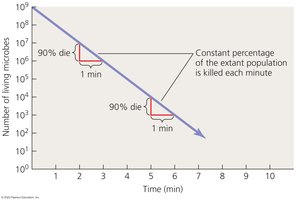
Microbial populations are not killed instantly; death occurs exponentially, with a constant fraction of organisms dying at each interval. The D value (decimal reduction time) is the time required to kill 90% of the microorganisms or spores under specific conditions.
Exponential death: Microbial death follows a logarithmic pattern.
D value formula:
Comparing Control Methods
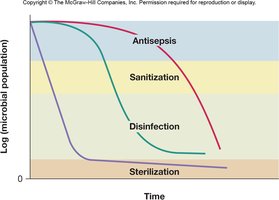
Different control methods achieve varying levels of microbial reduction over time. The effectiveness and speed depend on the method used.
Sterilization: Achieves complete elimination of microbes.
Disinfection: Reduces microbial load but may not eliminate all spores.
Sanitization: Lowers microbial population to safe levels.
Antisepsis: Reduces microbial load on living tissue.
Physical Methods of Microbial Control
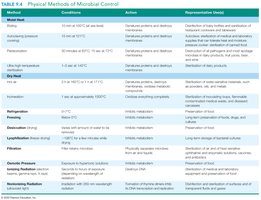
Physical methods utilize heat, filtration, and radiation to control microbial populations. Each method has specific conditions and applications.
Method | Conditions | Action | Representative Uses |
|---|---|---|---|
Moist Heat (Boiling) | 100°C for 10 min | Denatures proteins and destroys membranes | Disinfection of water, utensils |
Autoclaving | 121°C, 15 psi, 15 min | Denatures proteins and destroys membranes | Sterilization of media, instruments |
Pasteurization | Varies (e.g., 63°C for 30 min) | Denatures proteins | Destruction of pathogens in beverages |
Dry Heat | 160°C for 2 hr | Denatures proteins, oxidizes cell components | Sterilization of glassware |
Filtration | Membrane filters | Physically removes microbes | Sterilization of heat-sensitive liquids |
Radiation | UV, gamma rays | Damages DNA | Sterilization of surfaces, food |
Chemical Methods of Microbial Control
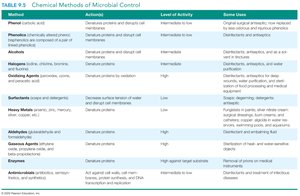
Chemical agents are used to disinfect, sterilize, or sanitize surfaces and materials. Their effectiveness depends on their mechanism of action and level of activity.
Method | Action(s) | Level of Activity | Some Uses |
|---|---|---|---|
Phenolics | Denature proteins, disrupt membranes | Intermediate to low | Disinfectants, antiseptics |
Alcohols | Denature proteins, dissolve membranes | Intermediate | Disinfectants, antiseptics |
Halogens | Oxidize proteins | High | Disinfectants, antiseptics |
Oxidizing agents | Oxidize proteins | High | Disinfectants, sterilants |
Surfactants | Reduce surface tension | Low | Soaps, detergents |
Aldehydes | Denature proteins | High | Disinfectants, sterilants |
Gaseous agents | Denature proteins | High | Sterilization of heat-sensitive items |
Enzymes | Act against target substrates | High against target | Disinfectants, food industry |
Biological Control Methods
Biological control involves the use of microorganisms or their products to reduce or eliminate pathogens. This approach is increasingly used in food safety and environmental applications.
Bacterial control: Bdellovibrio species can reduce intestinal pathogens.
Bacteriophage control: Phages are used to target and destroy specific bacteria, such as Salmonella and Listeria in the food industry.
Microbial toxins: Bacteriocins produced by bacteria can inhibit or kill other microbes.
Example: Bacteriophage application in food processing to prevent foodborne illnesses.
