 Back
BackControlling Microbial Growth in the Environment: Principles and Methods
Study Guide - Smart Notes
 Tailored notes based on your materials, expanded with key definitions, examples, and context.
Controlling Microbial Growth in the Environment
Basic Principles of Microbial Control
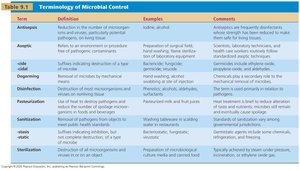
Microbial control is essential in healthcare, food production, and public health to prevent infection and contamination. Various terms describe the methods and levels of microbial control, each with specific definitions and applications.
Term | Definition | Examples | Comments |
|---|---|---|---|
Antisepsis | Reduction in the number of microorganisms and viruses, particularly potential pathogens, on living tissue | Iodine, alcohol | Antiseptics are frequently disinfectants whose strength has been reduced to make them safe for living tissue |
Aseptic | Refers to an environment or procedure free of pathogenic contaminants | Preparation of surgical field, hand washing, flame sterilization of laboratory equipment | Scientists, laboratory technicians, and health care workers use aseptic techniques |
Degerming | Removal of microbes by mechanical means | Hand washing, alcohol swabbing at site of injection | Chemicals play a secondary role to the mechanical removal of microbes |
Disinfection | Destruction of most microorganisms and viruses on nonliving tissue | Phenolics, alcohols, aldehydes, soaps | Term is used only in relation to pathogens |
Sanitization | Removal of pathogens from objects to meet public health standards | Washing tableware in scalding water in restaurants | Standards of sanitization vary among governmental jurisdictions |
Pasteurization | Use of heat to destroy pathogens and reduce the number of spoilage microorganisms in foods and beverages | Milk, fruit juices | Heat-tolerant microbes survive |
Sterilization | Destruction of all microorganisms and viruses in or on an object | Preparation of microbiological culture media and canned food | Typically achieved by steam under pressure, incineration, or ethylene oxide gas |
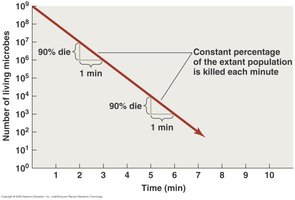
The Rate of Microbial Death
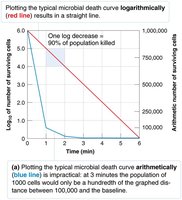
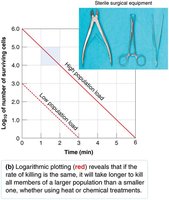
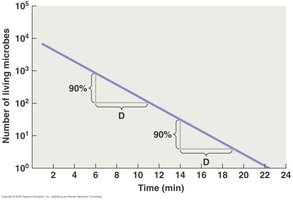
Microbial death occurs at a constant rate when exposed to a lethal agent. This rate is often expressed as a logarithmic decline, meaning a constant percentage of the population is killed per unit time. Understanding this concept is crucial for designing effective sterilization and disinfection protocols.
Decimal Reduction Time (D-value): The time required to kill 90% of the microbial population under specific conditions.
Factors affecting death rate: Number of microbes, environment (organic matter, temperature, biofilms), time of exposure, and microbial characteristics.
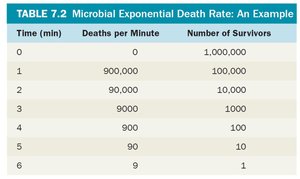
Time (min) | Deaths per Minute | Number of Survivors |
|---|---|---|
0 | 0 | 1,000,000 |
1 | 900,000 | 100,000 |
2 | 90,000 | 10,000 |
3 | 9,000 | 1,000 |
4 | 900 | 100 |
5 | 90 | 10 |
6 | 9 | 1 |
Factors Affecting Efficacy of Antimicrobial Methods
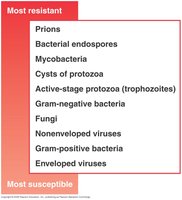
The effectiveness of antimicrobial agents depends on several factors, including the site to be treated, the relative susceptibility of microorganisms, and environmental conditions such as temperature and pH.
Site to be treated: Harsh chemicals and extreme heat cannot be used on humans, animals, or fragile objects.
Relative susceptibility: Microorganisms vary in resistance; prions are most resistant, enveloped viruses are most susceptible.
Environmental conditions: Higher temperatures and certain pH levels can enhance the activity of disinfectants.
Actions of Microbial Control Agents
Antimicrobial agents act by disrupting cell walls and membranes, damaging proteins and nucleic acids, and interfering with cellular metabolism and reproduction.
Alteration of membrane permeability: Leads to leakage of cellular contents.
Damage to proteins: Denaturation affects enzyme function and structural integrity.
Damage to nucleic acids: Can halt protein synthesis and cause fatal mutations.
Physical Methods of Microbial Control
Heat-Related Methods
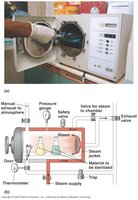
Heat is a widely used method for microbial control, causing denaturation of proteins and disruption of cell membranes and nucleic acids. Both moist and dry heat are employed, each with specific applications and effectiveness.
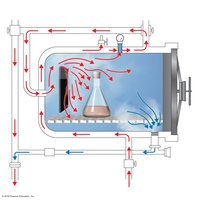
Moist heat: Includes boiling, autoclaving, pasteurization, and ultrahigh-temperature sterilization.
Dry heat: Used for materials that cannot tolerate moist heat; includes incineration and hot-air sterilization.
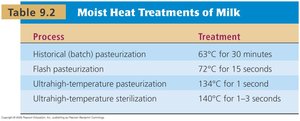
Process | Treatment |
|---|---|
Historical (batch) pasteurization | 63°C for 30 minutes |
Flash pasteurization | 72°C for 15 seconds |
Ultrahigh-temperature pasteurization | 134°C for 1 second |
Ultrahigh-temperature sterilization | 140°C for 1–3 seconds |
Refrigeration and Freezing
Low temperatures inhibit microbial metabolism and growth. Refrigeration halts most pathogens, while freezing is more effective when done slowly.
Dessication and Lyophilization
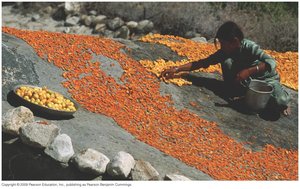
Drying removes water, inhibiting microbial growth. Lyophilization (freeze-drying) is used for long-term preservation of cultures.
Filtration
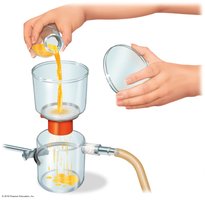
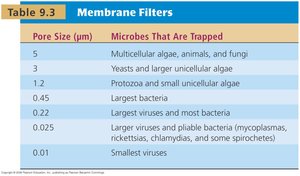
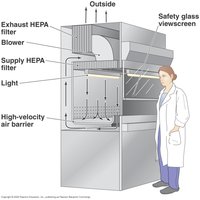
Filtration removes microbes from air or liquids by passing them through a membrane with defined pore sizes. HEPA filters are used for air, and membrane filters for liquids.
Pore Size (μm) | Microbes That Are Trapped |
|---|---|
5 | Multicellular algae, animals, and fungi |
3 | Yeasts and larger unicellular algae |
1.2 | Protozoa and small unicellular algae |
0.45 | Largest bacteria |
0.22 | Largest viruses and most bacteria |
0.025 | Larger viruses and pliable bacteria |
0.01 | Smallest viruses |
Osmotic Pressure
High concentrations of salt or sugar create hypertonic environments, causing cells to lose water and inhibiting microbial growth. Fungi are more tolerant of these conditions than bacteria.
Radiation
Radiation is used to control microbial growth by damaging DNA. Ionizing radiation (X-rays, gamma rays, electron beams) creates ions that disrupt cellular molecules, while nonionizing radiation (UV light) causes thymine dimers in DNA.
Chemical Methods of Microbial Control
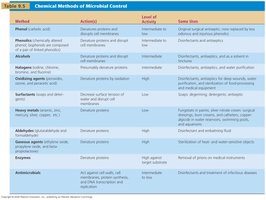
Chemical agents are used as disinfectants and antiseptics, affecting cell walls, membranes, proteins, or DNA. Their effectiveness depends on concentration, exposure time, temperature, pH, and presence of organic matter.
Method | Action(s) | Level of Activity | Some Uses |
|---|---|---|---|
Phenol | Denatures proteins and disrupts cell membranes | Intermediate to low | Original surgical antiseptic, now replaced by newer and less irritating phenolics |
Phenolics | Denature proteins and disrupt cell membranes | Intermediate to low | Disinfectants, antiseptics, and soaps |
Alcohols | Denature proteins and disrupt cell membranes | Intermediate | Disinfectants, antiseptics, and solvent in tinctures |
Halogens | Presumably denature proteins | Intermediate | Disinfectants, antiseptics, and water purification |
Oxidizing agents | Denature proteins by oxidation | High | Disinfectants, antiseptics, and water purification |
Surfactants | Decrease surface tension of water and disrupt cell membranes | Low | Soaps and detergents |
Heavy metals | Denature proteins | Low | Fungicides in paints, algicides in water reservoirs, silver nitrate cream, surgical dressings, burn creams |
Aldehydes | Denature proteins | High | Disinfectant and embalming fluid |
Gaseous agents | Denature proteins | High | Sterilization of heat- and water-sensitive objects |
Enzymes | Act against microorganisms | High | Removal of prions on medical instruments |
Antimicrobials | Act against cell walls, cell membranes, protein synthesis, and DNA transcription and replication | High | Disinfectants and preservation of food |
Methods for Evaluating Disinfectants and Antiseptics
Phenol coefficient: Ratio of effectiveness compared to phenol.
Use-dilution test: Metal cylinders dipped in bacteria, exposed to disinfectant, then cultured to assess survival.
Kelsey-Sykes capacity test: Measures minimum time required for disinfectant to be effective.
In-use test: Swabs from objects before and after disinfectant application, cultured to monitor growth.
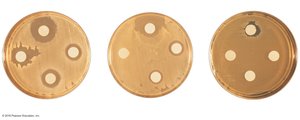
Disk-diffusion method: Filter paper disks soaked in chemicals placed on culture; zone of inhibition indicates efficacy.
Development of Resistant Microbes
Extensive use of antiseptics and disinfectants can promote the development of resistant microbes. It is important to use these products judiciously and according to guidelines to minimize resistance.
----------------------------------------
