 Back
BackDisproving Spontaneous Generation: Foundations of Modern Microbiology
Study Guide - Smart Notes
 Tailored notes based on your materials, expanded with key definitions, examples, and context.
Disproving Spontaneous Generation
Introduction to Spontaneous Generation
Spontaneous generation was a historical concept proposing that life could arise from non-living matter. This idea persisted for centuries until scientific experiments disproved it, establishing the principle that life originates only from pre-existing life.
Spontaneous Generation: The regular conversion of non-living matter into living organisms (e.g., soil to worms).
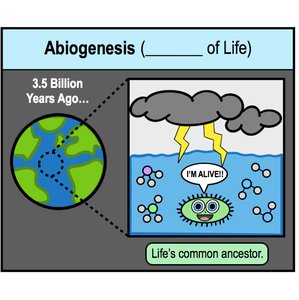
Abiogenesis: The theory of the origin of life from non-living matter, likely a one-time event in Earth's history.
Biogenesis: The theory that living organisms arise only from pre-existing life.
Historical Belief: Many ancient cultures believed life could spontaneously generate from non-living material.
Key Question: Does life require pre-existing life to form?
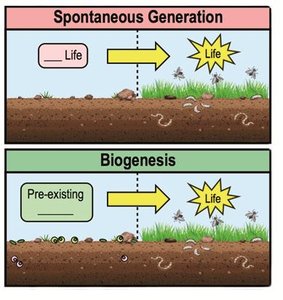
Biogenesis vs. Spontaneous Generation
Between 1668 and 1881, numerous experiments were conducted to test whether biogenesis or spontaneous generation was the true mechanism for the origin of life. These experiments laid the foundation for modern microbiology.
Biogenesis: Life arises from pre-existing life.
Spontaneous Generation: Life arises from non-living matter.
Experimental Evidence: Key experiments by Redi, Needham, Spallanzani, Pasteur, and Tyndall.
Key Experiments Disproving Spontaneous Generation
Francesco Redi’s Experiments (1668)
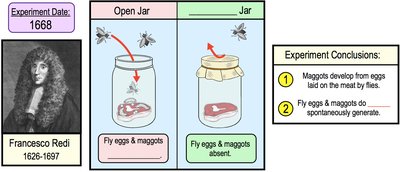
Francesco Redi was the first scientist to challenge spontaneous generation. He designed an experiment using meat in jars to demonstrate that maggots only appeared when flies could lay eggs on the meat, disproving the idea that maggots spontaneously generated from decaying meat.
Open Jar: Flies entered and laid eggs, resulting in maggots.
Covered Jar: Flies were prevented from entering, and no maggots appeared.
Conclusion: Maggots develop from fly eggs, not spontaneously from meat.
John Needham’s Experiments (1745)
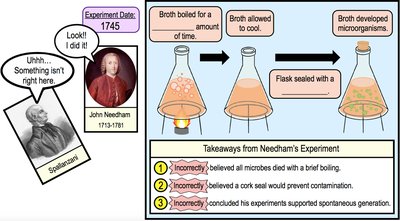
John Needham attempted to support spontaneous generation by boiling broth and sealing it with a cork. He observed microbial growth, but his experiment was flawed due to insufficient boiling and porous corks, which allowed contamination.
Flawed Sterilization: Brief boiling did not kill all microbes.
Contamination: Corks allowed microbes to enter after boiling.
Incorrect Conclusion: Needham believed microbes spontaneously generated in the broth.
Lazzaro Spallanzani’s Experiments (1767)
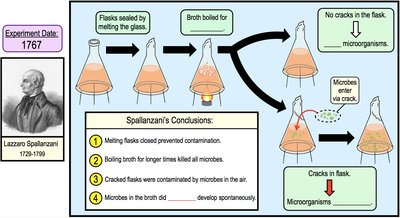
Lazzaro Spallanzani improved upon Needham’s experiment by sealing flasks with melted glass and boiling the broth for longer periods. He observed no microbial growth in sealed flasks, but growth occurred in cracked flasks, showing contamination from air.
Sealed Flasks: Prevented contamination after boiling.
Extended Boiling: Killed all microbes.
Cracked Flasks: Allowed microbes from air to enter.
Conclusion: Microbes do not spontaneously generate; contamination comes from the environment.
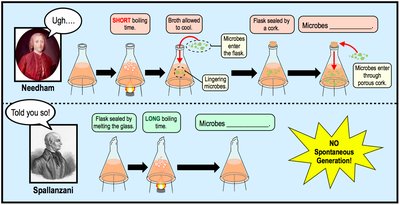
Needham vs. Spallanzani: Experimental Design Comparison
Spallanzani’s experiments differed from Needham’s in two major ways: he completely sealed the flasks before boiling and boiled the broths for a longer period, ensuring all microbes were killed and no contamination occurred.
Sealing Method: Spallanzani melted glass to seal flasks, Needham used corks.
Boiling Time: Spallanzani boiled longer, Needham boiled briefly.
Result: Spallanzani observed no spontaneous generation; Needham’s results were due to contamination.
Louis Pasteur’s Experiments (1859)
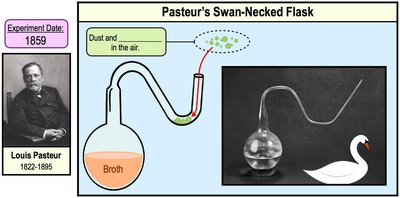
Louis Pasteur conclusively disproved spontaneous generation using swan-necked flasks. These flasks allowed air to enter but trapped dust and microbes in the neck, preventing contamination of the broth. Pasteur’s experiments demonstrated that microbes are present in the air and that life does not arise spontaneously.
Swan-Neck Flask: Designed to trap dust and microbes while allowing air flow.
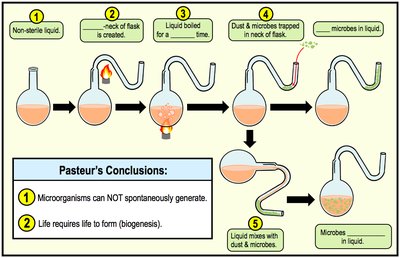
Experimental Steps:
Fill flask with sterile broth.
Form swan-neck with heat.
Boil broth extensively.
Dust and microbes trapped in neck.
Tilting flask mixes trapped microbes with broth, resulting in microbial growth.
Conclusion: Microorganisms cannot spontaneously generate; life requires pre-existing life (biogenesis).
John Tyndall’s Experiments (1881)
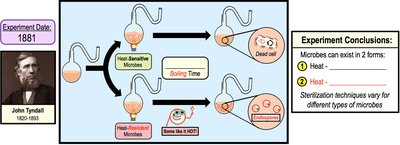
John Tyndall explained why Pasteur’s results could not always be replicated. He discovered that some broths contained heat-resistant microbes, later identified as bacterial endospores. Tyndall’s work showed that sterilization techniques must vary for different types of microbes.
Heat-Sensitive Microbes: Killed by boiling.
Heat-Resistant Microbes: Survive boiling; require more rigorous sterilization.
Endospores: Discovered by Ferdinand Cohn; explained persistent contamination.
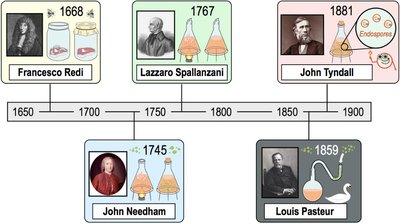
Summary Timeline of Key Scientists
The timeline below summarizes the major contributors to the study of spontaneous generation and biogenesis, highlighting their experiments and findings.
Practice Questions and Applications
Biogenesis Theory: Life requires pre-existing life to generate.
Redi’s Experiment: Maggots only form when flies lay eggs on meat.
Needham’s Flaws: Insufficient boiling and porous corks led to contamination.
Spallanzani’s Improvements: Sealed flasks and extended boiling prevented contamination.
Pasteur’s Swan-Neck Flask: Demonstrated that air contains microbes, but life does not arise spontaneously.
Tyndall’s Discovery: Heat-resistant microbes require special sterilization techniques.
Conclusion
The experiments of Redi, Needham, Spallanzani, Pasteur, and Tyndall collectively disproved spontaneous generation and established biogenesis as a fundamental principle in microbiology. These findings paved the way for modern aseptic techniques and the understanding of microbial life.
