 Back
BackDNA Mutation and Repair: Mechanisms, Types, and Detection in Microbiology
Study Guide - Smart Notes
 Tailored notes based on your materials, expanded with key definitions, examples, and context.
Mutation: Definition and Importance
What is a Mutation?
A mutation is a heritable change in the nucleotide sequence of a cell’s DNA. Mutations can affect large regions or single nucleotides and are rare events. While most mutations are harmful or neutral, some are beneficial and drive evolutionary change. Mutation is the engine of evolution, generating genetic variation for natural selection.
Heritable change: Passed from parent to offspring.
Genetic variation: Essential for adaptation and evolution.
Impact: Most mutations are neutral or harmful; rare beneficial mutations can improve survival.
Mutation Frequency
The frequency of DNA mutations varies by organism, repair mechanisms, and exposure to mutagens. Spontaneous mutation rates are low, typically around to mutations per base per replication.
Spontaneous mutations: Occur naturally during DNA replication.
Mutagen-induced mutations: Exposure to mutagens increases mutation rates.

Mutagens: Agents That Increase Mutation Frequency
Types of Mutagens
Mutagens are agents that increase the frequency of DNA mutations. They are classified as:
Radiation Mutagens: Ionizing (X-rays, gamma rays) and non-ionizing (UV light).
Chemical Mutagens: Nucleotide analogs, nucleotide-altering chemicals, frameshift mutagens.

Radiation-Induced Mutations
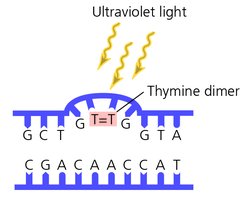
UV radiation can induce covalent bonding between adjacent thymine bases, forming thymine dimers that distort the DNA helix and interfere with replication and transcription.
Chemical Mutagens
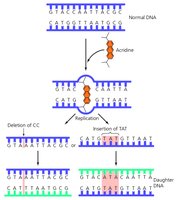
Nucleotide analogs: Chemical mimics of normal nucleotides, incorporated during DNA replication, causing abnormal base pairing and mutations.
Nucleotide-altering chemicals: Cause base substitutions and missense mutations.
Frameshift mutagens: Insert or delete bases, altering the reading frame and leading to nonsense mutations.

Types of Mutations and Their Effects
Point Mutations
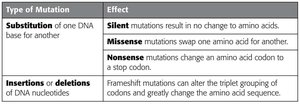
Point mutations involve the substitution of one DNA base for another. Their effects include:
Silent mutations: No change in amino acid sequence.
Missense mutations: Change one amino acid for another.
Nonsense mutations: Change an amino acid codon to a stop codon.

Frameshift Mutations
Frameshift mutations result from insertions or deletions of DNA nucleotides, altering the triplet grouping of codons and greatly changing the amino acid sequence.
Summary Table: Mutation Types and Effects
Type of Mutation | Effect |
|---|---|
Substitution of one DNA base for another | Silent: No change to amino acids. Missense: Swap one amino acid for another. Nonsense: Change to stop codon. |
Insertions or deletions of DNA nucleotides | Frameshift mutations alter codon grouping and greatly change amino acid sequence. |
DNA Repair Mechanisms
Proofreading by DNA Polymerase
DNA polymerase has built-in proofreading activity, removing incorrect bases by 3′ → 5′ exonuclease action and inserting the correct base, preventing many mutations before they become permanent.
Base-Excision Repair
This pathway fixes abnormal or chemically damaged bases. A DNA glycosylase removes the damaged base, an endonuclease cuts near the site, DNA polymerase inserts the correct base, and DNA ligase seals the backbone.
DNA Light Repair (Photoreactivation)
Photolyase enzyme, activated by visible light, breaks the covalent bond in thymine dimers, restoring original DNA without removing nucleotides. This pathway is found in bacteria, plants, and some animals, but not humans.
Mismatch Repair
Mismatch repair corrects base pair mismatches from DNA replication. Proteins detect the mismatch on the new strand, excise the segment containing the error, and DNA polymerase fills in the correct bases. DNA ligase seals the backbone.
Nucleotide-Excision Repair
Nucleotide-excision repair (NER) fixes bulky, helix-distorting lesions like thymine dimers. A protein complex detects the damage, cuts are made on both sides, the segment is removed, and the gap is filled by DNA polymerase and sealed by DNA ligase.
Strand Identification in Repair
During mismatch repair, cells distinguish the old strand from the new:
Bacteria: Old strand is methylated; new strand is not.
Eukaryotes: Repair system detects nicks on the new strand.
Mutant Identification and Mutagen Detection
Positive Selection
Mutant cells grow under selective conditions (e.g., antibiotic resistance), while wild-type cells do not. Colonies that appear are assumed to be mutants.
Negative (Indirect) Selection
Mutant cells cannot grow under certain conditions (e.g., absence of a required nutrient). Replica plating identifies auxotrophs by comparing colony positions on complete and selective media.
Ames Test
The Ames test determines whether a chemical compound increases mutation rate, helping identify potential carcinogens. A Salmonella strain with a mutation in the his gene is used; only bacteria that undergo reverse mutations can form colonies on histidine-free media.
Additional info:
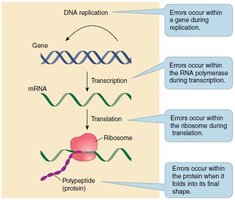
Mutations in DNA are more deleterious than transcription errors in RNA because DNA changes are permanent and heritable, while RNA errors are transient and affect only a single transcript.
Mutation rates are inversely related to genome size, with RNA viruses exhibiting the highest rates and higher eukaryotes the lowest.
