 Back
BackEnergy, Catalysis, and Biosynthesis: Microbial Metabolism and Enzyme Function
Study Guide - Smart Notes
 Tailored notes based on your materials, expanded with key definitions, examples, and context.
Energy, Catalysis, and Biosynthesis
Basic Concepts of Thermodynamics in Biological Systems
Biological systems are highly ordered, requiring energy input to maintain their structure and function. The laws of thermodynamics govern how energy is transformed and utilized in cells.
First Law of Thermodynamics: Energy cannot be created or destroyed, only converted from one form to another.
Second Law of Thermodynamics: Energy spontaneously disperses, increasing entropy (disorder) in the universe. Cells maintain order by releasing heat, thus increasing entropy in their surroundings.
Entropy: A measure of energy dispersal or disorder in a system.
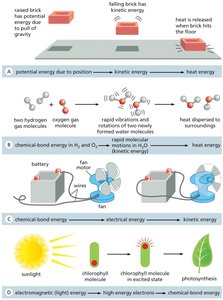
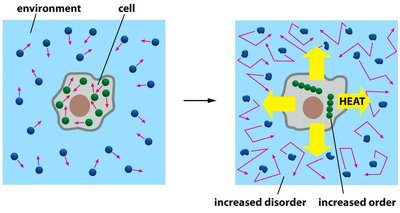
Additional info: Cells use energy from their environment (light or food) to build and maintain complex structures, counteracting entropy locally.
Free Energy and Chemical Reactions
The ability of a reaction to occur spontaneously is determined by its change in free energy (ΔG). Free energy is the energy available to do work at constant temperature and pressure.
ΔG: Change in free energy; negative ΔG indicates a spontaneous, energetically favorable reaction.
ΔG°: Standard free energy change, measured under standard conditions (25°C, 1 atm, 1 M concentration, pH 7).
Formula:
Energetically favorable reactions: ΔG < 0, increase disorder, occur spontaneously.
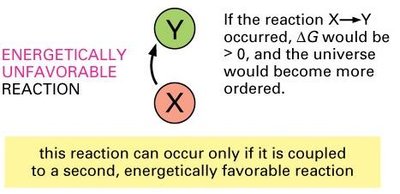
Energetically unfavorable reactions: ΔG > 0, require coupling to a favorable reaction.
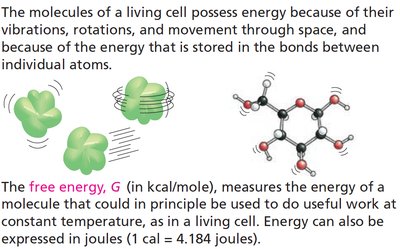
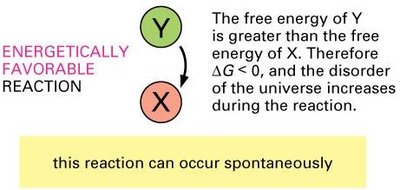
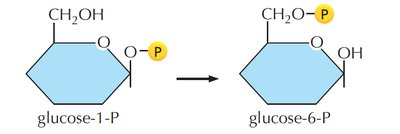
Example: The conversion of glucose-1-phosphate to glucose-6-phosphate has a ΔG° of -1.7 kcal/mol, favoring the formation of glucose-6-phosphate.
Additional info: At equilibrium, ΔG = 0, and the ratio of reactants to products is determined by ΔG° and the equilibrium constant (Keq).
Coupled Reactions and Activated Carrier Molecules
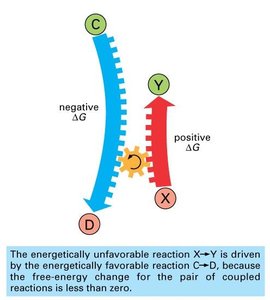
Cells drive energetically unfavorable reactions by coupling them to favorable ones, often using activated carrier molecules such as ATP and NADPH.
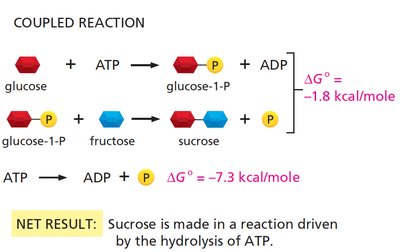
Coupled reactions: Unfavorable reactions (ΔG > 0) are driven by favorable reactions (ΔG < 0), so the net ΔG is negative.
Activated carriers: Molecules that store energy in transferable chemical groups or high-energy electrons.
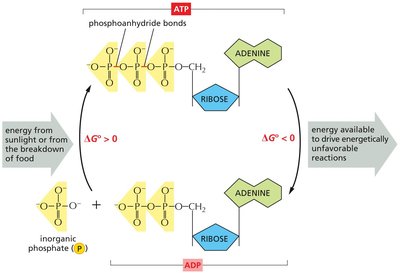
ATP: Carries phosphate groups; hydrolysis releases energy to drive cellular processes.
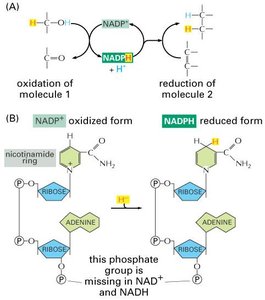
NADH/NADPH: Carry electrons and hydrogens; NADPH is used in biosynthetic (anabolic) reactions, NADH in catabolic reactions.
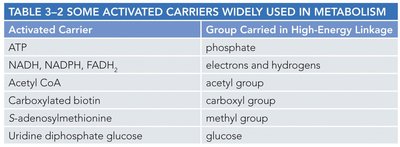
Activated Carrier | Group Carried in High-Energy Linkage |
|---|---|
ATP | phosphate |
NADH, NADPH, FADH2 | electrons and hydrogens |
Acetyl CoA | acetyl group |
Carboxylated biotin | carboxyl group |
S-adenosylmethionine | methyl group |
Uridine diphosphate glucose | glucose |
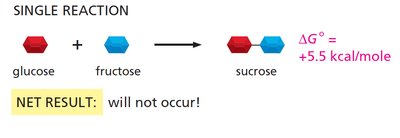
Example: Sucrose synthesis is energetically unfavorable (ΔG° = +5.5 kcal/mol) but can occur when coupled to ATP hydrolysis (ΔG° = -7.3 kcal/mol).
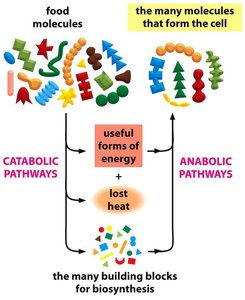
Energy Use in Cells: Catabolism and Anabolism
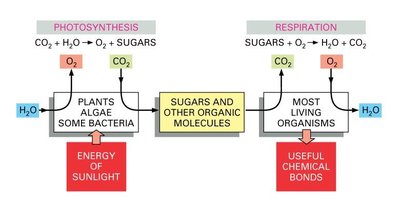
Cells obtain energy from their environment and use it for biosynthesis and maintenance. Catabolic pathways break down molecules to release energy, while anabolic pathways use energy to build cellular components.
Catabolic pathways: Degrade food molecules, releasing energy and building blocks.
Anabolic pathways: Use energy and building blocks to synthesize cellular molecules.
Photosynthesis: Converts sunlight into chemical energy (sugars).
Respiration: Converts sugars into useful chemical bonds, releasing CO2 and H2O.
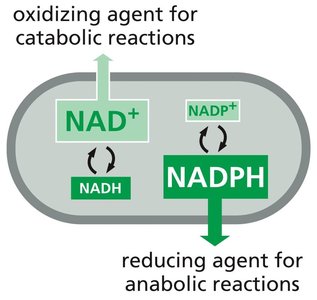
Oxidation and Reduction Reactions
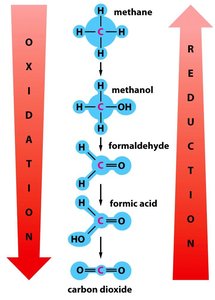
Oxidation-reduction (redox) reactions involve the transfer of electrons and are central to energy metabolism in cells.
Oxidation: Loss of electrons; often involves loss of hydrogen.
Reduction: Gain of electrons; often involves gain of hydrogen.
Hydrogenation: Reduction (gain of H).
Dehydrogenation: Oxidation (loss of H).
Reduced compounds: Store more energy (e.g., fats > sugars).
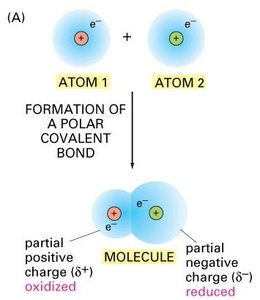
Example: Glucose oxidation: Glucose + 6O2 → 6CO2 + 6H2O, ΔG = -686 kcal/mol.
Enzymes and Catalysis
Enzymes are biological catalysts that accelerate chemical reactions by lowering the activation energy required. They do not alter the equilibrium or ΔG of a reaction, only the rate.
Catalysis: The acceleration of a chemical reaction by a catalyst (enzyme).
Activation energy: The energy barrier that must be overcome for a reaction to proceed.
Enzyme function: Enzymes bind substrates and facilitate their conversion to products.
Substrate: The molecule upon which an enzyme acts.
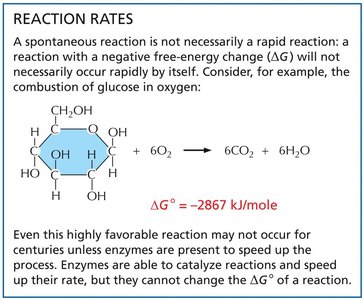
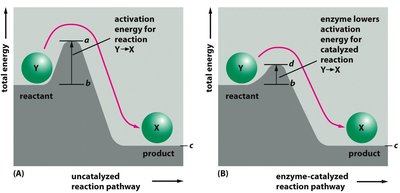
Example: The combustion of glucose is highly favorable but requires enzymes to occur rapidly in cells.
Evaluating Enzyme Performance: Kinetics and Inhibition
Enzyme kinetics describe how enzymes interact with substrates and how their activity can be regulated or inhibited.
Vmax: Maximum rate of an enzyme-catalyzed reaction (extrinsic value).
Km: Michaelis constant; substrate concentration at which the reaction rate is half of Vmax (intrinsic value).
Competitive inhibition: Inhibitor competes with substrate for the active site.
Noncompetitive inhibition: Inhibitor binds elsewhere, altering enzyme activity.
Additional info: Enzyme inhibitors are important for understanding metabolic regulation and drug design.
Summary Table: Key Terms and Concepts
Term | Definition |
|---|---|
Entropy | Dispersal of energy; disorder in a system |
ΔG | Change in free energy; determines spontaneity of a reaction |
Catalysis | Acceleration of a reaction by a catalyst (enzyme) |
Km | Michaelis constant; substrate concentration at half-maximal velocity |
Vmax | Maximum velocity of an enzyme-catalyzed reaction |
Coupled Reactions | Pairing of favorable and unfavorable reactions to drive cellular processes |
Substrate | Molecule acted upon by an enzyme |
