 Back
BackEpidemiology and Public Health Microbiology: Core Concepts and Applications
Study Guide - Smart Notes
 Tailored notes based on your materials, expanded with key definitions, examples, and context.
Epidemiology: Definition and Scope
What Is Epidemiology?
Epidemiology is the scientific discipline that evaluates the occurrence, determinants, distribution, and control of health and disease within defined human populations. An epidemiologist is a professional who practices epidemiology. The field plays a critical role in identifying the causes and patterns of diseases, as well as in developing strategies for prevention and control.
Occurrence: Frequency and patterns of diseases in populations.
Determinants: Factors that influence health events (e.g., biological, environmental, social).
Distribution: Analysis of disease spread across time, place, and population groups.
Control: Implementation of measures to reduce disease impact.
Historical Example: John Snow, considered the father of modern epidemiology, used statistical analysis to trace a cholera outbreak in London to a contaminated water pump, demonstrating the power of epidemiological methods even before the causative agent was known.
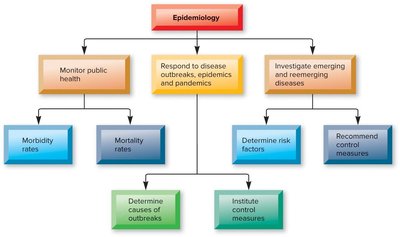
Major Functions and Goals of Epidemiology
Key Determinations in Epidemiology
Epidemiology seeks to answer several critical questions about disease in populations:
Causative Agent: Identification of the microorganism or factor responsible for disease.
Source/Reservoir: Determining where the pathogen resides and how it is maintained in nature.
Transmission Mechanism: Understanding how the disease spreads among hosts.
Host and Environmental Factors: Identifying factors that facilitate disease development.
Control Measures: Developing strategies to prevent and control disease spread.
Historical and Modern Relevance of Epidemiology
Significant Epidemics and Public Health Impact
Epidemiology has been essential in addressing both historical and modern epidemics:
Past Epidemics: Cholera, typhoid fever, smallpox, influenza, yellow fever.
Recent Epidemics: COVID-19, Ebola, HIV/AIDS, SARS, salmonellosis.
Scope: Extends beyond infectious diseases to include genetic, metabolic, nutritional, psychiatric, and age-related disorders.
Public Health Organizations
Centers for Disease Control and Prevention (CDC) and World Health Organization (WHO)
CDC: Located in Atlanta, Georgia, the CDC is the national center for disease prevention, control, environmental health, and health promotion in the United States.
WHO: The international counterpart, based in Geneva, Switzerland, coordinates global health efforts.
Key Epidemiological Terminology
Definitions of Disease Occurrence
Sporadic Disease: Occurs occasionally and irregularly (e.g., tetanus, rabies).
Endemic Disease: Maintains a steady, low-level frequency in a population (e.g., malaria).
Hyperendemic Disease: Frequency increases above endemic levels but not to epidemic proportions (e.g., dengue in certain regions).
Reservoir Host: Non-human species where a pathogen resides before transmission to humans (e.g., influenza in birds or pigs).
Outbreak: Sudden, unexpected occurrence of disease, usually localized.
Epidemic: Outbreak affecting many people, with a sudden increase above expected numbers. The index case is the first identified case.
Pandemic: Epidemic that spreads across countries or continents (e.g., 1918 and 2009 H1N1 influenza, COVID-19).
Patterns of Infectious Disease in Populations
Types of Epidemics
Infectious diseases can spread in populations in distinct patterns:
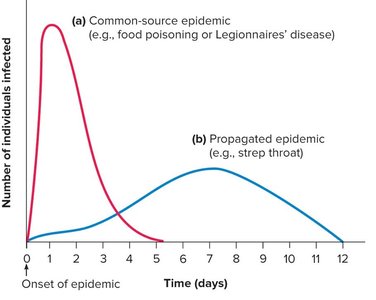
Common Source Epidemic: Originates from a single contaminated source (e.g., foodborne illness). Peaks rapidly, typically within 1–2 weeks.
Propagated Epidemic: Results from person-to-person transmission, leading to a slower, more prolonged rise and fall in cases (e.g., influenza among students after a break).
Surveillance and Measurement in Epidemiology
Public Health Surveillance
Surveillance involves systematic collection, analysis, and interpretation of health data to plan, implement, and evaluate public health practices. Modern surveillance uses clinical reports, laboratory data, registries, and field surveys.
Historical Note: Surveillance began in the 14th century to control plague, but scientific monitoring developed after the germ theory of disease in the 1800s.
Statistical Measures of Disease Frequency
Prevalence Rate: Proportion of a population infected at a given time. Formula:
Morbidity Rate: Number of new cases in a specific period per unit population. Formula:
Mortality Rate: Number of deaths from a disease per number of cases. Formula:
Case Study: Smallpox Eradication
Smallpox: Epidemiology Success Story
Agent: Caused by Variola major and Variola minor viruses.
Impact: Responsible for millions of deaths and cases of blindness before eradication.
Transmission: Airborne droplets from oral or nasal secretions.
Symptoms: Fever, vomiting, mouth ulcers, and skin rash.
Prevention: Vaccination with live vaccinia virus.
Eradication: WHO-led global vaccination campaign (1964–1980) led to eradication; routine vaccination discontinued in most countries.
Bioterrorism Concern: Interest in new vaccines due to potential use as a biological weapon.
Herd Immunity and Pathogen Evolution
Herd Immunity
Herd immunity is the resistance of a population to infection and pathogen spread due to immunity in a large proportion of individuals. The level of herd immunity can change with the introduction of new susceptible individuals or changes in the pathogen.
Antigenic Drift: Small genetic changes accumulate, producing antigenically different variants (e.g., seasonal influenza).
Antigenic Shift: Major genetic changes result in new subtypes with mixed surface antigens (e.g., pandemic influenza strains).
Emerging and Reemerging Infectious Diseases
Factors Contributing to Disease Emergence
Population growth and urbanization
Inadequate public health infrastructure
Increased international travel and migration
Climate change and habitat disruption
Microbial evolution and resistance
Vaccine refusal
Vaccines and Immunization
Types of Vaccines
Whole-Cell Vaccines: Contain inactivated (killed) or attenuated (weakened but live) microbes. Gold standard but may cause adverse reactions or revert to virulence (e.g., MMR vaccine).
Acellular or Subunit Vaccines: Use purified components (e.g., capsular polysaccharides, recombinant proteins, inactivated toxins) to reduce risks associated with whole-cell vaccines.
Recombinant-Vector Vaccines: Pathogen genes encoding antigens are inserted into nonvirulent vectors (e.g., adenovirus), which express the antigen in the host (e.g., AstraZeneca COVID-19 vaccine).
DNA Vaccines: Direct introduction of DNA encoding pathogen antigens into host cells, leading to antigen expression and immune response. Under trial for various pathogens.
mRNA Vaccines: Use mRNA encoding antigenic proteins, delivered into cells to stimulate immune response. First human trials began in 2013; widely used for COVID-19.
Examples of Acellular/Subunit Vaccines
Microorganism or Toxin | Vaccine Subunit |
|---|---|
Haemophilus influenzae type b (Hib) | Polysaccharide-protein conjugate (HbCV) or bacterial polysaccharide (HbPV) |
Neisseria meningitidis | Polysaccharides of serotypes A/C/Y/W-135 |
Streptococcus pneumoniae | 23 distinct capsular polysaccharides |
Hepatitis B virus | Recombinant surface antigen (HbsAg) |
Human papillomavirus | Recombinant protein subunits |
Corynebacterium diphtheriae toxin | Inactivated exotoxin (toxoid) |
Clostridium tetani toxin | Inactivated exotoxin (toxoid) |
Summary Table: Causes of Death in the United States (Selected Years)
Cause | 1900 (%) | 2016 (%) |
|---|---|---|
Heart diseases | 8.0 | 23.1 |
Cancer | 3.7 | 21.8 |
Pneumonia and influenza | 11.8 | 1.9 |
Tuberculosis | 11.3 | Not determined |
Gastrointestinal diseases | 8.3 | Not determined |
Cerebrovascular diseases | 6.2 | 5.2 |
Senility (Alzheimer’s, dementias) | 6.8 | 4.2 |
Pulmonary diseases | Not determined | 5.6 |
Kidney diseases | 4.7 | 1.8 |
Accidents | 4.2 | 5.9 |
Diabetes mellitus | Not determined | 2.9 |
Diphtheria | 2.3 | Not determined |
Suicide | Not determined | 1.6 |
All other causes | 32.7 | 25.9 |
Total | 100.0 | 100.0 |
Conclusion
Epidemiology is foundational to public health microbiology, providing the tools to understand, monitor, and control infectious and non-infectious diseases. Advances in vaccine technology, surveillance, and statistical analysis continue to improve our ability to respond to emerging health threats.
